
Agelenopsis oregonensis
Chamberlin & Ivie, 1935
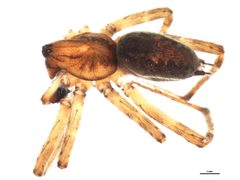
Agelenopsis oregonensis is a funnel-web spider in the Agelenidae. It is found in the United States and Canada, with records from Alberta and British Columbia. Like other members of its , it constructs sheet webs with a funnel-shaped retreat. The was described by Chamberlin and Ivie in 1935.
Pronunciation
How to pronounce Agelenopsis oregonensis: //ˌædʒəˌlɛˈnɒpsɪs ˌɒrɪɡoʊˈnɛnsɪs//
These audio files are automatically generated. While they are not always 100% accurate, they are a good starting point.
Identification
Agelenopsis are distinguished from the related western Hololena by their long , which are typically held parallel to each other; Hololena has short spinnerets directed somewhat inward. Agelenopsis oregonensis averages substantially larger than Hololena, with mature females typically 10–20 mm in body length compared to 9–12 mm for Hololena females. Most Agelenopsis share a color pattern of two parallel or converging dark stripes on a pale , a central reddish or brownish abdominal band often bordered by pale wavy lines, and annulated legs with alternating light and dark bands. Definitive identification to species level requires microscopic examination of genitalia.
Images
Distribution
United States and Canada. Specific records include Alberta and British Columbia in Canada. North American distribution is present in both countries.
Behavior
Constructs a thick, flat, hammock- or bowl-shaped web with a funnel-like retreat in one corner. The web is not sticky; a tangle of threads above the platform intercepts flying insects and knocks them onto the sheet. The spider is highly sensitive to vibrations and rapidly emerges to subdue prey, dragging it back into the retreat to feed.
Similar Taxa
- Hololena spp.Both are agelenid funnel-web weavers with similar web architecture and general body plan. Distinguished by length and body size: Agelenopsis has long, parallel spinnerets and larger body size (10–20 mm females), while Hololena has short, inward-directed spinnerets and smaller size (9–12 mm females).
- Calilena spp.Another western agelenid with long similar to Agelenopsis. Calilena is distinguished by other morphological features visible under microscopic examination.
More Details
Taxonomic note
The Agelenopsis is in need of taxonomic revision according to some arachnologists. -level identification is challenging and typically requires examination of genitalia.
Sources and further reading
- BugGuide
- Wikipedia
- GBIF taxonomy match
- iNaturalist taxon
- NCBI Taxonomy
- Catalogue of Life
- Grasshoppers of Colorado
- Grasshoppers of Colorado
- Species Records and Accounts
- Bug Eric: Spider Sunday: Hololena Funnel-web weavers
- New Guide Offers Latest in Carrot Weevil Management
- Bug Eric: OrThoptera Thursday: Eastern Ant Cricket