
Hahniidae
Bertkau, 1878
Comb-tailed Spiders, Dwarf Sheet Spiders
Genus Guides
4- Antistea(dwarf sheet spiders)
- Cicurina(cave meshweaver)
- Hahnia(comb-tailed spiders)
- Neoantistea(dwarf sheet spiders)
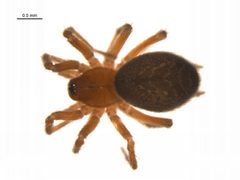
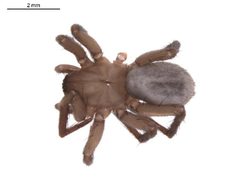
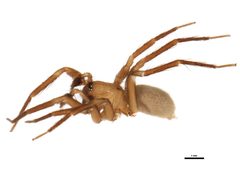
Hahniidae, commonly known as comb-tailed spiders or dwarf sheet spiders, are a of small araneomorph spiders characterized by their distinctive arrangement. Most are under 4 mm in body length as , with some reaching nearly 8 mm. The family was historically classified within Agelenidae but has been recognized as a distinct family since at least 1957. Members are divided into two : Hahniinae, with spinnerets arranged in a single transverse row resembling a comb, and Cryphoecinae, with spinnerets in two staggered rows.
Pronunciation
How to pronounce Hahniidae: /hɑːˈni.aɪdiː/
These audio files are automatically generated. While they are not always 100% accurate, they are a good starting point.
Identification
The most conspicuous diagnostic feature of Hahniinae is the arrangement of all six in a single transverse row across the back of the , giving the its . Cryphoecinae members have spinnerets in two staggered rows. within Hahniinae are distinguished by tracheal placement on the abdomen, relative size of , length of lateral spinneret segments, and spur shape on male palps. Cryphoecinae genera are separated primarily by genitalia features and cheliceral fang furrow .
Images
Habitat
Members of Hahniinae (except Neoantistea) do not build webs in North America. Neoantistea constructs thin, sheet-like webs stretched across small depressions in soil, frequently across mammal footprints, with the spider sequestered at the web edge among moss or soil particles. Cryphoecinae are found in chronically moist : under bark on dead trees, in leaf litter, moss, and under stones. Some occupy high-altitude areas (1239–2214 m in Chinese Wuling Mountains) or cave environments. The Calymmaria builds distinctive inverted cone webs under loose bark, in bark furrows, beneath moss on rocks or logs, among streamside rocks, under cliff overhangs, cave entrances, and on buildings.
Distribution
Hahniidae has a global distribution with concentration in North America, Europe, and Asia. In North America, Neoantistea and Hahnia occur throughout most of the continent; Antistea brunnea ranges in British Columbia, southeast Canada, and the northeast U.S.; Cryphoecinae are primarily restricted west of the Rocky Mountains in Canada and northern states or chronically rainy forest . The Calymmaria has 31 north of Mexico, with all but two confined to the Pacific coast east to the Cascade Mountains (two Appalachian species). First records exist for Ecuador, Thailand, and Germany (Hahnia picta). Chinese records include numerous species from Chongqing, Hubei, Guizhou, and Guangdong provinces.
Behavior
Neoantistea travels on the underside of its web to secure prey. Cryphoeca montana is . Calymmaria are nocturnal, emerging at night to hang beneath the sheet portion of their web above the cone, sometimes venturing over the cone exterior. When attacking prey, Calymmaria bites and retreats, possibly multiple times, before hauling the victim back to the platform web to feed.
Similar Taxa
- AgelenidaeHahniidae was historically classified within Agelenidae (funnel-web weavers) until 1957; both include small web-building spiders, but Hahniidae is distinguished by the transverse row of in Hahniinae and the unique inverted cone webs of Calymmaria versus the funnel-shaped webs of Agelenidae.
Sources and further reading
- BugGuide
- GBIF taxonomy match
- iNaturalist taxon
- NCBI Taxonomy
- Catalogue of Life
- Bug Eric: Basket-web Weavers
- Bug Eric: March 2014
- Bug Eric: Comb-tailed Spiders
- First Record of the Family Hahniidae in Ecuador with Description of Thirteen New Species and Three New Genera (Araneae: Hahniidae)
- A new genus and three new species of Hahniidae (Araneae) from China
- Erstfund vonHahnia picta(Araneae, Hahniidae) in Deutschland – mit Angaben zu Habitatpräferenz und Verbreitung
- A new cave-dwelling species of Hahnia C. L. Koch, 1841 from Guizhou Province, China (Araneae, Hahniidae)
- Description of three new species of the genus Cicurina Menge, 1871 from Guangdong, China (Araneae, Hahniidae)
- First records and a new genus of comb-tailed spiders (Araneae: Hahniidae) from Thailand with comments on the six-eyed species of this family
- Diversity of spiders in Daba Mountain National Nature Reserve, Chongqing, China (II): Two new species of Hahniidae (Arachnida, Araneae).
- A new species of Neoantistea Gertsch, 1934 from Yintiaoling National Nature Reserve, Chongqing, China (Araneae, Hahniidae).