
Neoantistea
Gertsch, 1934
dwarf sheet spiders
Species Guides
3- Neoantistea agilis
- Neoantistea magna(Thick-hooked Comb-tailed Spider)
- Neoantistea riparia
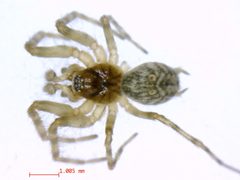
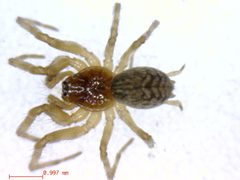
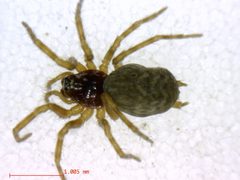
Neoantistea is a of dwarf sheet spiders in the Hahniidae, established by Willis J. Gertsch in 1934. The genus contains approximately 25 distributed across North America, Mexico, and parts of Asia. These spiders are characterized by their small size, with most under 4 mm in body length. Neoantistea is notable within the Hahniinae for being one of the few genera that constructs webs, unlike related genera such as Hahnia and Antistea.
Pronunciation
How to pronounce Neoantistea: /ˌniːoʊˈæntɪstiːə/
These audio files are automatically generated. While they are not always 100% accurate, they are a good starting point.
Identification
Distinguished from other Hahniinae by the combination of web-building (absent in Hahnia and Antistea in North America) and specific genitalic characters. Males of Neoantistea are identified by palpal features including tegulum shape, embolus position, and patellar structure. The genus Neoantistea can be separated from the superficially similar Antistea by web presence and details of tracheal placement. Separation from Hahnia requires examination of size proportions and male palpal spur .
Images
Habitat
Occupies small depressions in soil, including mammal footprints and other ground surface irregularities. Webs are constructed across these depressions and are typically visible only when laden with dew. Spiders sequester themselves at web margins amid mosses or soil particles, traveling on the underside of the web to capture prey. Leaf litter and areas under stones near streams also documented.
Distribution
Widespread across North America from Canada through the United States to Mexico; extends into Asia with records from Kashmir, Nepal, Russia, China, Korea, and Japan. Twenty-five recognized as of 2019, with highest diversity in the United States and Mexico.
Behavior
Constructs small, thin, sheet-like webs across soil depressions; the only web-building in Hahniinae in North America. Spiders travel on the underside of the web to secure prey. Cryptic habits result in infrequent direct observation despite apparent commonness in suitable .
Ecological Role
Presumably functions as a of small ground-dwelling in soil and leaf litter ; specific prey records lacking.
Human Relevance
No documented economic or medical importance. Occasionally encountered in ecological sampling such as pitfall trapping. Too small to be conspicuous to casual observers.
Similar Taxa
- HahniaAlso in Hahniinae with comb-tailed arrangement; distinguished by lack of web construction in North America and different size proportions
- AntisteaShares comb-tailed arrangement; distinguished by absence of webs in North America and different tracheal placement
- Cryphoecinae (subfamily)Other of Hahniidae; distinguished by staggered (two-row) arrangement rather than single transverse row
More Details
Taxonomic history
Hahniidae was formerly classified within Agelenidae (funnel-web weavers) as recently as 1957, but is now recognized as a distinct family.
Collection methods
Most frequently collected through pitfall trapping and litter sampling; direct observation of living specimens in the field is exceptionally difficult due to small size and cryptic habits.