
Antistea
Simon, 1898
dwarf sheet spiders
Species Guides
1Antistea is a of dwarf sheet spiders in the Hahniidae, established by Eugène Simon in 1898. The genus contains only two : A. brunnea (Palearctic) and A. elegans (Nearctic), together forming a Holarctic distribution pattern. These spiders are among the least commonly encountered hahniids due to their small size and cryptic habits.
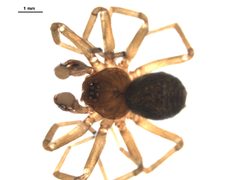
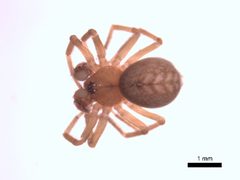
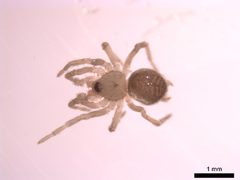
Pronunciation
How to pronounce Antistea: /ænˈtaɪstiə/
These audio files are automatically generated. While they are not always 100% accurate, they are a good starting point.
Identification
Antistea belongs to the Hahniinae, whose members are distinguished by having all six arranged in a single transverse row across the back of the , resembling the teeth of a comb. Within Hahniinae, Antistea is separated from Neoantistea and Hahnia by subtle morphological characters including the placement of the tracheal on the underside of the abdomen, relative size of the , length of segments on the lateral spinnerets, and the shape of curved spurs on the palps of mature males. Unlike Neoantistea, Antistea does not build webs in North America.
Images
Distribution
Holarctic: A. brunnea occurs in the Palearctic (distribution records from Denmark, Norway, Sweden), while A. elegans occurs in the Nearctic. A. brunnea specifically ranges in British Columbia, southeast Canada, and the northeast United States.
Similar Taxa
- NeoantisteaBoth belong to Hahniinae with comb-like arrangement; Neoantistea builds thin sheet webs across small depressions in soil, while Antistea does not build webs in North America.
- HahniaBoth in Hahniinae with six in single transverse row; distinguished by genitalia features, size, and lateral spinneret segment length.
- CryphoecaBoth in Hahniidae but Cryphoeca belongs to Cryphoecinae, which has in two staggered rows rather than a single comb-like row.
More Details
Taxonomic history
The Hahniidae was formerly classified within Agelenidae (funnel-web weavers) as recently as 1957, but is now recognized as a distinct family.
Size
Like most hahniids, Antistea are extremely small, with under four millimeters in body length, contributing to their rarity in field observations.