
Antistea brunnea
(Emerton, 1909)
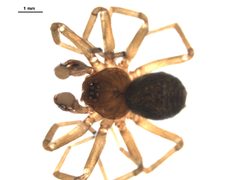
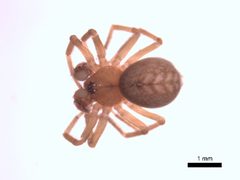
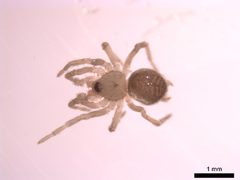
Antistea brunnea is a small true spider in the Hahniidae, commonly known as the comb-tailed spiders or dwarf sheet spiders. This is one of the larger members of the Antistea and ranges across northeastern North America. It builds thin, sheet-like webs across small depressions in soil, often in mammal footprints. The species is seldom encountered due to its small size and cryptic habits.
Pronunciation
How to pronounce Antistea brunnea: /ænˈtiːstiə ˈbrʊniə/
These audio files are automatically generated. While they are not always 100% accurate, they are a good starting point.
Identification
Antistea brunnea can be distinguished from other hahniid by the placement of the tracheal on the underside of the , relative size of the , and length of segments on the lateral . Mature males possess curved spurs on the tibial segment of the palps. The is larger than most hahniids, with exceeding 4 mm in body length. All six spinnerets are arranged in a single row across the back of the abdomen, the characteristic 'comb-tailed' arrangement of the Hahniinae.
Images
Habitat
Builds thin, sheet-like webs stretched across small depressions in soil, including mammal footprints. Webs are only readily visible when laden with dew. The spider sequesters itself amid mosses or soil particles at the edge of the web, traveling on the underside to secure prey.
Distribution
British Columbia, southeast Canada, and the northeastern United States. Records include Alberta, Manitoba, and Ontario in Canada.
Similar Taxa
- Neoantistea radulaAlso in Hahniidae with similar web-building , but Neoantistea builds visible webs while most other Hahniinae (including Antistea) do not; distinguished by genitalic and arrangement characters
- Hahnia spp.Same and with identical arrangement; distinguished by tracheal placement and male palpal spur
- Cryphoeca montanaSame but in Cryphoecinae, which has in two staggered rows rather than single row; and found under bark rather than in soil depressions