
Hahnia
C. L. Koch, 1841
comb-tailed spiders, dwarf sheet spiders
Species Guides
2- Hahnia cinerea(Ash Hahniid Spider)
- Hahnia glacialis
Hahnia is the most -rich of the comb-tailed spider Hahniidae, with approximately 102 valid species distributed worldwide. These spiders are small, cryptic arachnids characterized by their distinctive arrangement. Most species are under 4 mm in body length as . The genus was established by C. L. Koch in 1841 and was formerly classified within Agelenidae until recognized as a distinct family. Species occur across diverse including caves, forest litter, and under bark.
Pronunciation
How to pronounce Hahnia: /ˈhaɪniə/
These audio files are automatically generated. While they are not always 100% accurate, they are a good starting point.
Identification
Distinguishing Hahnia from other Hahniidae requires examination of microscopic characters: placement of the tracheal on the , relative size of the , length of segments on the lateral , and shape of spurs on male palps. From Neoantistea, which also builds sheet webs, Hahnia differs in spinneret arrangement and lacks the web-building seen in Neoantistea. From Cryphoecinae genera, Hahnia is distinguished by the single-row spinneret arrangement versus the two staggered rows in Cryphoecinae.
Images
Appearance
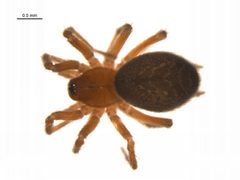
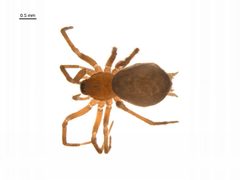
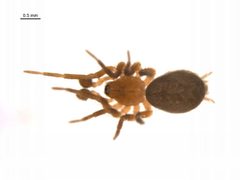
typically measure under 4 mm in body length, with some reaching up to 8 mm. The most conspicuous feature is the arrangement of all six in a single transverse row across the , resembling comb teeth. This distinguishes Hahnia from the related Cryphoecinae, where spinnerets are arranged in two staggered rows. The body is small and compact, adapted for cryptic lifestyles in confined spaces.
Habitat
varies by . Some species inhabit caves; others occur under bark of old deciduous trees, in leaf litter, moss, and soil depressions. The includes both web-building and non-web-building species. Neoantistea builds small sheet webs across mammal footprints and soil depressions, but most Hahnia species in North America do not construct webs. Cave-dwelling species have been documented from China.
Distribution
Worldwide distribution with 24 recorded from China. Specific species distributions vary: Hahnia picta is recorded from Europe (Austria, Germany), while other species occur throughout most of North America. Some Cryphoecinae relatives are restricted to western North America, Canada, and northern states in chronically rainy forest .
Behavior
Most do not build capture webs. When webs are present (Neoantistea), they are thin, sheet-like structures visible only when laden with dew, stretched across small depressions. The spider occupies a retreat at the web edge among moss or soil particles, traveling on the web underside to secure prey. Cave-dwelling species exhibit troglomorphic adaptations appropriate to subterranean environments.
Similar Taxa
- NeoantisteaAlso builds sheet webs and occurs in similar microhabitats, but Neoantistea has different arrangement and is the only Hahniinae in North America that constructs webs
- CryphoecaSimilar small size and cryptic habits, but Cryphoecinae have in two staggered rows rather than single transverse row; distinguished by genitalia and cheliceral
- AntisteaAnother Hahniinae with similar preferences, distinguished by male spur and tracheal placement
More Details
Taxonomic history
The Hahniidae was classified within Agelenidae as recently as 1957, but is now recognized as a distinct family. Hahnia remains the type of Hahniidae and its most -diverse genus.
Species diversity
With 102 described , Hahnia represents the majority of diversity in Hahniidae. Seven species occur in North America, while 24 species are documented from China alone.
Collection challenges
These spiders are seldom encountered alive due to small size and cryptic habits. Most records come from pitfall trapping, litter sampling, and examination of bark and moss substrates. Preserved specimens require binocular dissecting microscope for adequate examination.
Sources and further reading
- BugGuide
- Wikipedia
- iNaturalist taxon
- NCBI Taxonomy
- Catalogue of Life
- Bug Eric: March 2014
- Bug Eric: Comb-tailed Spiders
- Erstfund vonHahnia picta(Araneae, Hahniidae) in Deutschland – mit Angaben zu Habitatpräferenz und Verbreitung
- A new cave-dwelling species of Hahnia C. L. Koch, 1841 from Guizhou Province, China (Araneae, Hahniidae)