
Cryphoeca
Thorell, 1870
Species Guides
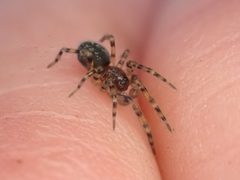
2Cryphoeca is a of small araneomorph spiders first described by Tamerlan Thorell in 1870. The genus name derives from Greek meaning "hidden," reflecting its reclusive habits beneath loose bark and within stone walls. The genus contains twelve described with a Holarctic distribution spanning North America, Europe, and Asia. Cryphoeca species are and among the larger members of their , reaching nearly eight millimeters in body length.
Pronunciation
How to pronounce Cryphoeca: /krɪˈfoʊɪkə/
These audio files are automatically generated. While they are not always 100% accurate, they are a good starting point.
Identification
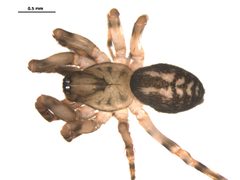
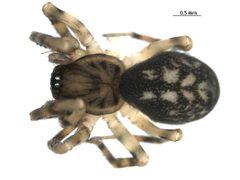
Distinguished from other Hahniidae by the two-row (staggered) arrangement; Hahniinae have six spinnerets in a single transverse row. Cryphoeca montana specifically is identifiable by its and under bark on dead trees, in leaf litter, moss, and under stones. Separation from other Cryphoecinae requires examination of male and female genitalia and cheliceral fang furrow .
Images
Appearance
Small to medium-sized spiders for their , with some reaching nearly 8 mm in body length. Members of the Cryphoecinae (including Cryphoeca) possess arranged in two staggered rows across the , distinguishing them from the comb-like single row arrangement found in Hahniinae. Specific morphological characters used for species identification include features of the male and female genitalia, and of the cheliceral fang furrow.
Habitat
Forest , particularly in chronically rainy or moist conditions. Cryphoeca montana has been documented under loose bark on dead trees, in leaf litter, moss, and beneath stones. The shows preference for concealed microhabitats that provide shelter and humidity.
Distribution
Holarctic distribution encompassing North America (USA, Canada), Europe (including Germany, Austria, Switzerland, Italy, Eastern Europe, Russia from Europe to Far East), and Asia (Japan, Turkey, Bulgaria). Specific have more restricted ranges: C. montana in USA and Canada; C. silvicola widespread across Europe, Turkey, Russia, and Japan; C. angularis, C. shingoi, and C. shinkaii to Japan; C. brignolii in Switzerland and Italy; C. nivalis in Switzerland, Austria, and Italy; C. pirini in Bulgaria and Turkey; C. thaleri in Turkey.
Seasonality
may be found in most seasons; Cryphoeca montana is nocturnally active. Specific seasonal peaks not documented in available sources.
Life Cycle
Complete through , spiderling, and stages. Specific details of egg sac construction, developmental duration, and mating not documented in available sources.
Behavior
activity pattern documented for C. montana. Strongly cryptic habits; spiders hide under loose bark, in stone walls, leaf litter, moss, and beneath stones. The name directly references this hiding .
Ecological Role
Predatory in forest floor and subcortical . Specific prey items and ecological interactions not documented.
Similar Taxa
- HahniaBoth in Hahniidae; distinguished by Hahnia having in single comb-like row (Hahniinae) versus two staggered rows in Cryphoecinae
- NeoantisteaBoth small sheet-web spiders in Hahniidae; Neoantistea builds visible sheet webs across depressions while Cryphoeca is non-web-building and more cryptic
- AntisteaSimilar size and ; distinguished by genitalic characters and cheliceral requiring microscopic examination
More Details
Taxonomic history
The Hahniidae was formerly included within Agelenidae (funnel-web weavers) as recently as 1957. Cryphoeca has been transferred between Hahniidae and Cybaeidae in different classifications; current sources place it in Cybaeidae, Cryphoecinae.
Etymology
name Cryphoeca derives from Greek roots meaning "hidden," directly referencing the spider's reclusive habit of hiding under loose bark and in stone walls.