
Hahnia cinerea
Emerton, 1890
Ash Hahniid Spider
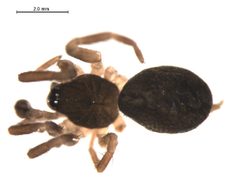
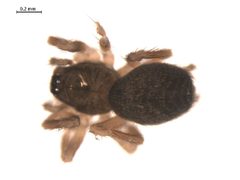
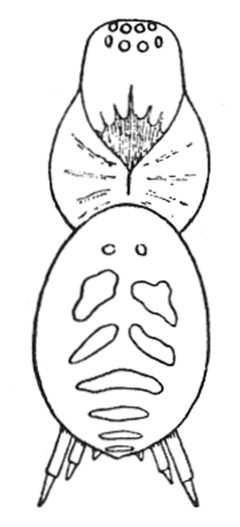
Hahnia cinerea is a small true spider in the Hahniidae, commonly known as the Ash Hahniid Spider. It belongs to the Hahniinae, whose members are characterized by having all six arranged in a single transverse row across the back of the , resembling the teeth of a comb—hence the 'comb-tailed spiders.' The was described by Emerton in 1890 and occurs in North America.
Pronunciation
How to pronounce Hahnia cinerea: /ˈhɑːniə sɪˈnɪəriə/
These audio files are automatically generated. While they are not always 100% accurate, they are a good starting point.
Identification
Distinguished from other Hahniidae by subtle genitalic characters: placement of tracheal on , relative size of , and length of segments on lateral . Separated from Neoantistea by different web-building (Hahnia does not build capture webs in North America). Distinguished from Antistea by geographic range and male palp spur . Cryphoecinae differ in having spinnerets in two staggered rows rather than one transverse row.
Images
Appearance
are very small, under 4 millimeters in body length. The most conspicuous morphological feature is the arrangement of : all six are aligned in a single row across the . Coloration is ash-gray (cinerea = ashen), consistent with its specific epithet. The are relatively small compared to some related . Male palps bear curved spurs on the tibial segment.
Habitat
Found in leaf litter, moss, and soil microhabitats. Occurs in small depressions in soil and among ground-level vegetation. Frequently associated with mammal footprints and other small ground depressions where related build webs. Inhabits reasonably dry situations under stones and other ground cover objects.
Distribution
North America; confirmed records from Alberta, Canada and the United States. Specific range details beyond 'North America' are not well documented in available sources.
Seasonality
likely active year-round in suitable microhabitats, with peak activity during warmer months. Exact not documented for this specifically.
Behavior
Does not build capture webs for prey capture in North America (unlike the related Neoantistea). Constructs silk retreats for molting, sac guarding, and . Travels on the undersides of substrates. Very agile when fleeing disturbance. Good climber, found on foliage as well as ground.
Ecological Role
Predatory in soil and leaf litter . Part of the cryptic ground-dwelling spider fauna that contributes to and nutrient cycling in forest and grassland .
Human Relevance
No documented economic or medical importance. Too small to be conspicuous to general observers. Occasionally encountered in pitfall trap surveys and ecological studies of ground-dwelling arthropods.
Similar Taxa
- NeoantisteaAlso in Hahniinae with six in single row, but builds thin sheet webs across small ground depressions; Hahnia does not build capture webs in North America
- Antistea brunneaSimilar size and but restricted to British Columbia, southeast Canada, and northeast U.S.; distinguished by male palp
- Cryphoecinae genera (e.g., Cryphoeca)Also in Hahniidae but have in two staggered rows rather than single transverse row; generally larger (up to 8 mm) and more restricted to western North America and moist forest
More Details
Taxonomic history
The Hahniidae was formerly classified within Agelenidae (funnel-web weavers) as recently as 1957, but is now recognized as a distinct family.
Detection difficulty
This is easily overlooked due to extremely small size (<4 mm), cryptic ground-dwelling habits, and lack of conspicuous webs. Specimens are most commonly collected through pitfall trapping or litter sampling rather than direct observation.