
Hololena santana
Chamberlin & Ivie, 1942
Hololena santana is a funnel-web weaver spider in the Agelenidae, described by Chamberlin & Ivie in 1942. The is found in the United States and belongs to a of approximately 30 recognized species restricted to the western third of North America. Like other Hololena, it constructs flat, sheet-like webs with a funnel-shaped retreat and is known to occasionally enter human dwellings.
Pronunciation
How to pronounce Hololena santana: /ˌhoʊloʊˈliːnə sænˈtænə/
These audio files are automatically generated. While they are not always 100% accurate, they are a good starting point.
Identification
Distinguished from Agelenopsis and Calilena by short directed inward rather than long spinnerets held parallel. Smaller than Agelenopsis, which averages 10-20 mm body length. Microscopic examination of genitalia is required for definitive -level identification within Hololena. The is in need of taxonomic revision, making field identification to species challenging.
Images
Appearance
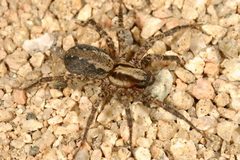
Medium-sized spider with body length 8-12 mm (males 8-9 mm, females 9-12 mm). pale with two parallel or converging dark stripes. with central reddish or brownish band running lengthwise, often bordered by pale wavy lines. Legs annulated with alternating bands of light and dark. short and often directed somewhat inward toward each other, distinguishing it from related with long, parallel spinnerets.
Habitat
Found in diverse environments including gardens, yards, hedges, and human dwellings. Constructs webs in vegetation and on structures. Juveniles and mature males wander away from webs and frequently enter buildings.
Distribution
United States. The Hololena is restricted to the western third of the U.S., from Washington and Idaho south to southern California and New Mexico; specific distribution records for H. santana within this range are limited.
Seasonality
Mature males wander in search of females deep into fall. One confirmed observation on October 29 in Colorado Springs. Activity extends into November in some regions.
Life Cycle
Embryos develop within silk sacs produced by females. Spiderlings may hatch within the sac and remain until weather becomes favorable for . Ballooning for has been observed in the .
Behavior
Constructs thick, flat, hammock- or bowl-shaped webs with funnel-like retreat in one corner. Web is not sticky; relies on tangle of threads above the sheet to intercept flying insects and knock them onto the platform. Extremely sensitive to vibrations; dashes out immediately to subdue prey and drags victim back into retreat to feed. Male courtship involves bouncing legs and on female's web, creating 1-6 vibrations. Receptive female responds by drawing in legs and entering cataleptic paralysis. Male repeatedly inserts palps to transfer sperm. Female may recover prematurely and chase male off web.
Ecological Role
of flying and crawling insects. Contributes to insect control in gardens and natural areas. Webs may provide microhabitat for other small arthropods.
Human Relevance
Occasionally enters human dwellings, where it may startle residents but helps control pest insects. Documented bites are rare; three verified cases resulted in headaches and vomiting episodes lasting approximately four hours in two cases, with mild reaction in the third. All victims recovered without medical treatment within days. Bites are defensive, not aggressive.
Similar Taxa
- AgelenopsisLarger body size (10-20 mm vs. 8-12 mm) and long held parallel rather than short, inward-directed spinnerets
- CalilenaLong, parallel vs. short, inward-directed spinnerets in Hololena
More Details
Taxonomic Status
The Hololena is in need of revision according to arachnologists, with approximately 30 recognized . Species-level identification often requires microscopic examination of genitalia.