
Euwallacea similis
(Ferrari, 1867)
ambrosia beetle
Euwallacea similis is a small (2.2–2.7 mm) native to South and Southeast Asia and Australia, now globally distributed through human trade in timber and wood commodities. It colonizes stressed, cut, or recently dead trees rather than healthy living trees, distinguishing it from related like E. fornicatus. The exhibits haplodiploid sex determination and inbreeding , with females farming symbiotic Fusarium fungi in wood galleries. First recorded in the Iberian Peninsula in 2025, it is considered a high-risk pest due to its habits and potential to pathogenic fungi.
Pronunciation
How to pronounce Euwallacea similis: /juːˈwæləsiə ˈsɪmɪlɪs/
These audio files are automatically generated. While they are not always 100% accurate, they are a good starting point.
Identification
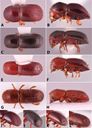
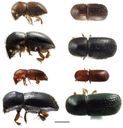
Females measure 2.2–2.7 mm in body length. convex with minutely reticulate surface and faint, shallow punctures. Pronotum sides nearly straight; margin broadly rounded without serrations. Elytral apex narrowly rounded; elytral declivity sloping and convex. Large, distinct present on lower third of interspace 1. Elytral interspace 7 acutely elevated and very weakly crenulate. Reliable -level identification from morphologically similar Euwallacea (particularly E. fornicatus members) requires molecular genetic analysis; no single set of physical measurements provides complete diagnostic certainty.
Images
Habitat
Colonizes stressed, dying, cut, or recently dead trees across diverse forest and urban environments. Particularly common in disturbed areas. Unlike E. fornicatus, does not typically attack healthy living trees.
Distribution
Native to South and Southeast Asia (Bangladesh, Bhutan, Cambodia, China, India, Indonesia, Laos, Malaysia, Myanmar, Nepal, Pakistan, Philippines, Singapore, Sri Lanka, Taiwan, Thailand, Vietnam) and Australia (including Papua New Guinea and Solomon Islands). Introduced and established in Africa (Cameroon, Egypt, Kenya, Mauritania, Mauritius, Seychelles, South Africa, Tanzania), Europe (Spain, Portugal), the Americas (United States, Mexico), and Pacific islands (Fiji, French Polynesia, Guam, Kiribati, Marshall Islands, New Caledonia, Northern Mariana Islands, Palau, Samoa, Christmas Island, Cocos Islands, Bonin Islands). First confirmed in Iberian Peninsula (Southeastern Spain) in 2025.
Seasonality
fly mainly around dusk and are readily attracted to light in large numbers.
Diet
Xylomycetophagous: and larvae feed on ambrosia fungi (including Fusarium ) cultivated on gallery walls. Does not consume wood directly.
Life Cycle
Haplodiploid sex determination system with inbreeding . Males typically mate with sisters within the parental gallery system before . laid in branching tunnel galleries excavated in one transverse plane; larvae develop and pupate within the same gallery system. chambers not located at cambial level or within wood. Females transport fungal spores in mycangia to establish new colonies.
Behavior
Highly with broad plant range (145+ documented). attack material ranging from small branches and seedlings to large logs. Gallery systems consist of branching tunnels in a single transverse plane. Strongly attracted to light; activity. Translocated globally through international timber and wood product trade.
Ecological Role
Secondary borer that contributes to decomposition of stressed and dead woody material in native range. In invaded regions, acts as economically damaging introduced pest with potential to pathogenic fungi and accelerate tree mortality. Part of globally significant complex.
Human Relevance
Considered high-risk pest due to polyphagy, global trade-mediated , and fungal associations. control challenging due to minimal surface exposure and non-phytophagous diet; limited efficacy of and contact demonstrated. Subject to early detection trapping networks in regions of recent establishment.
Similar Taxa
- Euwallacea fornicatusMorphologically cryptic member; distinguished by attacking live healthy trees (vs. stressed/dead ), higher repetitive element content in , and molecular genetic analysis required for definitive separation
- Euwallacea whitfordiodendrusFormerly confused within E. fornicatus complex; distinguished by genetic analysis and subtle morphometric differences in pronotum and dimensions
- Euwallacea kuroshioCryptic congeneric in same complex; native to Japan, Indonesia, Taiwan; requires molecular for reliable separation
Sources and further reading
- BugGuide
- Wikipedia
- GBIF taxonomy match
- iNaturalist taxon
- NCBI Taxonomy
- Encyrtid Holdings | Entomology Research Museum
- Bug Eric: A Jumping Spider, Tutelina similis
- Study Shows American Dog Ticks in Western U.S. Are a Separate Species
- Search Continues for Methods to Control Fungus-Farming Beetle in SoCal Trees
- Forest Pest Invasions Can—And Should—Be Studied Before They Happen
- So Many Shot Hole Borers: New Research Charts Four Nearly Identical Species
- Chromosome structural rearrangements in invasive haplodiploid ambrosia beetles revealed by the genomes of Euwallacea fornicatus and Euwallacea similis (Coleoptera, Curculionidae, Scolytinae)
- Chromosome Structural Rearrangements in Invasive Haplodiploid Ambrosia Beetles Revealed by the Genomes of Euwallacea fornicatus (Eichhoff) and Euwallacea similis (Ferrari) (Coleoptera, Curculionidae, Scolytinae)
- Euwallacea similis (Ferrari), a new ambrosia beetle (Coleoptera: Curculionidae: Scolytinae) for the Iberian Peninsula, and new records on Euwallacea fornicatus (Eichhoff), Xyleborus bispinatus Eichhoff and Amasa parviseta Knížek & Smith