
Euwallacea fornicatus
Wood & Bright, 1992
tea shot-hole borer, polyphagous shot-hole borer, PSHB
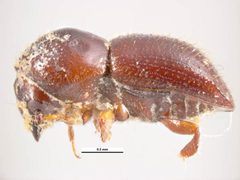
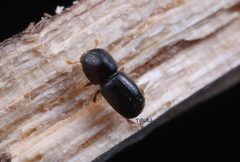
Euwallacea fornicatus is an ambrosia beetle (Coleoptera: Curculionidae: Scolytinae) native to Asia that has established in North America, Israel, South Africa, Australia, and South America. It is now recognized as part of a cryptic containing at least four distinct (E. fornicatus, E. fornicatior, E. whitfordiodendrus, and E. kuroshio) that are morphologically indistinguishable but genetically distinct. The species is a significant economic pest of tea, avocado, citrus, and numerous ornamental and native trees, acting as a for Fusarium fungi that cause Fusarium dieback .
Pronunciation
How to pronounce Euwallacea fornicatus: /juˌwɔlɪˈeɪʃə fɔrnɪˈkɑtəs/
These audio files are automatically generated. While they are not always 100% accurate, they are a good starting point.
Identification
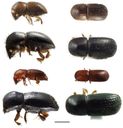
Reliable identification to level within the E. fornicatus complex requires molecular analysis ( sequencing, particularly COI gene), as morphological characters alone cannot distinguish the four cryptic species with certainty. Body dimensions vary considerably within each species (1.8–2.9 mm range). Some morphological characters (pronotum and dimensions, protibial socketed denticles) show partial correlation with genetic clades but have too many exceptions for definitive identification.
Images
Habitat
Breeds in living trees across diverse environments including commercial orchards (avocado, citrus, tea), urban forests, riparian corridors, and native woodlands. Has been detected in greenhouses in Europe. Successfully establishes in both agricultural and natural .
Distribution
Native to Southeast Asia (southern regions). Introduced and established in: USA (California, Florida, Hawaii), Israel, South Africa, Australia (Western Australia), Argentina, Brazil, Uruguay, and various European countries via greenhouse introductions. Climate modeling indicates potential for northward range expansion with warming temperatures.
Seasonality
Development from to requires approximately 398 degree days, with thermal limits of t_min 13.34°C, t_max 33.08°C, and t_opt 27.51°C. Activity patterns vary by region; in temperate introduced ranges, peak activity generally occurs during warmer months when temperatures approach optimal developmental conditions.
Diet
Does not consume wood directly. and larvae feed exclusively on symbiotic fungi (primarily Fusarium euwallaceae and related Fusarium ) cultivated in galleries excavated in tree xylem. Fungal spores are transported in mycangia located in the .
Host Associations
- Camellia sinensis - reproductive major economic pest of tea
- Persea americana - reproductive avocado; severe damage in California and Israel
- Citrus spp. - reproductive citrus
- Theobroma cacao - reproductive cacao
- Acer negundo - reproductive box elder
- Platanus racemosa - reproductive California sycamore
- Quercus spp. - reproductive oaks including English oak and coast live oak
- Albizia julibrissin - reproductive silk tree
- Liquidambar styraciflua - reproductive sweetgum
- Erythrina spp. - reproductive coral tree
- Alectryon excelsus - reproductive Tītoki
- Parkinsonia florida - reproductive Blue Palo Verde
- Acer macrophyllum - reproductive big leaf maple
- Ficus macrophylla - reproductive Moreton Bay fig
- Melaleuca quinquenervia - reproductive paperbark
Life Cycle
Haplodiploid inbreeding system: females are , males are haploid and develop from unfertilized . Females mate with siblings within natal galleries before dispersing. Males are flightless and remain in galleries. Development from egg to requires approximately 398 degree days. Larvae are legless, C-shaped, with sclerotized capsules typical of Curculionidae.
Behavior
Females bore into tree bark and excavate galleries in xylem, inoculating fungal carried in mandibular mycangia. Galleries are seeded with fungal spores and ; larvae feed on developing fungus. Females are attracted to specific ratios of 2-heneicosanone and 2-tricosanone , with -specific blend ratios. Also attracted to quercivorol, a produced by fungal symbionts. Females are repelled by pheromone blends of other cryptic species. occurs via of mated females to new host trees.
Ecological Role
pest and . Tunneling and fungal block tree , causing branch dieback and tree mortality. The combination of damage and Fusarium (Fusarium dieback) kills trees even though the fungus alone is a weak pathogen. In invaded regions, threatens urban forest services (shade, wildlife , carbon storage, property values) and natural riparian habitats.
Human Relevance
Severe economic pest with estimated potential damage of A$28 billion (0.66% of GDP) in South Africa alone. Threatens global avocado and tea industries. In urban areas, forces costly removal and destruction of infested trees; in Perth, Australia, efforts required removal of mature trees including 300-year-old specimens. measures implemented in affected regions. Management strategies include (removal and grinding of infested wood), chemical control (limited efficacy), and development of varieties. attempts have shown little success. Firewood transport is a major for human-mediated spread.
Similar Taxa
- Euwallacea fornicatiorCryptic in same complex; morphologically indistinguishable but genetically distinct (11–15% sequence divergence); historically synonymized under E. fornicatus; differs in geographic origin (southern Southeast Asia) and preferences
- Euwallacea whitfordiodendrusCryptic in same complex ( shot hole borer); morphologically indistinguishable; originates from northern Southeast Asia; introduced to California, Israel, South Africa; extremely broad range
- Euwallacea kuroshioCryptic in same complex (Kuroshio shot hole borer); morphologically indistinguishable; believed native to Pacific Islands/Japan/Indonesia/Taiwan; introduced to California and Mexico; impacts San Diego County forests
- Euwallacea similisCongeneric ambrosia beetle; attacks stressed or dead trees rather than healthy ; outbreeding rather than haplodiploid inbreeding; less economically damaging
- Xyleborus glabratus ambrosia beetle in same ; of laurel wilt ; similar gallery construction and fungal but distinct range (primarily Lauraceae)
Misconceptions
The name 'Euwallacea fornicatus' was historically applied to what is now recognized as at least four distinct cryptic . Research prior to 2018 often treated these as a single species, confounding understanding of preferences and invasion . The ' shot hole borer' is sometimes applied to the entire complex but properly refers to E. whitfordiodendrus specifically. The beetles do not directly consume wood—their damage comes from gallery construction and fungal , not herbivory.
Sources and further reading
- BugGuide
- Wikipedia
- GBIF taxonomy match
- iNaturalist taxon
- NCBI Taxonomy
- Catalogue of Life
- The Day That The Beetles Invaded the Bohart | Bug Squad
- Euwallacea fornicatus Archives - Entomology Today
- Xyleborus glabratus and Euwallacea fornicatus - Entomology Today
- Search Continues for Methods to Control Fungus-Farming Beetle in SoCal Trees
- So Many Shot Hole Borers: New Research Charts Four Nearly Identical Species
- four species of Euwallacea - Entomology Today
- Euwallacea fornicatus . [Distribution map].
- Introduction and establishment of Euwallacea fornicatus (Coleoptera: Curculionidae: Scolytinae) in Brazil
- Invasive Shot Hole Borers Euwallacea fornicatus, E. kuroshio, and E. perbrevis (Coleoptera: Curculionidae: Scolytinae)
- Distribution, Pest Status and Fungal Associates of Euwallacea nr. fornicatus in Florida Avocado Groves
- Chromosome structural rearrangements in invasive haplodiploid ambrosia beetles revealed by the genomes of Euwallacea fornicatus and Euwallacea similis (Coleoptera, Curculionidae, Scolytinae)
- The First Report of Euwallacea fornicatus (Eichhoff, 1868) (Coleoptera: Scolytinae) in Türkiye with New Reproductive Host Plant
- Supplementary material 1 from: Ceriani-Nakamurakare E, Gomez DF, Trebino A, Listre A, Ingaramo L, Armand Pilón A, Bollazzi M (2025) Increasing breeding host range and fast spread across Uruguay reveals the invasion potential of Euwallacea fornicatus (Coleoptera, Scolytinae) in South America. NeoBiota 98: 247-260. https://doi.org/10.3897/neobiota.98.147227
- Uncharted Territories: First report of Euwallacea fornicatus (Eichhoff) in South America with new reproductive hosts records.
- Pheromones of three ambrosia beetles in the Euwallacea fornicatus species complex: ratios and preferences
- Cost effectiveness of spread mitigation strategies for polyphagous shot hole borer Euwallacea fornicatus (Coleoptera: Curculionidae: Scolytinae)
- Chromosome Structural Rearrangements in Invasive Haplodiploid Ambrosia Beetles Revealed by the Genomes of Euwallacea fornicatus (Eichhoff) and Euwallacea similis (Ferrari) (Coleoptera, Curculionidae, Scolytinae)
- Quercivorol as a lure for the polyphagous and Kuroshio shot hole borers, Euwallacea spp. nr. fornicatus (Coleoptera: Scolytinae), vectors of Fusarium dieback
- Predicting the potential distribution in China of Euwallacea fornicatus (Eichhoff) under current and future climate conditions
- Temperature can limit the invasion range of the ambrosia beetle Euwallacea nr. fornicatus
- Author Correction: Predicting the potential distribution in China of Euwallacea fornicatus (Eichhoff) under current and future climate conditions