
Xyleborus glabratus
Eichhoff, 1877
Redbay Ambrosia Beetle
Xyleborus glabratus is a small ambrosia beetle native to Asia that has become a destructive pest in the southeastern United States since its detection in 2002. The is the primary of Raffaelea lauricola, the fungal that causes laurel wilt , which has killed millions of native Lauraceae trees including redbay, sassafras, and avocado. Females are the dispersing sex and initiate galleries in wood, where they cultivate fungal gardens as food for their offspring. The 's rapid spread threatens both forest and commercial avocado production.
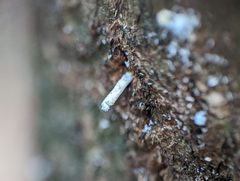
Pronunciation
How to pronounce Xyleborus glabratus: //zaɪlɪˈbɔːrəs ɡlæˈbreɪtəs//
These audio files are automatically generated. While they are not always 100% accurate, they are a good starting point.
Identification
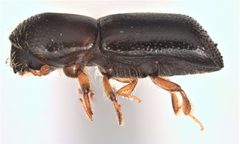
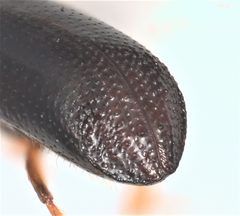
Distinguished from other Xyleborus by the steep and convex shape of the elytral declivity and the large size of indentations on the . The mostly hairless, shiny surface contrasts with the more pubescent appearance of related ambrosia beetles. Males are readily identified by their smaller size, reduced wings, and flightless condition. Larvae are white, legless, with amber-colored capsules; pupae are whitish, exarate, and similar in size to .
Images
Habitat
Associated with woody in the Lauraceae; in native range, colonizes stressed or injured native laurel trees; in invaded range, attacks healthy and stressed redbay, sassafras, avocado, and other Lauraceae. Galleries are excavated in xylem tissue of host stems and branches. Laboratory rearing successful on artificial sawdust-based diets supplemented with fungal .
Distribution
Native to Asia: India, Japan, Myanmar, Taiwan, China (Fujian, Hunan, Sichuan), Bangladesh. Introduced to North America: first detected 2002 in Port Wentworth, Georgia, USA. Established throughout southeastern US including Georgia, Florida, Alabama, Mississippi, North Carolina, South Carolina, Texas, Arkansas, Tennessee, Kentucky. Potential for further spread to Mexico and California identified through modeling.
Seasonality
Year-round with overlapping ; increase steadily through late summer and early fall without distinct peaks in studied populations. activity and occur throughout the year in suitable climates.
Diet
Obligate ambrosia fungus feeder; larvae and feed exclusively on symbiotic fungi cultivated within wood galleries, not on wood itself. Primary fungal associate is Raffaelea lauricola; other Raffaelea may be carried. Females transport fungal spores in mandibular mycangia to inoculate new galleries.
Host Associations
- Lauraceae (family) - Primary include multiple
- Persea borbonia - Redbay; major native in invaded range, experiencing massive mortality
- Persea americana - Avocado; commercial crop threatened in Florida
- Persea palustris - Swampbay
- Persea humilis - Silkbay
- Sassafras albidum - Sassafras; significant mortality in invaded range
- Cinnamomum camphora - Camphor tree
- Machilus - Native in Asia; mass wilt observed in Hong Kong
- Litsea monopetala - Native Asian
- Raffaelea lauricola - /Primary fungal associate; causing laurel wilt
Life Cycle
Complete : , larva, pupa, . Females initiate galleries in wood and lay eggs in tunnel . Larvae feed on ambrosia fungus growing on gallery walls. Development from egg to adult approximately 30–35 days at 25°C under laboratory conditions; field development estimated at 50–60 days. Males remain in natal gallery, mate with sisters, and do not disperse. Females emerge, disperse, and establish new galleries. Overlapping with continuous in suitable conditions.
Behavior
Females are the sole dispersing sex and initiate all new galleries. Males are flightless, remain in natal galleries, and mate with sibling females. Females carry fungal in paired mandibular mycangia and inoculate new galleries with spores. Gallery establishment preferentially targets stressed or dying trees, though healthy trees are attacked in invaded range. observed; females attracted to -derived volatile terpenoids including manuka oil and cubeb oil components. Entrance holes clustered on south side of stems in some hosts.
Ecological Role
Primary of laurel wilt Raffaelea lauricola; pest causing extensive mortality of native Lauraceae in southeastern US, disrupting forest structure and function. In native Asian range, colonizes stressed trees and contributes to natural forest dynamics; in invaded range, behaves as aggressive tree-killer. Fungal creates novel nutrient cycling in dead and dying wood.
Human Relevance
Major economic threat to Florida avocado industry ($54–65 million annually); responsible for death of over 6,000 commercial avocado trees in Florida. Significant ecological impact through loss of native redbay and sassafras . Spread facilitated by human transport of infested firewood and wooden packing materials. Subject of intensive research for detection lures, repellents, using fungi, and RNAi-based management. Regulatory concern for preventing spread to Mexico and western US.
Similar Taxa
- Xyleborus ferrugineusSimilar size and general appearance; distinguished by more pubescent surface and different elytral declivity structure
- Xyleborus affinisOverlapping distribution and use; X. glabratus distinguished by shinier, less hairy appearance and steeper elytral declivity
- Euwallacea aff. fornicatus (polyphagous shot hole borer)Another Asian ambrosia beetle in US; differs in gallery pattern (more branched), range (broader), and fungal associates; does not laurel wilt
- Xylosandrus crassiusculus ambrosia beetle with similar ; distinguished by smaller size, different mycangial structure, and less pathogenic fungal associations
More Details
Reproductive System
Arrhenotokous : females produce haploid male offspring from unfertilized and female offspring from fertilized eggs. Sex ratio highly female-biased, approximately 10:1 to 20:1 female:male. This system allows single females to establish new .
Mycangial Structure
Females possess paired mandibular mycangia—hollow invaginations at the base of each that store and transport fungal spores. These structures have been visualized using micro-CT scanning and laser ablation tomography, revealing complex three-dimensional .
Chemical Ecology
No known; attraction to including α-copaene, α-cubebene, and other sesquiterpenes from Lauraceae. Manuka oil and cubeb oil lures developed for detection. Repellents including verbenone and methyl salicylate show promise for protection of individual trees.
Management Research
fungi ( bassiana, Metarhizium brunneum, Isaria fumosorosea) show 75–100% mortality in laboratory and field trials. interference targeting essential genes (hsp, shi, iap) causes significant mortality. of infested material and restrictions on movement of wood remain primary regulatory approaches.
Sources and further reading
- BugGuide
- Wikipedia
- GBIF taxonomy match
- iNaturalist taxon
- NCBI Taxonomy
- Catalogue of Life
- Bembicid Holdings | Entomology Research Museum
- Xyleborus glabratus and Euwallacea fornicatus - Entomology Today
- Forest Pest Invasions Can—And Should—Be Studied Before They Happen
- The Best Look Yet at the Tiny Fungus Storage Units Inside Ambrosia Beetles
- The Ambrosia Beetle Megaplatypus mutatus: Tiny but Destructive
- Fungi May be Used to Control Fungus-farming Beetles
- Xyleborus glabratus . [Distribution map].
- Life Cycle, Development, and Culture ofXyleborus glabratus(Coleoptera: Curculionidae: Scolytinae)
- Distribution of the Invasive Redbay Ambrosia BeetleXyleborus glabratusIn Southeastern Texas
- Utility of essential oils for development of host-based lures for Xyleborus glabratus (Coleoptera: Curculionidae: Scolytinae), vector of laurel wilt
- Raffaeleaspecies associated withXyleborus glabratuswith particular emphasis onR. lauricola, the cause of laurel wilt
- Reference Gene Identification and RNAi-Induced Gene Silencing in the Redbay Ambrosia Beetle (Xyleborus glabratus), Vector of Laurel Wilt Disease
- Potential invasion of exotic ambrosia beetles Xyleborus glabratus and Euwallacea sp. in Mexico: A major threat for native and cultivated forest ecosystems
- Factors affecting Xyleborus glabratus attack and host utilization in sassafras and redbay in the Carolinas
- Evaluation of Lure Combinations Containing Essential Oils and Volatile Spiroketals for Detection of Host-Seeking Xyleborus glabratus (Coleoptera: Curculionidae: Scolytinae)
- Comparative Analysis of Terpenoid Emissions from Florida Host Trees of the Redbay Ambrosia Beetle,Xyleborus glabratus(Coleoptera: Curculionidae: Scolytinae)
- Attraction of Redbay Ambrosia Beetle, Xyleborus Glabratus, To Leaf Volatiles of its Host Plants in North America
- Evaluation of repellents for the redbay ambrosia beetle, Xyleborus glabratus, vector of the laurel wilt pathogen