
Scolytinae
Motschulsky, 1850
Bark and Ambrosia Beetles, Bark Beetles
Tribe Guides
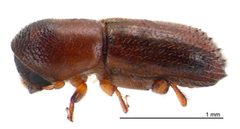
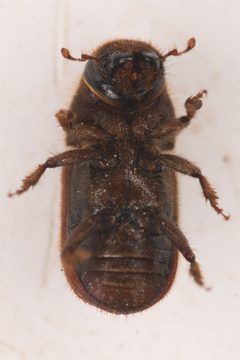
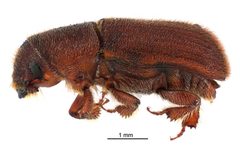
21Scolytinae is a of weevils (Curculionidae) comprising approximately 220 and 6,000 commonly known as bark and ambrosia beetles. Members are characterized by their specialized association with woody plants, where they excavate galleries beneath bark for and larval development. The subfamily includes some of the most economically significant forest pests globally, such as the southern pine (Dendroctonus frontalis) and mountain pine beetle (Dendroctonus ponderosae), which cause billions of dollars in timber losses. Species exhibit diverse feeding strategies: phloem-feeding bark beetles consume living or dying tree tissues, while ambrosia beetles cultivate symbiotic fungi in galleries as a food source.
Pronunciation
How to pronounce Scolytinae: //skɒˈlaɪtɪniː//
These audio files are automatically generated. While they are not always 100% accurate, they are a good starting point.
Identification
Scolytinae are distinguished from other weevils by their compact, cylindrical body form adapted for burrowing, with a short, broad rostrum. are elbowed (geniculate) with a distinct club, often appearing flattened. Many have a pronounced declivity (slope) at the end of the . The group is traditionally separated from Platypodinae (pinhole borers) by gallery construction and fungal associations, though both are now placed in Curculionidae. Identification to or species requires examination of pronotal and elytral sculpturing, antennal club segmentation, and male genitalia.
Images
Habitat
Associated with woody plants across forest worldwide. Bark beetles colonize living, stressed, or recently dead trees, often requiring specific or . Ambrosia beetles typically infest dead or dying wood, including logs, lumber, and wood packaging materials. Many species are attracted to ethanol released by fermenting plant tissues or fire-damaged trees.
Distribution
distribution spanning all forested continents. Highest diversity in tropical regions, with significant representation in temperate and forests. Numerous have established outside native ranges through international trade in wood products.
Seasonality
periods vary by and climate. In temperate regions, many species exhibit spring or summer , with some having multiple annually. Others overwinter as larvae or adults within galleries. Tropical species often show less pronounced seasonality.
Diet
Phloem and cambium tissues of woody plants (phloeophagous ); symbiotic fungi cultivated in galleries (xylomycetophagous/ambrosia beetles). Some species feed on seeds or twigs.
Host Associations
- Pinus spp. - primary Major for Dendroctonus frontalis and numerous other bark beetle
- Liquidambar styraciflua - Susceptible to Acanthotomicus sp. in China; major timber in southeastern United States
- Acer spp. - Maple Scolytus koenigi and other phloem-feeding species
- Ochroma pyramidale - Balsa plantations in Ecuador Coptoborus ochromactonus
Life Cycle
Complete . bore into bark to initiate galleries. are deposited in along gallery walls. Larvae feed on phloem or cultivated fungi, expanding galleries as they develop. occurs within the gallery system. New adults emerge through exit holes or parental entrance tunnels. time ranges from approximately 30 days in summer for multivoltine to one year for species.
Behavior
Mass attack in many : pioneer beetles release that recruit conspecifics to overcome tree defenses. Some species exhibit sequential with heterospecifics—for example, Dendroctonus terebrans (black turpentine beetle) may facilitate host location for Dendroctonus frontalis through shared signals including frontalin and exo-brevicomin. Ambrosia beetles transport fungal spores in specialized cuticular structures called mycangia. Fire-associated species are attracted to smoke and heat, colonizing burned or damaged trees.
Ecological Role
Major agents of tree mortality in natural and managed forests, influencing forest and carbon cycling. irruptions can convert living forests to dead wood, altering structure for decades. Some act as for pathogenic fungi, including those causing . In natural , they accelerate decomposition of woody debris and create habitat for secondary forest organisms. disrupt forest ecosystems in novel ranges.
Human Relevance
Among the most economically damaging forest insects globally. The southern pine (Dendroctonus frontalis) caused over $900 million in losses from 1960-1990 and over $1 billion during a 1998-2002 . The mountain pine beetle (Dendroctonus ponderosae) has affected 88 million acres of western North American conifer forests. Management relies on silvicultural practices (thinning, prescribed fire), -based monitoring and disruption, and rapid removal of infested trees. International trade regulations (ISPM 15) target wood packaging materials to prevent inadvertent transport.
Similar Taxa
- PlatypodinaeAlso wood-boring weevils with similar gallery construction; distinguished by different fungal practices and morphological features of the
- BuprestidaeFlatheaded borers also colonize fire-damaged trees and may be attracted to smoke; distinguished by larval form (flattened, expanded thoracic segments) and body shape
- CerambycidaeLonghorned beetles include wood-boring larvae; distinguished by extremely long (often exceeding body length) and larval galleries in heartwood rather than phloem
More Details
Mycangia and Fungal Associations
Ambrosia beetles possess mycangia—specialized cuticular invaginations or pouches for transporting symbiotic fungal spores. These structures represent a key morphological distinguishing xylomycetophagous from phloeophagous . The also differs between feeding guilds: ambrosia beetles show elongated proventriculi with sclerotized on the , while phloem-feeding Scolytus species have extended laminate teeth on the plate.
Invasion Biology
Global trade is the primary driver of Scolytinae invasions. capable of sib-mating (inbreeding) are disproportionately represented among successful invaders, as single females can establish without mates. Cumulative trade volume between regions strongly predicts invasion frequency. Climate matching and forest area are weaker predictors than trade connectivity.
Semiochemical Ecology
systems are highly developed, with -specific blends of and anti-aggregation compounds. Cross-species communication occurs: Dendroctonus frontalis responds to frontalin produced by Dendroctonus terebrans, and to exo-brevicomin which D. frontalis does not itself produce. This chemical eavesdropping may facilitate location but true mutualism remains unproven.
Sources and further reading
- BugGuide
- iNaturalist taxon
- NCBI Taxonomy
- Catalogue of Life
- Meet the 'Extreme Insects' Aug. 19 at Bohart Museum of Entomology Open House | Bug Squad
- Bug Eric: February 2009
- American Sweetgum Picks Up a Beetle Pest in China
- Southern Pine Beetle: How a Fellow Species May Help in Host Location
- The Potential U.S. Economic Cost of a New Sweetgum-Killing Pest
- Domestic Sea Trade Aids Wood-Boring Beetles' Range Expansion
- Drivers of global Scolytinae invasion patterns
- Southern Pine Beetle Dendroctonus frontalis (Coleoptera: Curculionidae: Scolytinae)
- The bark and ambrosia beetles of Bhutan (Coleoptera: Curculionidae: Scolytinae and Platypodinae): a synopsis with three new species of Scolytinae
- Morphological and behavioural features of bark beetles of the tribe Scolytini (Coleoptera, Curculionidae, Scolytinae) associated with fungi
- Determination of Scolytinae and Platypodinae (Coleoptera : Curculionidae) flight area using sticky traps
- Evolutionary and functional characterization of oxidative stress proteins in dendroctonus ponderosae hopkins (curculionidae: scolytinae)
- Diversité des Scolytes : Coléoptèra, Curculionidae, Scolytinae et leurs champignons associés dans l'écosystème forestier d'Equateur
- Biology features of Scolytus koenigi Schevyrew, 1890 (Coleoptera: Curculionidae: Scolytinae) in forest-steppe zone of the European part of Russia
- Discrimination of Odors Associated With Conspecific and Heterospecific Frass by Sibling Species Dendroctonus frontalis (Coleoptera: Curculionidae: Scolytinae) and Dendroctonus mesoamericanus (Coleoptera: Curculionidae: Scolytinae)