
Xyleborus ferrugineus
(Fabricius, 1801)
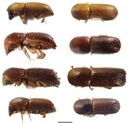
Xyleborus ferrugineus is an ambrosia beetle ( Scolytinae) that cultivates symbiotic fungi for nutrition rather than feeding directly on wood. Females bore into trees to create galleries where they farm ambrosia fungi, which serve as the sole food source for and larvae. The exhibits strong , with females being larger, more numerous, and solely responsible for gallery formation and colony founding. It has been documented as a potential of Ceratocystis cacaofunesta, the causal agent of lethal wilt in cocoa.
Pronunciation
How to pronounce Xyleborus ferrugineus: /zaɪˈlɛbɔrəs fɛˈruːd͡ʒɪniəs/
These audio files are automatically generated. While they are not always 100% accurate, they are a good starting point.
Identification
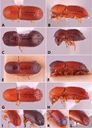
Distinguished from other Xyleborus by its reddish-brown coloration and association with cultivated ambrosia fungi in galleries. Xyleborus affinis is a closely related species with which it has been compared in electroantennographic studies; X. ferrugineus shows stronger EAG responses to ethanol and different bark volatile profiles, particularly to Persea schiedeana at 24–48 hours of aging. Molecular identification may be required for definitive separation from morphologically similar . The species can be separated from bark-feeding Scolytinae by its fungal and gallery structure.
Images
Habitat
Associated with forested and agricultural environments in tropical and subtropical regions. Colonizes weakened, stressed, or dead hardwood trees; has been observed in apparently healthy . Found in cocoa plantations, natural forests, and areas with suitable woody substrates for gallery establishment.
Distribution
Pantropical and subtropical distribution spanning Africa (Angola, Cameroon, Ghana, Kenya, Madagascar, Nigeria, South Africa, Tanzania, Uganda, and others), Asia (Malaysia), Australasia and Pacific Islands (Fiji, Hawaii, Papua New Guinea, Samoa, Solomon Islands), North America (Mexico, southern USA), Central America and West Indies (Belize, Rica, Guatemala, Panama, West Indies), and South America (Argentina, Brazil, Ecuador, French Guiana, Guyana, Venezuela, and others). In Mexico, highest climatic suitability occurs in Chiapas, Tamaulipas, and Veracruz; no suitability detected in Aguascalientes, Guanajuato, or Zacatecas. Climate models predict potential poleward range expansion under future warming scenarios.
Diet
Obligate mutualist with ambrosia fungi; does not consume wood directly. and larvae feed exclusively on fungal gardens cultivated within galleries. The mutualistic fungus is essential for —beetles developed from asymbiontic to adulthood on sterilized artificial diet, but reproduced only when the fungus was inoculated. Bacterial alone are insufficient to replace the fungal mutualist.
Host Associations
- Theobroma cacao - Cocoa tree; documented interaction with Ceratocystis cacaofunesta transmission
- Bursera simaruba - source; bark volatiles elicit electroantennographic responses
- Mangifera indica - source in electroantennographic studies
- Persea schiedeana - Bark volatiles at 24–48 h aging elicit strongest EAG responses in this
- Ceratocystis cacaofunesta - Suspected of lethal wilt fungus in cocoa; interaction requires further study
Life Cycle
Development from to can occur on sterilized meridic diet, but requires fungal inoculation. Females initiate galleries in wood and inoculate ambrosia fungi. Larvae develop within galleries, feeding on fungal gardens. Males are wingless and remain in natal galleries; females disperse to found new colonies. The complete cycle is closely tied to fungal success.
Behavior
Females are attracted to ethanol, a volatile cue associated with stressed or decaying wood. Electroantennographic studies show strong olfactory responses to ethanol and bark volatiles, with responses differing between wild and laboratory-reared individuals. Gallery initiation and maintenance involve cooperative fungal inoculation and tending. Males do not disperse; they remain in parental galleries where they mate with sisters.
Ecological Role
Primary decomposer of dead and stressed woody material in tropical forests through ambrosia fungus . Contributes to nutrient cycling by accelerating wood breakdown via fungal activity. Potential pest in cocoa agroecosystems through association with Ceratocystis wilt . Serves as and agent for mutualistic fungi and possibly associated microorganisms.
Human Relevance
Considered a pest in timber and forestry industries due to presence in commercial wood products, causing structural damage, aesthetic defects, and reduced lumber value. Fungal staining and wood degradation reduce marketability. Potential threat to cocoa production as a of Ceratocystis cacaofunesta. Subject of research on ambrosia beetle-fungus , chemical , and risk assessment. Used as model organism for studying nutritional requirements of ambrosia beetles, including sterol and vitamin dependencies.
Similar Taxa
- Xyleborus affinisClosely related with overlapping distribution and similar ambrosia beetle ; distinguished by electroantennographic response patterns to bark volatiles—X. affinis shows highest response to Bursera simaruba at 48 h, while X. ferrugineus responds most strongly to Persea schiedeana
- Xyleborus glabratusAnother Xyleborus ambrosia beetle; distinguished by association with laurel wilt (Raffaelea lauricola) in Lauraceae and more limited distribution in southeastern USA
- Xyleborus volvulus with similar pantropical distribution and ambrosia beetle ; often co-occurs in distribution modeling studies but may differ in preferences and climatic tolerances
- Euwallacea aff. fornicatus shot hole borer; distinguished by different affiliation, mass leading to branch breakage, and different fungal associates
More Details
Nutritional Requirements
Laboratory studies demonstrate that X. ferrugineus has specific dietary requirements: lack of dietary Δ7-sterol markedly shortens locomotor vigor, , and longevity in females. Ascorbic acid and related compounds inhibit reproduction, indicating precise nutritional optimization for fungal mutualism.
Research Significance
This has been extensively used in research on ambrosia beetle-fungus , including pioneering studies on mycangia structure using micro-CT scanning and laser ablation tomography. It serves as a model for understanding the obligate nature of ambrosia beetle-fungus mutualisms.
Sources and further reading
- BugGuide
- Wikipedia
- GBIF taxonomy match
- iNaturalist taxon
- NCBI Taxonomy
- Catalogue of Life
- UBI Professor Demonstrates 'How to Draw a Bug' at Bohart Museum Open House | Bug Squad
- Listening to Larvae: How Acoustics Can Measure Efficacy of Palm Weevil Management
- Forest Pest Invasions Can—And Should—Be Studied Before They Happen
- The Ambrosia Beetle Megaplatypus mutatus: Tiny but Destructive
- Northern Ireland, invertebrate finds in review 2023 - Buglife Blog - Buglife
- The Best Look Yet at the Tiny Fungus Storage Units Inside Ambrosia Beetles
- Xyleborus ferrugineus . [Distribution map].
- Current and potential distribution of Xyleborus ferrugineus and Xyleborus volvulus (Coleoptera: Curculionidae) in Mexico
- Effects of climate change on the potential distribution of Xyleborus ferrugineus, Xyleborus volvulus and Euwallacea kuroshio1
- Advances in understanding of the interaction between Ceratocystis cacaofunesta and Xyleborus ferrugineus (Coleoptera: Curculionidae: Scolytinae) on cocoa trees
- Inhibition of reproduction of Xyleborus ferrugineus by ascorbic acid and related chemicals
- Electroantennographic Responses of Wild and Laboratory-Reared Females of Xyleborus affinis Eichhoff and Xyleborus ferrugineus (Fabricius) (Coleoptera: Curculionidae: Scolytinae) to Ethanol and Bark Volatiles of Three Host-Plant Species
- Insect-Host Tissue Interrelations between Xyleborus ferrugineus (Coleoptera: Scolytidae) and Theobroma cacao in Costa Rica1
- Symbiosis: Effects of a Mutualistic Fungus upon the Growth and Reproduction of Xyleborus ferrugineus
- The Interaction of Xyleborus ferrugineus (Coleoptera: Scolytidae) Behavior and Initial Reproduction in Relation to Its Symbiotic Fungi1
- Lack of dietary Δ7-sterol markedly shortens the periods of locomotor vigor, reproduction and longevity of adult female Xyleborus ferrugineus (coleoptera, scolytidae)