
Xyleborus volvulus
(Fabricius, 1794)
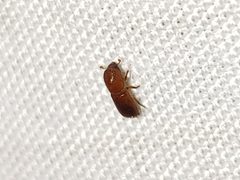
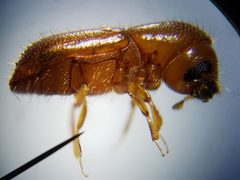
Xyleborus volvulus is a bark beetle in the Curculionidae. It is native to tropical and subtropical regions and has been documented in North America, the Caribbean, Middle America, and Africa. The is an ambrosia beetle that cultivates symbiotic fungi in tunnels bored into wood. It has been observed to carry Raffaelea lauricola, the causing laurel wilt , which has altered its status from a wood degrader to a potential pest of avocado and other lauraceous trees.
Pronunciation
How to pronounce Xyleborus volvulus: /zaɪˈlɛbərəs ˈvɒlvjʊləs/
These audio files are automatically generated. While they are not always 100% accurate, they are a good starting point.
Images
Habitat
Tropical and subtropical climates. In Mexico, distribution is limited by cold temperatures (absent from higher elevations) and low humidity (absent from desert regions). Climatically suitable areas are characterized by: precipitation of wettest month, isothermality, mean temperature range, precipitation of driest month, and maximum temperature of warmest month.
Distribution
Native to tropical and subtropical regions. Documented in North America, the Caribbean, Middle America (primarily Mexico), and Africa. In Mexico, present in states with suitable climate including Jalisco, Chiapas, and Veracruz; absent from Baja California, Baja California Sur, Coahuila, and Nuevo León due to unsuitable climatic conditions.
Diet
Feeds on symbiotic fungi cultivated in tunnels bored into wood. The obligate mutualistic relationship with fungi is required for survival.
Host Associations
- Lauraceae - potential pestStatus elevated from wood degrader to potential pest due to acquisition of Raffaelea lauricola
- avocado - potential pestThreatened by laurel wilt transmission
Behavior
Bores tunnels into weakened trees to cultivate symbiotic fungi. Has a multipartite flexible association with different Raffaelea fungal , with documented lack of fidelity in mutualistic associations that may facilitate acquisition of new fungal partners.
Ecological Role
Wood degrader in native . Potential following acquisition of Raffaelea lauricola .
Human Relevance
Potential pest of avocado and other lauraceous crops due to ability to Raffaelea lauricola, the causal agent of laurel wilt .
Similar Taxa
- Xyleborus glabratusBoth are ambrosia beetles in the Xyleborus that Raffaelea lauricola; X. glabratus is the primary vector of laurel wilt in the southeastern United States
- Xyleborus ferrugineusCo-occurring in Mexico with overlapping distribution and similar ; both studied together in distribution modeling research
More Details
Fungal Associates
Has a multipartite flexible mutualistic association with different Raffaelea . This lack of fidelity may explain the documented acquisition of Raffaelea lauricola, the causing laurel wilt .
Distribution Modeling
distribution models using Maxent algorithm with 152 presence records indicate extensive potential for range expansion within Mexico to areas where the species is not currently present.
Sources and further reading
- BugGuide
- Wikipedia
- GBIF taxonomy match
- iNaturalist taxon
- NCBI Taxonomy
- Catalogue of Life
- Don't Miss the Nematodes at UC Davis Biodiversity Museum Day | Bug Squad
- Right This Way to the UC Davis Nematode Collection! | Bug Squad
- Xyleborus glabratus and Euwallacea fornicatus - Entomology Today
- Forest Pest Invasions Can—And Should—Be Studied Before They Happen
- The Story of the Little Fire Ant: Modern Medicine Learns From Indigenous Cultures
- The Ambrosia Beetle Megaplatypus mutatus: Tiny but Destructive
- Current and potential distribution of Xyleborus ferrugineus and Xyleborus volvulus (Coleoptera: Curculionidae) in Mexico
- Xyleborus volvulus (Coleoptera: Curculionidae): Biology and Fungal Associates
- Effects of climate change on the potential distribution of Xyleborus ferrugineus, Xyleborus volvulus and Euwallacea kuroshio1