
Xyleborus affinis
Eichhoff, 1868
sugarcane shot-hole borer
Xyleborus affinis is a highly widespread ambrosia beetle native to the American tropics, now found in tropical and subtropical regions worldwide. It cultivates symbiotic fungi in galleries bored into decaying wood, feeding exclusively on these fungal gardens. The exhibits facultative eusociality with delayed of offspring, who assist with nest maintenance and care. Females are the dispersing sex and are strongly attracted to ethanol and specific plant volatiles. Despite frequent association with declining trees, it primarily colonizes wood already in early decay rather than causing primary mortality.

Pronunciation
How to pronounce Xyleborus affinis: //zaɪˈlɛbɔrəs əˈfɪnɪs//
These audio files are automatically generated. While they are not always 100% accurate, they are a good starting point.
Identification
Distinguished from X. perforans and X. volvulus by the dull, nontransparent declivity that slants downward; the other two have shiny, smooth declivities. Females are larger than males and possess fully developed wings. Males are rare in , wingless, and have reduced sensory structures. Temperature during development affects degree of in and pronotum shape.
Images
Appearance
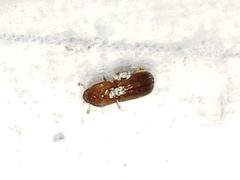
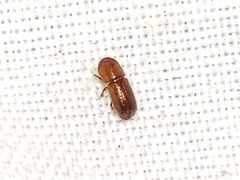
are yellowish to reddish-brown with an elongated, cylindrical body typical of Xyleborus. Females measure 2.0–2.7 mm, larger than the 1.7–2.0 mm males. Males are wingless with reduced and . The declivity ( slope of ) is diagnostic: dull and nontransparent, slanting downward, unlike the shiny smooth declivity of X. perforans and X. volvulus. in shape and pronotum size varies with developmental temperature.
Habitat
Dying or recently dead trees in early stages of decay; damp fallen logs on moist ground or partially immersed in water. Found in natural woodlands, tropical and subtropical forests, and rubber plantations. Selects large, moist wood pieces with sufficient moisture to support symbiotic fungal growth.
Distribution
Native to American tropics; now in tropical and subtropical regions worldwide. In the United States, occurs from Michigan south to Florida and west to Texas. Present throughout Central and South America, the Caribbean, Africa, Asia, Australia, Europe, and Pacific Islands including Hawaii. Spread facilitated by international timber trade.
Diet
Obligately fungivorous; cultivates and feeds exclusively on symbiotic ambrosia fungi (Raffaelea spp.) grown in galleries bored into wood. Larvae feed solely on fungal gardens.
Host Associations
- Raffaelea ambrosia fungi - mutualistic cultivar - sole food sourceinoculated into galleries by females
- Streptomyces griseus XylebKG-1 - defensive actinobacterial produces cycloheximide to inhibit fungal antagonists
- Nectria sp. - antagonist/ of fungal mutualisminhibited by actinobacterial
- Hevea brasiliensis - plantrubber tree; major pest in Hainan
- Bursera simaruba - plantstrongest antennal response to 48h-aged bark
- Mangifera indica - plantmango
- Persea schiedeana - plantchinini
- Saccharum officinarum - plantsugarcane; source of
- Cedrela odorata - plantSpanish cedar
- Theobroma cacao - plantcacao
- Persea americana - plantavocado
- other Lauraceae - plantcan Raffaelea lauricola causing laurel wilt
Life Cycle
Haplodiploid sex determination: females develop from fertilized () , males from unfertilized (haploid) eggs. Eggs are ivory-colored, ellipsoidal, 0.6–1.0 mm, laid in fungus-lined galleries. At 29°C, eggs laid 3–27 days after introduction; larvae hatch in 7–14 days (14–35 days at 22–24°C). Larvae are white, legless, slightly bent. takes 11–23 days at 29°C (21–35 days at 22–24°C). emerge 18–35 days post-pupation at 29°C (27–35 days at 22–24°C). Development time from egg to adult approximately 30 days at 26°C under laboratory conditions. Multiple may inhabit same log, with daughter females assisting in gallery expansion—atypical for ambrosia beetles.
Behavior
Strongest antennal olfactory response to ethanol among tested compounds, though less attracted than most Xyleborus . Responds to aged bark volatiles, particularly 48-hour-aged Bursera simaruba (3-carene and limonene predominant). Attracted to α-pinene, (+)-longifolene, tetradecane, 2-phenyl-2-propanol, and (S)-cis-verbenol. activity peaks 18:00–20:30. Females bore into wood, establish vertical galleries with horizontal side branches, inoculate tunnel walls with fungal spores carried in mycangium. Facultatively eusocial: offspring delay to assist mother with nest hygiene, care, and fungus —cooperative involving both adults and larvae that is unique among .
Ecological Role
Decomposer of dying and dead wood, accelerating decay of already deteriorating timber. Secondary pest of economically important plants including rubber, mango, cacao, and avocado. of pathogenic fungi: transmits Ceratocystis fimbriata (causal agent of mango wilt) and Raffaelea lauricola (causal agent of laurel wilt ) between plant . Defensive mutualism with actinobacteria protects fungal cultivar from antagonists, stabilizing nutritional .
Human Relevance
Significant pest of natural rubber industry in Hainan, China, and of other tropical crops. Misidentified as primary cause of tree death due to presence on moist timber, but primarily colonizes already declining trees. However, gallery systems can compromise structural integrity of cut timber more than other ambrosia beetles due to cooperative excavation by daughter females. concern due to ease of transport in wood products and international trade. Potential to expand laurel wilt range through fungal transmission.
Similar Taxa
- Xyleborus perforanssimilar size, coloration, and ; distinguished by shiny smooth declivity versus dull nontransparent declivity in X. affinis
- Xyleborus volvulusco-occurs in Florida, similar ; distinguished by shiny smooth declivity versus dull slanting declivity in X. affinis
- Xyleborus glabratusboth ambrosia beetles in Xyleborus, but X. glabratus has more pronounced taxonomic differences and is primary of laurel wilt rather than secondary vector
- Xyleborinus saxeseniisimilar fungus-farming and facultative eusociality, but different with distinct morphological features
Misconceptions
Mistakenly believed to cause tree death due to presence on moist timber; insufficient evidence supports this. Rather, it targets and accelerates decay of already deteriorated and weak trees.
Sources and further reading
- BugGuide
- Wikipedia
- GBIF taxonomy match
- iNaturalist taxon
- NCBI Taxonomy
- Catalogue of Life
- Meet 'Mantis Master Keeper' Andrew Pfeifer | Bug Squad
- Saving the Rusty-Patched Bumble Bee | Bug Squad
- Take 2 on tropical tiger moths: Spotted oleander caterpillar moth, Empyreuma affinis — Bug of the Week
- Mason bees in peril when parasitic wasps arrive – Leucospid wasp, Leucospis affinis — Bug of the Week
- A Tick that Feeds on Birds May Increase the Range of Lyme Disease
- Forest Pest Invasions Can—And Should—Be Studied Before They Happen
- Cycloheximide-Producing Streptomyces Associated With Xyleborinus saxesenii and Xyleborus affinis Fungus-Farming Ambrosia Beetles
- Electroantennographic Responses of Wild and Laboratory-Reared Females of Xyleborus affinis Eichhoff and Xyleborus ferrugineus (Fabricius) (Coleoptera: Curculionidae: Scolytinae) to Ethanol and Bark Volatiles of Three Host-Plant Species
- Ligand-binding properties of XaffOBP9, a Minus-C odorant-binding protein from Xyleborus affinis (Coleoptera: Curculionidae: Scolytinae)
- Cycloheximide-Producing Streptomyces Associated with Xyleborinus saxesenii and Xyleborus affinis Fungus-Farming Ambrosia Beetles