
Xyleborinus saxesenii
(Ratzeburg, 1837)
fruit-tree pinhole borer, Keyhole Ambrosia Beetle
Xyleborinus saxesenii is a small ambrosia beetle native to the Palaearctic region that has become one of the most widespread ambrosia beetles globally. It exhibits facultative eusociality with cooperative breeding, where daughters delay to assist with care, fungus farming, and nest maintenance. The cultivates Raffaelea sulphurea as its primary fungal mutualist, though it has been observed to feed on wood tissue as well, making it xylomycetophagous. It primarily colonizes dead or dying wood but has been documented attacking live trees, including economically important species such as chestnut and apple, causing concern in forestry and orchard management.
Pronunciation
How to pronounce Xyleborinus saxesenii: //zaɪlɛbəˈraɪnəs sækˈseɪsiˌnaɪ//
These audio files are automatically generated. While they are not always 100% accurate, they are a good starting point.
Identification
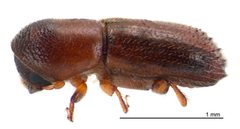
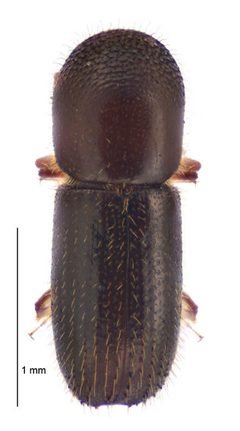
Distinguished from Xyleborus by the conical scutellum. Separated from other Xyleborinus species by the combination of smaller, less pointed elytral spines and a rounded . Males are wingless with reduced , while females possess functional wings. The species is frequently confused with other small ambrosia beetles in ethanol-baited trap catches, requiring microscopic examination for reliable identification.
Images
Appearance
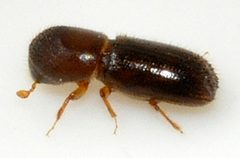
females are 2.0–2.4 mm in length with cylindrical, elongated, brown bodies. The scutellum is conical—a diagnostic feature of the Xyleborinus. X. saxesenii is distinguished from similar Xyleborinus by smaller, less pointed spines at the elytral apex and a rounded rather than tapered . Males are smaller, wingless, with reduced compared to females. are oval, shiny, white-yellow, 0.52–0.55 mm long. Larvae are legless, white to yellow with golden-white capsules. Pupae are white, up to 2 mm long, with in size.
Habitat
Primarily inhabits galleries in the heartwood or sapwood of dead or dying trees. Found in freshly dead wood, with optimal humidity conditions required for successful fungal . Laboratory rearing occurs on artificial agar-sawdust medium. Attacks live trees under stress, including chestnut and apple trees in commercial orchards.
Distribution
Native to the Palaearctic region; introduced to North America, South America (Uruguay), and globally distributed through commercial wood transfer. In the United States, established on both East and West coasts with separate introduction events, and present in Hawaii. One of the most common ambrosia beetles in North America despite its origin.
Seasonality
In Turkey (Samsun and Ordu provinces), emerge from late March through late September, with peak trapping in July and August. occurs at temperatures of 18–20°C. In North Carolina orchards, active in association with rapid apple decline surveys from 2017–2019.
Diet
Obligate mutualistic relationship with cultivated fungus Raffaelea sulphurea; feeds on ambrosial growth (aleurioconidia) of this fungus. Also consumes wood tissue, classifying the as xylomycetophagous. Larvae feed exclusively on the fungal garden within the gallery.
Host Associations
- Raffaelea sulphurea - mutualistic fungal cultivarPrimary nutritional ; beetles inoculate wood with this fungus and farm it as sole food source
- Raffaelea canadensis - mutualistic fungal cultivarSecondary nutritional mutualist present in some
- Streptomyces griseus XylebKG-1 - actinobacterial defensive Produces cycloheximide that inhibits fungal antagonist Nectria sp. but not the mutualistic cultivar
- Nectria sp. - fungal antagonist/Competes with cultivated fungi; suppressed by actinobacterial
- Aspergillus - pathogenic competitorCompetes with R. sulphurea; detected by females who increase hygienic
- Beauveria bassiana - fungus females attracted to it, possibly to contain spread; larvae avoid it
- Castanea (chestnut) - plantLive tree attacks documented in Tennessee
- Malus (apple) - plantAssociated with rapid apple decline in North Carolina orchards
- Prunus persica (peach) - plantAmbrosia beetle pest of fruit trees
- Persea americana (avocado) - plantPoses risk in southeastern U.S.
Life Cycle
Females bore into wood to establish galleries and inoculate tunnel walls with fungal mutualist. After 4–51 days, once the fungal garden is established, females lay 5–15 . Eggs develop in approximately five days, during which they are moved and groomed. Larvae pass through three instar stages: first instar ~4 days, second and third instars 4–17 days. follows, with in pupal size. Males eclose before first female . females may disperse immediately or delay dispersal to assist with care and fungus farming; some never disperse. Unfertilized females produce exclusively male broods and fail to establish new galleries.
Behavior
Exhibits cooperative breeding with age-based division of labor: larvae primarily enlarge galleries, females maintain fungal gardens, both groom offspring. Females delay sexual to increase natal gallery productivity, demonstrating alloparental care. Males are flightless, remain in natal galleries, and wander constantly seeking unfertilized females; they successfully mate only with females and do not contribute to nest maintenance. Females detect Aspergillus and increase hygienic such as social ; males do not alter behavior. Adult females are attracted to bassiana while larvae avoid it. Limited evidence for nestmate recognition despite diverse cuticular hydrocarbon profiles; foreign females from other or are not aggressively excluded, suggesting of non-kin.
Ecological Role
Decomposer of dead and dying wood through gallery construction and fungal . for mutualistic fungi and actinobacterial . Participant in defensive mutualism that protects fungal agriculture. Contributes to wood decomposition and nutrient cycling in forest . As , may alter fungal dynamics in colonized wood.
Human Relevance
Economic pest of fruit trees and timber; attacks live chestnut, apple, peach, and avocado trees. Difficult to control with . Associated with rapid apple decline in North Carolina, though not identified as primary cause. Detected via ethanol-baited traps for monitoring. measures include removal and burning of infected branches with wound sealing. Citizen science monitoring programs (e.g., Backyard Bark Beetles) use simple soda bottle traps to track distribution. May provide incidental benefit by killing live insects in timber prior to export.
Similar Taxa
- Xylosandrus crassiusculus (granulate ambrosia beetle)Similar size and ; distinguished by morphological features and trap capture patterns. Both attack fruit trees and are captured in ethanol-baited traps, but X. crassiusculus is native to Asia rather than Palaearctic region.
- Xylosandrus germanus (black stem borer)Overlapping distribution and range in North American orchards. X. germanus dominates in New York and New England apple orchards while X. saxesenii is more common in North Carolina; morphological differences in scutellum and body shape allow separation.
- Other Xyleborinus speciesConical scutellum shared within ; X. saxesenii separated by elytral spine size and abdominal shape. Requires microscopic examination for reliable identification.
- Xyleborus speciesSimilar ambrosia beetle and appearance; distinguished by scutellum shape—conical in Xyleborinus versus different in Xyleborus.
More Details
Genetic system and sex ratio
Haplodiploid with arrhenotokous ; males develop from unfertilized (haploid) , females from fertilized () eggs. Sex ratio strongly female-biased (1:5 to 1:30 typical for tribe), with optimal containing 1–2 males. Approximately one-third of mothers produce no male offspring. Inbreeding via brother-sister mating occurs within galleries.
Microbial community succession
Fungal in galleries transition from nutritional mutualists to non-beneficial secondary fungi during development. Raffaelea sulphurea dominates young nests and declines over time, while R. canadensis remains more stable. Rapid correlates with slower offspring development, suggesting costs of secondary . Laboratory nests show extreme reduction in microbial diversity compared to field nests.
Selection experiments
Artificial selection for early over five showed limited response, with initial changes in traits recovering to baseline levels. This suggests low genetic variability due to sibmating habits or high phenotypic plasticity in social . Correlation between nest lifespan and productivity may explain philopatry and cooperative behavior.
Nestmate recognition
Highly diverse individual cuticular hydrocarbon profiles exist within nests, comparable to other social insects. However, behavioral exclusion of foreign females is absent or extremely subtle, even when introduced from different or . This of non-kin may be adaptive for inbreeding species to increase genetic diversity within nests.
Sources and further reading
- BugGuide
- Wikipedia
- GBIF taxonomy match
- iNaturalist taxon
- NCBI Taxonomy
- What Role, If Any, Do Ambrosia Beetles Play in Rapid Apple Decline?
- Study Confirms Effectiveness of Cheap, Simple Traps for Citizen Science Project
- Xyleborinus saxesenii Archives - Entomology Today
- Xyleborinus_saxesenii - Entomology Today
- Observations on sex ratio and behavior of males in Xyleborinus saxesenii Ratzeburg (Scolytinae, Coleoptera)
- Highly diverse cuticular hydrocarbon profiles but no evidence for social closure in the ambrosia beetle Xyleborinus saxesenii
- Cycloheximide-Producing Streptomyces Associated With Xyleborinus saxesenii and Xyleborus affinis Fungus-Farming Ambrosia Beetles
- Highly Diverse Cuticular Hydrocarbon Profiles but No Evidence for Aggression Towards Non-kin in the Ambrosia Beetle Xyleborinus Saxesenii
- Highl diverse cuticular hydrocarbon profiles but no evidence for aggression towards non-kin in the ambrosia beetle Xyleborinus saxesenii
- Effects of selection for early dispersal on the ambrosia beetle Xyleborinus saxesenii and its fungal symbionts
- Figure 1 from: Biedermann P (2010) Observations on sex ratio and behavior of males in Xyleborinus saxesenii Ratzeburg (Scolytinae, Coleoptera). ZooKeys 56: 253-267. https://doi.org/10.3897/zookeys.56.530
- Figure 2 from: Biedermann P (2010) Observations on sex ratio and behavior of males in Xyleborinus saxesenii Ratzeburg (Scolytinae, Coleoptera). ZooKeys 56: 253-267. https://doi.org/10.3897/zookeys.56.530
- Figure 4 from: Biedermann P (2010) Observations on sex ratio and behavior of males in Xyleborinus saxesenii Ratzeburg (Scolytinae, Coleoptera). ZooKeys 56: 253-267. https://doi.org/10.3897/zookeys.56.530
- Figure 3 from: Biedermann P (2010) Observations on sex ratio and behavior of males in Xyleborinus saxesenii Ratzeburg (Scolytinae, Coleoptera). ZooKeys 56: 253-267. https://doi.org/10.3897/zookeys.56.530
- Figure 6 from: Biedermann P (2010) Observations on sex ratio and behavior of males in Xyleborinus saxesenii Ratzeburg (Scolytinae, Coleoptera). ZooKeys 56: 253-267. https://doi.org/10.3897/zookeys.56.530
- Comparing the succession of microbial communities throughout development in field and laboratory nests of the ambrosia beetle Xyleborinus saxesenii
- Cycloheximide-Producing Streptomyces Associated with Xyleborinus saxesenii and Xyleborus affinis Fungus-Farming Ambrosia Beetles
- Highly diverse cuticular hydrocarbon profiles but no evidence for aggression towards non‐kin in the ambrosia beetle Xyleborinus saxesenii
- Artificial Selection of Early Emerging Helpers in the Cooperatively Breeding Ambrosia Beetle Xyleborinus saxesenii and Its Effects on Various Life History Traits and Their Fungal Symbionts