
Xyleborinus
Reitter, 1913
Species Guides
6Xyleborinus is a of ambrosia beetles in the Scolytinae, comprising over 80 described . These beetles are fungus-farmers that excavate galleries in wood and cultivate symbiotic fungi as their primary food source. The genus includes economically significant species such as Xyleborinus saxesenii, which has been associated with rapid apple decline in North American orchards. Xyleborinus exhibits extraordinary morphological diversity, particularly in Madagascar where a recent radiation produced at least 32 species following a single event 8.5–11.0 million years ago.
Pronunciation
How to pronounce Xyleborinus: /ksɪˌlɛbɔˈraɪnəs/
These audio files are automatically generated. While they are not always 100% accurate, they are a good starting point.
Identification
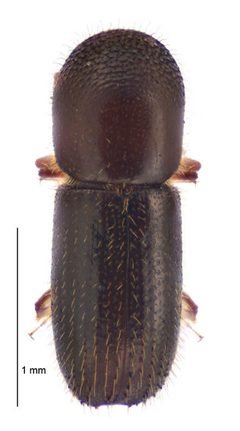
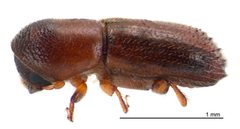
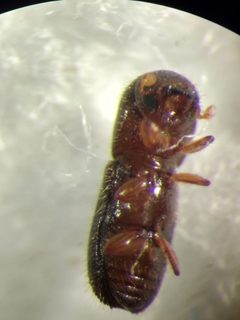
Xyleborinus are distinguished from other ambrosia beetles by morphological characters of the pronotum, , and declivity. In the Afrotropical region, species identification relies on COI divergence thresholds, with morphological differences associated with >7% divergence indicating distinct species. The exhibits extraordinary morphological variation in Madagascar, with features such as tuberculate, spinate, or concave declivities, and modified elytral margins. Identification keys for regional faunas exist but require knowledge of Scolytinae .
Images
Habitat
in this construct tunnel systems (galleries) in the heartwood or sapwood of trees, typically under bark of dead or dying trees. Some species infest living trees, particularly when trees are stressed. Gallery systems are excavated in xylem tissue where fungal gardens are established. Laboratory studies have successfully reared species on artificial agar-sawdust media.
Distribution
Xyleborinus has a global distribution with highest diversity in tropical regions. The Afrotropical fauna includes 47 valid , with 32 to Madagascar resulting from a recent radiation. The is present in North America, Europe, and Asia. Xyleborinus saxesenii, native to the Palearctic, is now the most common ambrosia beetle in North America. Xyleborinus attenuatus, native to East Asia, is in Europe including the Czech Republic.
Seasonality
activity varies by and region. Xyleborinus attenuatus in Central Europe exhibits flight activity from mid-March to May, with F1 emerging in August and September and in wood or soil under infested trees. Xyleborinus saxesenii has been trapped year-round in southeastern U.S. citizen science surveys, with seasonal peaks likely corresponding to temperature and stress events.
Diet
All are obligate fungal-feeders (xylomycetophagous). and larvae feed on cultivated ambrosia fungi grown on gallery walls. Primary fungal mutualists include species of Ambrosiella and Raffaelea. Xyleborinus saxesenii primarily cultivates Raffaelea sulphurea (also reported as Ambrosiella sulfurea). Larvae consume both fungus and wood tissue; adults feed by cropping the fungal layer covering gallery walls.
Host Associations
- Raffaelea sulphurea - primary fungal mutualistCultivated as food source; also reported as Ambrosiella sulfurea
- Raffaelea canadensis - nutritional mutualistMaintained at stable abundance throughout nest development
- Ambrosiella spp. - fungal mutualistCultivated by multiple Xyleborinus
- Nectria sp. - antagonistParasitic fungus inhibited by Streptomyces actinobacterial
- Streptomyces griseus - defensive mutualistProduces cycloheximide that inhibits fungal antagonists but not mutualists
- deciduous trees - X. attenuatus predominantly occupies soft deciduous trees
- apple trees - X. saxesenii associated with rapid apple decline in North Carolina orchards
- avocado trees - X. saxesenii poses risk to avocado in southeastern U.S.
Life Cycle
Females excavate tunnels and initiate fungal gardens. are laid in a single large chamber. Larvae develop through feeding on fungus and wood, then pupate within the gallery. Males typically eclose before females, are flightless, and remain in natal galleries. Females mature, may remain in natal galleries for extended periods (subsocial ), then disperse to found new galleries. Multiple overlapping occur within established nests. Xyleborinus attenuatus has one generation per year in Central Europe.
Behavior
exhibit haplodiploid with strongly female-biased sex ratios due to inbreeding and local mate competition. Females produce 0–3 sons per . Males are flightless, wander constantly through galleries seeking unfertilized females, and mate only with females. Nearly all dispersing females are fertilized. Subsocial occurs: daughters may remain in natal galleries beyond maturity, potentially assisting in rearing additional brood. Nestmate recognition appears weak or absent; foreign females are not aggressively excluded from nests.
Ecological Role
As fungal-farmers, Xyleborinus contribute to wood decomposition and nutrient cycling in forest . They act as for their symbiotic fungi, transporting spores between trees. Some species function as secondary pests, attacking stressed or dying trees. may alter forest composition. The association with defensive actinobacteria that produce antimicrobial compounds represents a complex multipartite mutualism.
Human Relevance
Several are economically significant pests. Xyleborinus saxesenii is associated with rapid apple decline in North American orchards and poses risks to avocado production. The species is the most common ambrosia beetle in North America despite being non-native. Xyleborinus attenuatus is in Europe and requires monitoring as a potential of plant pathogenic fungi. Citizen science projects have utilized simple ethanol-baited traps to monitor distribution of invasive Xyleborinus species.
Similar Taxa
- XylosandrusBoth are ambrosia beetle in tribe Xyleborini with similar gallery construction and fungal . Xylosandrus such as X. germanus and X. crassiusculus are often recovered alongside Xyleborinus saxesenii in orchard surveys; distinguished by pronotal and declivital .
- XyleborusClosely related in tribe Xyleborini with similar . Some Xyleborinus were historically classified in Xyleborus; distinguished by subtle morphological characters of the elytral declivity and .
More Details
Madagascar Radiation
Xyleborinus exhibits an extraordinary recent adaptive radiation in Madagascar, with at least 32 arising from a single event no earlier than 8.5–11.0 million years ago. This represents one of the most rapid diversification events documented in ambrosia beetles.
Species Concepts
Taxonomic revision of Afrotropical Xyleborinus established that COI divergence >7% correlates with morphological boundaries, providing a molecular benchmark for species identification in this morphologically variable .
Chemical Ecology
Xyleborinus saxesenii exhibits highly diverse cuticular hydrocarbon profiles comparable to eusocial insects, yet lacks evidence for nestmate recognition or aggression toward non-kin. This suggests cuticular hydrocarbons serve communication functions other than nestmate discrimination, or that acceptance of non-nestmates provides genetic diversity benefits in inbreeding systems.
Sources and further reading
- BugGuide
- Wikipedia
- GBIF taxonomy match
- iNaturalist taxon
- NCBI Taxonomy
- Catalogue of Life
- Xyleborinus_saxesenii - Entomology Today
- Xyleborinus saxesenii Archives - Entomology Today
- What Role, If Any, Do Ambrosia Beetles Play in Rapid Apple Decline?
- Study Confirms Effectiveness of Cheap, Simple Traps for Citizen Science Project
- Observations on sex ratio and behavior of males in Xyleborinus saxesenii Ratzeburg (Scolytinae, Coleoptera)
- Highly diverse cuticular hydrocarbon profiles but no evidence for social closure in the ambrosia beetle Xyleborinus saxesenii
- Figure 2 from: Biedermann P (2010) Observations on sex ratio and behavior of males in Xyleborinus saxesenii Ratzeburg (Scolytinae, Coleoptera). ZooKeys 56: 253-267. https://doi.org/10.3897/zookeys.56.530
- Figure 1 from: Biedermann P (2010) Observations on sex ratio and behavior of males in Xyleborinus saxesenii Ratzeburg (Scolytinae, Coleoptera). ZooKeys 56: 253-267. https://doi.org/10.3897/zookeys.56.530
- Figure 4 from: Biedermann P (2010) Observations on sex ratio and behavior of males in Xyleborinus saxesenii Ratzeburg (Scolytinae, Coleoptera). ZooKeys 56: 253-267. https://doi.org/10.3897/zookeys.56.530
- Effects of selection for early dispersal on the ambrosia beetle Xyleborinus saxesenii and its fungal symbionts
- Highly Diverse Cuticular Hydrocarbon Profiles but No Evidence for Aggression Towards Non-kin in the Ambrosia Beetle Xyleborinus Saxesenii
- Highl diverse cuticular hydrocarbon profiles but no evidence for aggression towards non-kin in the ambrosia beetle Xyleborinus saxesenii
- Figure 3 from: Biedermann P (2010) Observations on sex ratio and behavior of males in Xyleborinus saxesenii Ratzeburg (Scolytinae, Coleoptera). ZooKeys 56: 253-267. https://doi.org/10.3897/zookeys.56.530
- Distribution of the invasive ambrosia beetle Xyleborinus attenuatus Blandford, 1894 (Coleoptera: Curculionidae: Scolytinae) in the Czech Republic (Central Europe)
- Integrated Taxonomic Revision of AfrotropicalXyleborinus(Curculionidae: Scolytinae) Reveals High Diversity After Recent Colonization of Madagascar
- Figure 6 from: Biedermann P (2010) Observations on sex ratio and behavior of males in Xyleborinus saxesenii Ratzeburg (Scolytinae, Coleoptera). ZooKeys 56: 253-267. https://doi.org/10.3897/zookeys.56.530
- Comparing the succession of microbial communities throughout development in field and laboratory nests of the ambrosia beetle Xyleborinus saxesenii
- Cycloheximide-Producing Streptomyces Associated with Xyleborinus saxesenii and Xyleborus affinis Fungus-Farming Ambrosia Beetles
- Cycloheximide-Producing Streptomyces Associated With Xyleborinus saxesenii and Xyleborus affinis Fungus-Farming Ambrosia Beetles