
Xyleborinus attenuatus
Wood & Bright, 1992
Xyleborinus attenuatus is an ambrosia beetle native to East Asia that has established throughout Europe and North America. As a member of the Scolytinae, it cultivates symbiotic ambrosia fungi within galleries excavated in wood, feeding on the fungal growth rather than the wood itself. In Central Europe, it completes one annually with activity occurring from mid-March to May and F1 emerging in August and September. It predominantly colonizes soft deciduous trees and has not been reported to cause significant economic damage, though it multiple ambrosia fungi .
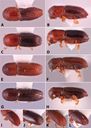
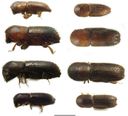
Pronunciation
How to pronounce Xyleborinus attenuatus: //zaɪˌlɛbɔːˈraɪnəs əˌtɛnjʊˈeɪtəs//
These audio files are automatically generated. While they are not always 100% accurate, they are a good starting point.
Identification
Xyleborinus attenuatus can be distinguished from other Xyleborinus by its attenuated (slender, tapering) body form, as suggested by the specific epithet. It belongs to a characterized by small size typical of ambrosia beetles. Accurate identification to species level requires examination of morphological details including elytral declivity structure and other microscopic features; dissection and comparison with or expert identification is recommended.
Images
Habitat
Predominantly occupies soft deciduous trees. overwinter in wood or in the ground beneath infested trees. Found from lowland to montane elevations throughout its invaded range in Central Europe.
Distribution
Native to East Asia. in Europe, where it is widespread throughout the Czech Republic from lowlands to mountains. Also present in North America and Southern Asia. Records from Austria; Belgium record marked as doubtful.
Seasonality
In Central Europe, activity occurs from mid-March to May. F1 emerge in August and September. occurs as adults in wood or ground beneath infested trees.
Diet
Cultivates and feeds on ambrosia fungi, specifically Ambrosiella spp. and Raffaelea spp., which are introduced into gallery chambers excavated in wood.
Host Associations
- soft deciduous trees - breeding substratePrimary type for gallery construction and fungal
Life Cycle
One per year in Central Europe. fly and establish new galleries in mid-March to May. Larval development proceeds through summer with F1 adults emerging August-September. Adults overwinter before reproducing the following spring.
Behavior
Excavates gallery chambers in xylem tissue of trees. Introduces and cultivates symbiotic ambrosia fungi on gallery walls. and larvae feed on fungal growth. Females are the primary colonizers; males are flightless and remain within galleries.
Ecological Role
of ambrosia fungi including Ambrosiella spp. and Raffaelea spp. Functions as a primary decomposer of dead and dying wood in native range; in invaded ranges, may colonize stressed living trees. No significant economic damage reported to date, but monitoring recommended due to fungal vector capacity.
Human Relevance
Subject of citizen science monitoring efforts for bark and ambrosia beetles. Simple trapping protocols using ethanol-baited soda bottles have been validated for detection. Not currently considered a major economic pest, though its fungal associations warrant continued surveillance in orchard and forest settings.
Similar Taxa
- Xyleborinus saxeseniiSimilar , also in North America and Europe, distinguished by morphological details of elytral declivity and size
- Xylosandrus germanusAnother ambrosia beetle in same , distinguished by different gallery architecture and fungal associations
More Details
Taxonomic authorship note
The was originally described by Blandford in 1894 as Xyleborus attenuatus; Wood & Bright (1992) transferred it to the Xyleborinus, hence the current authorship.
Sources and further reading
- BugGuide
- GBIF taxonomy match
- iNaturalist taxon
- NCBI Taxonomy
- Catalogue of Life
- Xyleborinus_saxesenii - Entomology Today
- Xyleborinus saxesenii Archives - Entomology Today
- What Role, If Any, Do Ambrosia Beetles Play in Rapid Apple Decline?
- Study Confirms Effectiveness of Cheap, Simple Traps for Citizen Science Project
- Curculionidae | Beetles In The Bush | Page 2
- Distribution of the invasive ambrosia beetle Xyleborinus attenuatus Blandford, 1894 (Coleoptera: Curculionidae: Scolytinae) in the Czech Republic (Central Europe)