
Xylosandrus germanus
Hoffmann, C.H., 1941
black stem borer, alnus ambrosia beetle, black timber bark beetle
Xylosandrus germanus is a tiny ambrosia beetle native to eastern Asia that has become a significant pest in Europe and North America. Females, which are -capable and substantially larger than the flightless males, excavate galleries in stressed or recently dead woody plants to cultivate fungal gardens. The exhibits a quasisocial structure with foundress females performing distinct behavioral roles that shift from gallery construction and care to entrance-blocking as the colony matures. Its rapid spread—tens of kilometers per year in some regions—is facilitated by climate change, global timber trade, and an unusual where single foundresses can establish through sib-mating.
Pronunciation
How to pronounce Xylosandrus germanus: //ˌzaɪloʊˈsændrəs dʒɜːrˈmeɪnəs//
These audio files are automatically generated. While they are not always 100% accurate, they are a good starting point.
Identification
Females can be distinguished from similar Xylosandrus by their small size and association with Ambrosiella grosmanniae fungal gardens. Males are rarely encountered and are flightless, smaller, and broader relative to length than females. The species is separated from Xylosandrus crassiusculus (granulate ambrosia beetle) by geographic patterns in some regions—X. germanus dominates in northeastern North American orchards while X. crassiusculus predominates in southeastern regions. Entrance holes produce distinctive compressed sawdust columns resembling toothpicks projecting from trunks.
Images
Appearance
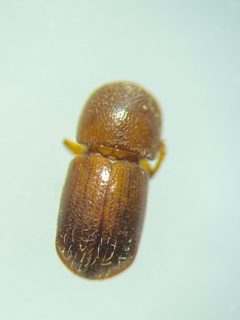
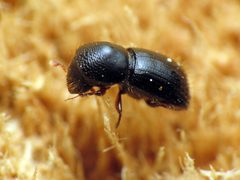
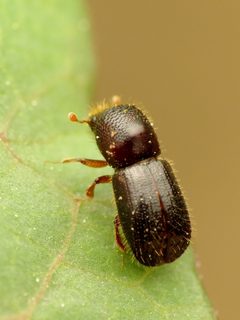
females measure up to 2 mm in length with a body approximately 2.3 times as long as wide. Males are substantially smaller, ranging 1.3–1.8 mm, with a body twice as wide as long, and lack the mycetangia present in females. are white, translucent, shiny, ellipsoidal, approximately 0.67 mm long and 0.38 mm wide. The exhibits pronounced .
Habitat
Temperate forest , including oak, beech, and spruce forests. In invaded regions, occupies ornamental plantings, orchards (apple, pecan), and recently felled timber. Attacks both living but stressed trees and dead or dying woody material. Shows vertical expansion into higher altitudes in Europe, likely climate-mediated. Unlike most Xyleborini, occurs outside tropical zones.
Distribution
Native to eastern Asia (Japan, Korea, China, Taiwan, Vietnam). Introduced to Europe (first recorded Germany 1951/1952, now present in at least 21 countries including Austria, Belgium, France, Italy, Poland, Switzerland, Czech Republic, Slovakia, Slovenia, UK, Ukraine, and others). Established in North America since 1932, now present across eastern US, Pacific Northwest, and Canada (British Columbia to Quebec). Also recorded in New Zealand.
Seasonality
in spring coincides with approximately 75 growing degree days (base 50°F). In North America, emergence typically occurs within 6 days of full bloom on Cornelian cherry dogwood, within 4 days of first bloom on Norway maple, and at full bloom on border forsythia. Two to three per year in the United States; one to two generations in Europe and Japan. overwinter in galleries at tree bases.
Diet
Obligate mutualist with Ambrosiella grosmanniae, which females cultivate in galleries as sole food source for themselves and offspring. Does not consume wood directly; instead feeds on fungal mycelia.
Host Associations
- Ambrosiella grosmanniae - obligate mutualistprimary nutritional ; females carry fungus in mycetangia and establish gardens in new galleries; -laying only proceeds after fungal establishment
- Beauveria bassiana - fungus most frequently isolated from dead beetles in Slovakia
- Ophiostoma quercus - associatemost frequently isolated fungus from living beetles in Slovakia
Life Cycle
Females excavate galleries consisting of entrance tunnels, chambers, and branch tunnels, typically at tree bases. Each female lays 2–54 in the United States (12–20 progeny in Germany). Larvae pass through three instars. Complete development from egg to takes approximately 30 days. follows : males develop from unfertilized eggs, females or males from fertilized eggs, with female-biased sex ratios influenced by . Mating occurs between siblings within maternal galleries before female . Two to three per year in North America; one to two in Europe and Japan. Adults overwinter in galleries.
Behavior
Foundress females exhibit age-related behavioral transitions: initially construct galleries and tend fungal gardens and , later shift primarily to blocking gallery entrances to protect brood from enemies and prevent premature larval exit. Larvae engage in hygienic including removal, of dead nestmates, and siblings. female offspring enter dormancy; adult male offspring actively seek mates with sisters before dispersing. No clear division of labor among offspring. Colony structure is quasisocial (no generational overlap).
Ecological Role
Ambrosia beetle that accelerates decomposition of dead and stressed woody material through fungal . In native range, likely functions as secondary decomposer. In invaded regions, has become ambrosia beetle in many forest types, potentially displacing native scolytid . Attacks on recently felled high-value timber cause economic losses in forestry.
Human Relevance
Major economic pest of woody ornamentals and orchard crops (apple, pecan). In North American nurseries, recognized as one of the most economically significant pests. In Europe, generally viewed as secondary pest but increasingly damaging to logging industry through of stored round timber. Implicated in association with rapid apple decline, though research indicates it is not the sole causal factor. Suspected for plant including Fusarium . Spread facilitated by human transport of infested wood; management complicated by ineffectiveness of trunk-applied . Ethanol-baited traps used for monitoring.
Similar Taxa
- Xylosandrus crassiusculussimilar size and ; granulate ambrosia beetle predominates in southeastern North America while X. germanus dominates in northeastern regions; both associated with rapid apple decline
- Xyleborinus saxeseniico-occurs in North American apple orchards; both attracted to ethanol; distinguished by different geographic patterns
More Details
Fungal symbiont specificity
Research indicates X. germanus females can distinguish volatiles of different fungal associates and show strong preference for substrates pre-inoculated with A. grosmanniae. This specificity may underlie its success as an .
Climate change association
Vertical expansion to higher altitudes in Europe and rapid post-2000 spread across the continent have been linked to warming temperatures. Cold winter temperatures appear to have minimal impact on persistence.
Management challenges
Trichoderma fungi show promise as agents by suppressing A. grosmanniae growth, which halts X. germanus production. Verbenone shows limited repellent effect.
Sources and further reading
- BugGuide
- Wikipedia
- GBIF taxonomy match
- iNaturalist taxon
- NCBI Taxonomy
- Catalogue of Life
- Xylosandrus germanus - Entomology Today
- What Role, If Any, Do Ambrosia Beetles Play in Rapid Apple Decline?
- Xylosandrus crassiusculus Archives - Entomology Today
- The Best Look Yet at the Tiny Fungus Storage Units Inside Ambrosia Beetles
- 3-D reconstruction of ambrosia beetle via micro-CT scanning - Entomology Today
- Xylosandrus germanus . [Distribution map].
- Fungi associated with ambrosia beetle Xylosandrus germanus in Slovakia
- Life History of the Ambrosia Beetle Xylosandrus germanus (Coleoptera: Scolytidae)1
- Beitrag zum eingeschleppten Schwarzen Nutzholzborkenkäfer Xylosandrus germanus. Biologie und Schadenpotential an im Wald gelagertem Rundholz im Vergleich zu Xyloterus lineatus und Hylecoetus dermestoides | The Imported Japanese Scolytid beetle Xylosandrus germanus: Biology and Damage Potential for Stored Round Timber Compared to Xyloterus lineatus and Hylecoetus dermestoides
- Comparative Morphology and Distribution of Antennal Sensilla onXylosandrus germanusandXylosandrus crassiusculus(Coleoptera: Curculionidae: Scolytinae)
- RELATION BETWEEN ATTACK BY XYLOSANDRUS GERMANUS (COLEOPTERA: SCOLYTIDAE) AND DISEASE SYMPTOMS IN BLACK WALNUT
- NEW HOSTS, DISTRIBUTION, AND BIOLOGICAL NOTES ON AN IMPORTED AMBROSIA BEETLE, XYLOSANDRUS GERMANUS (COLEOPTERA: SCOLYTIDAE)
- The Distribution of <i>Xylosandrus Germanus</i> in America North of Mexico (Coleoptera: Scolytidae)
- In-gallery social behaviors of the ambrosia beetle, Xylosandrus germanus (Coleoptera: Curculionidae)
- Distribution and abundance of the alien Xylosandrus germanus and other ambrosia beetles (Coleoptera: Curculionidae, Scolytinae) in different forest stands in central Slovenia
- Distribution, Habitat Preference, and Management of the Invasive Ambrosia Beetle Xylosandrus germanus (Coleoptera: Curculionidae, Scolytinae) in European Forests with Emphasis on the West Carpathians
- Volatiles of fungal cultivars act as cues for host-selection in the fungus-farming ambrosia beetle Xylosandrus germanus
- Abundance and distribution of Xylosandrus germanus (Blandford 1894) (Coleoptera, Scolytidae) in Belgium: new observations and an attempt to outline its range