
Xylosandrus crassiusculus
Wood, 1982
Granulate Ambrosia Beetle, Asian Ambrosia Beetle
Xylosandrus crassiusculus is a small ambrosia beetle native to tropical and subtropical Asia that has become one of the most successful wood-boring beetles globally. are reddish-brown, 2–3 mm long, and exhibit a specialized fungus-farming mutualism. Females excavate galleries in wood, introduce the symbiotic fungus Ambrosiella roeperi, and cultivate it as the sole food source for themselves and their offspring. The is on broadleaf trees and shrubs, infesting stressed nursery stock, young trees, and stacked timber, causing economic damage in forestry and agriculture.
Pronunciation
How to pronounce Xylosandrus crassiusculus: //ˌksaɪloʊˈsændrəs ˌkræsiˈʌskjələs//
These audio files are automatically generated. While they are not always 100% accurate, they are a good starting point.
Identification
Distinguished from other Xylosandrus by antennal and distribution: sensilla chaetica, basiconica, coeloconica, ampullacea, styloconica, and Bohm sensilla occur in species-specific patterns detectable via scanning electron microscopy. From Xylosandrus germanus (black stem borer), it differs in abundance and arrangement of these sensilla. Molecular identification via COI or 28S rDNA sequencing confirms species identity. In field settings, it may be distinguished from X. germanus by geographic context and associations, though overlap exists.
Images
Appearance
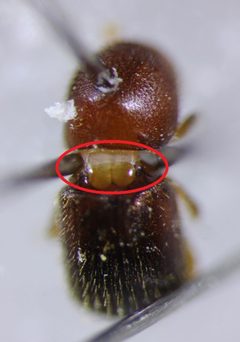
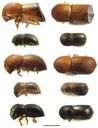
are reddish-brown bark beetles measuring 2–3 mm in length. Males are flightless and smaller than females. Females possess functional wings enabling . The body form is compact and typical of scolytine beetles adapted for tunneling in wood.
Habitat
Inhabits broadleaf woody plants across tropical, subtropical, and temperate regions. Colonizes branches as small as 1.5 cm diameter and trunks 2.5–6 cm diameter. Found in natural forests, plantations, nurseries, orchards, and in stored timber. Prefers stressed or young trees but will attack apparently healthy young trees. Does not infest conifers.
Distribution
Native to tropical and subtropical eastern Asia (China, Japan, Korea, Taiwan, Southeast Asia, India, Sri Lanka). Introduced and established in Africa (Cameroon, Congo, Côte d'Ivoire, Equatorial Guinea, Ghana, Kenya, Madagascar, Mauritania, Mauritius, Nigeria, Seychelles, Sierra Leone, Tanzania), Europe (Italy, Slovenia, and expanding), North America (southeastern USA first reported 1974, now widespread from Maryland to Texas and west to Oregon and Washington), Central America ( Rica, Guatemala, Panama), South America (Argentina, Brazil, French Guiana, Uruguay), and Oceania (Australia, New Zealand, New Caledonia, Palau, Papua New Guinea, Samoa, Guam).
Diet
Exclusively mycophagous. Both and larvae feed entirely on the symbiotic fungus Ambrosiella roeperi, which females cultivate within wood galleries. The has been observed to be attracted to the odor of this fungus, which may concentrate attacks on specific trees.
Host Associations
- Areca catechu - Arecanut kernel decay in Karnataka, India; first documented case of spermatophagy in this
- Theobroma cacao - Cocoa pod in Karnataka, India; associated with mirid bug Helopeltis theivora in selection
- Persea americana - Avocado in South Africa (Limpopo Province)
- Malus domestica - Apple trees; associated with rapid apple decline in North Carolina but not primary causal agent
- Prunus persica - Peach trees; first recorded in South Carolina 1985
- Quercus calliprinos - Palestine oak in Israel
- Ceratonia siliqua - Carob in Europe
- Quercus spp. - Oak in United States
- Prunus spp. - Cherry, plum in United States
- Lagerstroemia indica - Crape myrtle in United States
- Carya illinoinensis - Pecan in United States
- Diospyros virginiana - Persimmon in United States
- Ulmus spp. - Elm in United States
- Liquidambar styraciflua - Sweet gum in United States
- Magnolia spp. - Magnolia in United States
- Ficus carica - Fig in United States
- Aesculus spp. - Buckeye in United States
- Ipomoea batatas - Sweet potato in United States
- Areca spp. - Areca palm in India
- Cocos nucifera - Coconut in India
- Hevea brasiliensis - Rubber in India
- Nephelium lappaceum - Rambutan in India
- Theobroma cacao - Cocoa in India
- Artocarpus heterophyllus - Jackfruit in India
- Tectona grandis - Teak in India
Life Cycle
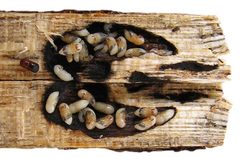
Females mate with siblings within natal galleries before . Winged females disperse to new material, excavate entrance tunnels, and construct galleries in wood. are laid within galleries; larvae develop through feeding on cultivated fungal gardens, enlarging the galleries as they grow. occurs within the gallery system. The female remains with her , in the gallery. Developmental stages (egg, larva, pupa) have been documented within infested arecanut kernels.
Behavior
Females engage in sibling mating prior to . Dispersal is female-mediated; males are flightless and do not leave natal galleries. Females locate material and excavate tunnels using . They transport fungal in specialized mycangia (internal fungus-storing organs) and establish new fungal gardens in galleries. The is attracted to ethanol, a volatile cue released by stressed or damaged trees, which facilitates host location. In cocoa plantations, a complex interaction occurs where mirid bug (Helopeltis theivora) damage may predispose pods to beetle .
Ecological Role
As a fungus-farming ambrosia beetle, it functions as a primary decomposer of dead and stressed wood, accelerating wood degradation through gallery excavation and fungal . The mutualism with Ambrosiella roeperi represents a specialized nutritional . As an , it acts as a pest of economic trees in forestry and agriculture, particularly affecting young trees, nursery stock, and plantation crops. Its association with other organisms (mirid bugs, additional fungi including yeasts such as Ambrosiozyma monospora) creates multi- that can amplify damage to plants.
Human Relevance
Significant economic pest in forestry, agriculture, and horticulture. Causes damage to nursery stock, young trees in orchards, and plantation crops including arecanut, cocoa, avocado, peach, apple, and rubber. Infests stacked timber, reducing wood quality and value. Associated with rapid apple decline in North American orchards, though not established as primary causal agent. Management challenges arise from its cryptic lifestyle within wood, polyphagy, and spread. Detection relies on ethanol-baited trapping and inspection of gallery systems in symptomatic trees.
Similar Taxa
- Xylosandrus germanusSimilar size, , and ; distinguished by antennal and distribution patterns, and by molecular markers. X. germanus has been in some apple orchard surveys where X. crassiusculus was secondary.
- Xyleborinus saxeseniiCo-occurs in apple orchards and other ; distinguished by morphological features and molecular identification. Made up 31% of ambrosia beetles in North Carolina apple decline study versus 26% for X. crassiusculus.
More Details
Fungal Symbionts
Primary mutualistic fungus is Ambrosiella roeperi. A yeast , Ambrosiozyma monospora, has been newly documented from cocoa pod in India, representing an expanded understanding of the 's microbial associations.
Spermatophagy
First documented case of spermatophagy (consumption of ) in this was recorded during arecanut kernel studies in Karnataka, India.
Imaging Methods
Mycangia of Xylosandrus have been studied using micro-CT scanning, laser ablation tomography, and microtome sectioning, with micro-CT providing intact 3D reconstruction of these minute structures.
Sources and further reading
- BugGuide
- Wikipedia
- GBIF taxonomy match
- iNaturalist taxon
- NCBI Taxonomy
- Catalogue of Life
- What Role, If Any, Do Ambrosia Beetles Play in Rapid Apple Decline?
- Xylosandrus crassiusculus Archives - Entomology Today
- Xylosandrus germanus - Entomology Today
- The Best Look Yet at the Tiny Fungus Storage Units Inside Ambrosia Beetles
- 3-D reconstruction of ambrosia beetle via micro-CT scanning - Entomology Today
- Xylosandrus crassiusculus . [Distribution map].
- Xylosandrus crassiusculus . [Distribution map].
- Comparative Morphology and Distribution of Antennal Sensilla onXylosandrus germanusandXylosandrus crassiusculus(Coleoptera: Curculionidae: Scolytinae)
- New Host Record for the Asian Ambrosia Beetle, Xylosandrus crassiusculus (Motschulsky) (Coleoptera: Curculionidae)
- Chemical ecology, fungal interactions and forest stand correlations of the exotic Asian ambrosia beetle, Xylosandrus crassiusculus (Motschulsky) (Curculionidae)
- First record of the Asian ambrosia beetle, Xylosandrus crassiusculus (Motschulsky) (Coleoptera: Curculionidae, Scolytinae), in Slovenia
- Molecular characters of a bark beetle, Xylosandrus crassiusculus associated with avocado using 28S rDNA from regions of South Africa
- Molecular characters of a bark beetle, Xylosandrus crassiusculus associated with avocado using 28S rDNA from regions of South Africa
- Xylosandrus crassiusculus (Motschulsky) (Coleoptera: Curculionidae) and Its Fungal Symbiont Ambrosiella roeperi Associated with Arecanut Kernel Decay in Karnataka, India
- First Records ofXylosandrus crassiusculus(Motschulsky) (Coleoptera: Curculionidae: Scolytinae) from South America, with Notes on Its Distribution and Spread in the New World
- Xylosandrus crassiusculus (Motschulsky) on Cocoa Pods (Theobroma cacao L.): Matter of Bugs and Fungi