
Xylosandrus
Reitter, 1913
Species Guides
4- Xylosandrus amputatus
- Xylosandrus compactus(black twig borer)
- Xylosandrus crassiusculus(Granulate Ambrosia Beetle)
- Xylosandrus germanus(black stem borer)
Xylosandrus is a of ambrosia beetles in the Scolytinae, Curculionidae, containing approximately 54 globally. The type species is Xyleborus morigerus (Blandford, 1894). Species in this genus are fungus-farming beetles that excavate gallery chambers in wood, introduce symbiotic fungi, and feed on fungal growth rather than wood tissue. Several species, including X. crassiusculus and X. germanus, have become pests of ornamental and fruit trees in North America and elsewhere.
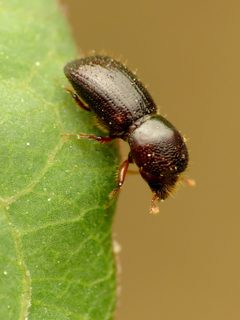
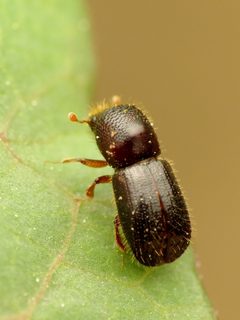
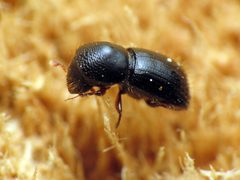
Pronunciation
How to pronounce Xylosandrus: /ˌzaɪlɔˈsændrəs/
These audio files are automatically generated. While they are not always 100% accurate, they are a good starting point.
Identification
in Xylosandrus can be distinguished from other ambrosia beetle by features of the mycangia (internal fungus-storing organs), though specific morphological characters distinguishing the genus require microscopic examination. Xylosandrus germanus is known as the black stem borer; X. crassiusculus is called the granulate ambrosia beetle. Micro-CT scanning has been used to visualize the three-dimensional structure of mycangia and associated musculature in X. amputatus.
Images
Distribution
The has a global distribution with native ranges in Asia. Xylosandrus germanus occurs in Europe (Austria, Belgium, France, Germany, Hungary, Italy, Russia, Slovenia, Switzerland), Asia (China, Japan, Korea Republic, Taiwan, Vietnam), North America (Canada, USA), and Oceania (New Zealand). Xylosandrus crassiusculus has been recorded in North America (USA), Central America and Caribbean, South America (Argentina, Brazil, French Guiana, Uruguay), and Oceania (Australia, New Zealand, Papua New Guinea, Samoa). Xylosandrus compactus occurs in Asia (India, Indonesia, Japan, Malaysia, Philippines, Sri Lanka, Taiwan, Thailand, Vietnam), Africa (Benin, Cameroon, Ghana, Kenya, Madagascar, Nigeria, Tanzania, Uganda), North America (USA), Central America and Caribbean, and Oceania (Fiji, Papua New Guinea, Samoa).
Diet
in this are xylomycetophagous, feeding primarily on symbiotic fungi cultivated within wood galleries rather than on wood itself. The beetles transport fungal spores in specialized mycangia and inoculate gallery walls with fungi that serve as larval food.
Host Associations
- Malus domestica - pestXylosandrus germanus found infesting apple trees in New York (2015, 2017) and Michigan (2016); associated with rapid apple decline in North Carolina orchards
- Prunus persica - pestXylosandrus crassiusculus identified infesting peach trees in South Carolina in 1985
- Coffea spp. - pestXylosandrus compactus attacks coffee plants
- Theobroma cacao - pestXylosandrus compactus attacks cocoa
- Persea americana - pestXylosandrus compactus attacks avocado
- Swietenia spp. - pestXylosandrus compactus attacks mahogany
- Camellia sinensis - pestXylosandrus compactus attacks tea
- Acer negundo - pestXylosandrus compactus in Turkey
- Acer pseudoplatanus - pestXylosandrus compactus in Turkey
- Aesculus hippocastanum - pestXylosandrus compactus in Turkey
- Buxus sempervirens - pestXylosandrus compactus in Turkey
- Carpinus betulus - pestXylosandrus compactus in Turkey
- Castanea sativa - pestXylosandrus compactus in Turkey
- Corylus avellana - pestXylosandrus compactus in Turkey
- Juglans regia - pestXylosandrus compactus in Turkey
- Malus floribunda - pestXylosandrus compactus in Turkey
- Prunus laurocerasus - pestXylosandrus compactus in Turkey
- Punica granatum - pestXylosandrus compactus in Turkey
- Quercus robur - pestXylosandrus compactus in Turkey
- Tilia tomentosa - pestXylosandrus compactus in Turkey
- Ulmus minor - pestXylosandrus compactus in Turkey
Behavior
Ambrosia beetles in this excavate gallery chambers in tree tissue, introduce symbiotic filamentous fungi, and rear offspring that consume the fungi as food. Stressed trees release ethanol, which attracts ambrosia beetle attack. In North Carolina apple orchards, X. germanus and X. crassiusculus were extracted from declining trees, comprising 34% and 26% of identified specimens respectively.
Ecological Role
in this function as fungus-farmers that symbiotic fungi into wood, creating microhabitats for fungal . In North Carolina apple orchards, 62 fungal species from 31 genera were associated with ambrosia beetle galleries, including Ambrosiella (symbiotic with X. germanus and X. crassiusculus), Chaetomium, Fusarium, Botryosphaeria, and Diaporthe. The beetles may contribute to tree decline but are not sole causative agents; abiotic stressors such as drought and rapid temperature changes facilitate both attack and fungal .
Human Relevance
Several are economically significant pests. Xylosandrus crassiusculus and X. germanus have long been pests of ornamental trees in North America and have more recently infested fruit trees. Xylosandrus compactus causes serious damage to economically valuable plants including coffee, cocoa, avocado, and tea worldwide. In 1995, X. germanus caused significant damage to stored Norway spruce and fir round timber in Europe; conventional used against other timber pests showed insufficient effect.
Similar Taxa
- Xyleborinus saxeseniiAlso an ambrosia beetle pest of apple trees; comprised 31% of specimens from declining apple trees in North Carolina study, compared to 34% X. germanus and 26% X. crassiusculus
- XyleborusRelated of ambrosia beetles; Xylosandrus was historically classified within Xyleborus (type Xyleborus morigerus)
- Xyloterus lineatusEuropean timber pest; conventional effective against X. lineatus showed insufficient effect against X. germanus
Sources and further reading
- BugGuide
- Wikipedia
- GBIF taxonomy match
- iNaturalist taxon
- NCBI Taxonomy
- Catalogue of Life
- Xylosandrus germanus - Entomology Today
- Xylosandrus crassiusculus Archives - Entomology Today
- What Role, If Any, Do Ambrosia Beetles Play in Rapid Apple Decline?
- The Best Look Yet at the Tiny Fungus Storage Units Inside Ambrosia Beetles
- 3-D reconstruction of ambrosia beetle via micro-CT scanning - Entomology Today
- Xylosandrus crassiusculus . [Distribution map].
- Xylosandrus compactus (Eichhoff)
- Xylosandrus crassiusculus . [Distribution map].
- İstilacı egzotik böcek türü Xylosandrus compactus (Eichhoff)’un İstanbul - Türkiye’deki konukçu bitki türleri Host plant species of invasive exotic insect species Xylosandrus compactus (Eichhoff) in Istanbul - Türkiye
- Comparative Morphology and Distribution of Antennal Sensilla onXylosandrus germanusandXylosandrus crassiusculus(Coleoptera: Curculionidae: Scolytinae)
- Distribution and Seasonal Abundance of Xylosandrus mutilatus (Coleoptera: Curculionidae)
- Chemical ecology, fungal interactions and forest stand correlations of the exotic Asian ambrosia beetle, Xylosandrus crassiusculus (Motschulsky) (Curculionidae)
- Xylosandrus compactus . [Distribution map].
- Beitrag zum eingeschleppten Schwarzen Nutzholzborkenkäfer Xylosandrus germanus. Biologie und Schadenpotential an im Wald gelagertem Rundholz im Vergleich zu Xyloterus lineatus und Hylecoetus dermestoides | The Imported Japanese Scolytid beetle Xylosandrus germanus: Biology and Damage Potential for Stored Round Timber Compared to Xyloterus lineatus and Hylecoetus dermestoides
- Xylosandrus compactus . [Distribution map].
- Xylosandrus germanus . [Distribution map].