
Hypothenemus
Westwood, J.O., 1834
Species Guides
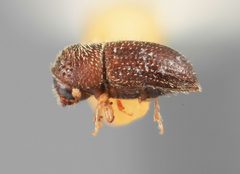
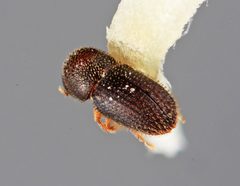
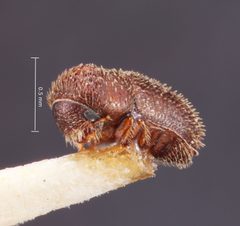
14Hypothenemus is a of bark beetles in the Curculionidae containing more than 200 described . The genus is most diverse in tropical and subtropical regions worldwide, with reduced representation in temperate areas of eastern North America and eastern Asia. Members are minute beetles, ranging from 0.6 mm to 2.2 mm in length, with males consistently smaller than females. The genus includes several economically significant species, most notably H. hampei (), which is considered the most destructive insect pest of coffee globally.
Pronunciation
How to pronounce Hypothenemus: /hɪpoʊˈθɛnəməs/
These audio files are automatically generated. While they are not always 100% accurate, they are a good starting point.
Identification
Identification to level requires microscopic examination. H. hampei () is distinguished from the morphologically similar H. obscurus by specific characteristics visible under light microscope and SEM; these morphological differences correlate with their respective feeding habits and associations. The two species can develop on alternative hosts but show reduced reproductive capacity on non-preferred hosts.
Images
Appearance
Extremely small beetles measuring 0.6–2.2 mm in length. Males are smaller than females. Body form typical of scolytine weevils (formerly placed in , now Curculionidae: Scolytinae). Detailed morphological features vary among ; H. hampei and H. obscurus exhibit species-specific characteristics distinguishable under light microscopy and scanning electron microscopy.
Habitat
Tropical and subtropical forests and agricultural systems. occupy diverse including coffee plantations (H. hampei), macadamia and avocado orchards (H. obscurus), and native woody vegetation. The completes its entire within coffee fruits, where it is protected from natural enemies and applications.
Distribution
Pantropical and subtropical distribution with highest diversity in tropical regions worldwide. Less frequent in temperate zones, though present in eastern North America and eastern Asia. H. hampei specifically has established across coffee-growing regions globally including Africa, Asia, Central and South America, the Caribbean, and Oceania (including Hawaii, detected 2010).
Seasonality
Activity patterns vary by and region. In coffee systems, H. hampei females are vulnerable during mass events when leaving natal berries to seek new fruit; these flights typically occur early in the season and post-harvest.
Diet
Feeding habits vary by . H. hampei feeds on endosperm tissue of coffee seeds. H. obscurus has been recorded from avocado and multiple crop . Both species can develop on alternative artificial diets but with significantly reduced reproductive capacity.
Host Associations
- Coffea spp. - primary H. hampei; feeds on seeds within fruits
- Persea americana - H. obscurus
- Macadamia - H. obscurus
Life Cycle
H. obscurus from to estimated at 28.5 ± 1.3 days; H. hampei at 26.8 ± 1.0 days on preferred . Development occurs primarily within host plant tissues (fruits/seeds). Cytogenetic analysis shows facultative heterochromatization with functional haplo- patterns. No evidence of in H. hampei or H. obscurus. number and karyotype similar between these two .
Behavior
female H. hampei bores into coffee fruits and subsequently into seeds, excavating tunnels for -laying. Larvae feed internally on seed tissue. Adults are protected within plant tissues for most of their , emerging only for to locate new . Flight activity represents the primary vulnerable life stage for management intervention.
Ecological Role
Herbivore and seed in natural and agricultural . In coffee agroecosystems, H. hampei acts as a significant regulator of plant reproductive output. Serves as for (Hymenoptera) that exert top-down population control, with parasitoid development and population growth influenced by temperature.
Human Relevance
Major agricultural pest . H. hampei () causes devastating economic damage to coffee production worldwide, reducing yield and quality of coffee products. Introduction to Hawaii in 2010 threatened the state's specialty coffee industry. Management relies on combining monitoring, field , applications, and frequent harvesting. Cultural control through frequent and efficient harvesting has proven more effective and economically viable than conventional -heavy approaches in Hawaii. The genus has been the focus of congressional attention in the United States regarding areawide integrated pest management policy for .
Similar Taxa
- Other Scolytinae generaFormerly classified in , now placed in Curculionidae; minute size and bark beetle shared across
- H. obscurusMorphologically similar to H. hampei; distinguished by -specific microscopic characteristics and preferences (avocado/macadamia vs. coffee)
More Details
Genetic research
Molecular studies using AFLP fingerprints have identified distinguishable fragments between H. hampei and H. obscurus, supporting -level differentiation. Research continues on transcriptome comparison to elucidate genetic basis for the monophagous habit of H. hampei.
Management economics
Comparative studies in Hawaii demonstrate that farms using frequent harvesting with reduced applications achieved 55% lower chemical control costs and 48% higher net benefits compared to conventional management, with significantly lower rates and higher coffee quality.
Sources and further reading
- BugGuide
- Wikipedia
- GBIF taxonomy match
- iNaturalist taxon
- NCBI Taxonomy
- Catalogue of Life
- Protecting American Coffee, Wine and Baseball Bats | Bug Squad
- Frequent Harvesting Proves Optimal for Managing Coffee Berry Borer in Hawaii
- The Role of Crop Profiles and Pest Management Strategic Plans in IPM Data
- Hypothenemus hampei . [Distribution map].
- Hypothenemus hampei . [Distribution map].
- Biologic, Morphologic, and Genetic Aspects of Hypothenemus Obscurus And Hypothenemus Hampei (Coleoptera: Curculionidae: Scolytinae)
- Bioecologia da broca-do-café, "Hypothenemus hampei" (Ferrari, 1867) ("Coleoptera: Curculionidae, scolytinae"), na ilha de São Tomé = Bioecología de la broca del café "Hypothenemus hampei" (Ferrari, 1867) ("Coleoptera: Curculionidae, scolytinae") en la isla de Santo Tomé = Bioecology of the coffee berry borer, "Hypothenemus hampei" (Ferrari, 1867) ("Coleoptera: Scolytidae") in São Tomé Island
- Behavior of the coffee drill (Hypothenemus hampei) before the effects of the biocide Neem (Azadirachta indica) and Higuerilla (Ricinus communis) in the Monzón district, Peru
- Biology and ecology of the coffee berry borer,Hypothenemus hampei
- Temperature Effects on Development and Population Growth of Two Parasitoids (Hymenoptera) of the Coffee Berry Borer (Hypothenemus hampei).