
Clambidae
Fischer von Waldheim, 1821
Minute Beetles, Fringe-winged Beetles
Genus Guides
3is a of minute beetles in the superfamily Clamboidea, comprising approximately 70 described across five . range from 0.7 to 2 mm in body length and exhibit distinctive fringe-winged with long hairs lining the wing margins. The family has a distribution excluding Antarctica, with the genus Clambus being the most widespread. Some species exhibit a conglobate body form capable of rolling into a ball.
Pronunciation
How to pronounce Clambidae: /klæmˈbaɪdiː/
These audio files are automatically generated. While they are not always 100% accurate, they are a good starting point.
Identification
Distinguished from other small polyphagan beetles by the combination of minute size (<2 mm), fringed wing margins with long hairs, and the modified capsule with deep clypeofrontal incision enabling vertical antennal movement. The conglobate body form (ability to roll into a ball) occurs in Clambinae + Calyptomerus but not in Acalyptomerus. Clambus is distinguished from other by completely subdivided . Acalyptomerus lacks the conglobate body form and has the head capsule not in contact with mesocoxae. Separation from Eucinetidae (the closest relative ) requires examination of mandibular structure: share a long, slender mandibular tooth with serrate edge with Eucinetidae, but differ in head capsule flattening and antennal features.
Images
Appearance
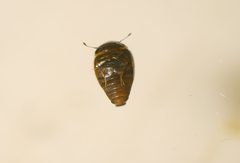
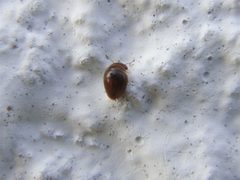
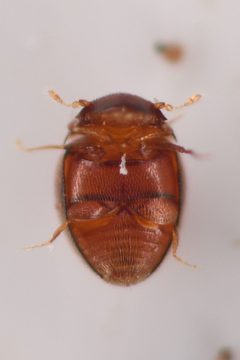
are tiny beetles measuring 0.7–2 mm in length. Body shape varies from flattened to convex; some can roll into a conglobate ball. The ranges from glabrous to densely hairy or scaly. The elytral margins bear characteristic long fringing hairs, giving the group its . The capsule is strongly flattened and broadened with a deep clypeofrontal incision that enables vertical antennal movement. are integrated into the contour of the head in most ; in Clambus, the is completely subdivided.
Habitat
associations are poorly documented for most . Clambus nigrellus has been documented along small brooks in Finland, suggesting riparian or moist microhabitat associations for at least some species. The conglobate body form in several suggests to tight spaces such as leaf litter, soil crevices, or decaying organic matter.
Distribution
distribution on all continents except Antarctica. The Clambus is worldwide in distribution. Sphaerothorax is restricted to Australia and New Zealand. Acalyptomerus has a circumtropical distribution. The shows biogeographic patterns consistent with long-term isolation of landmasses, as evidenced by distinct faunas across the Sunda Islands.
Diet
Clambids commonly feed on fungi.
Behavior
Some can roll into a conglobate ball, a defensive associated with the body form where the side of the capsule contacts the mesocoxae. The deep clypeofrontal incision of the head enables vertical antennal movement, likely important for sensory function in confined microhabitats.
Ecological Role
Fungivorous members of the decomposer in leaf litter and soil microhabitats.
Human Relevance
No direct economic or medical significance. Poorly known due to minute size and identification difficulties, leading to under-recording in regional faunas. Some such as Clambus nigrellus in Finland have been historically overlooked rather than genuinely rare.
Similar Taxa
- EucinetidaeClosest relative within Scirtoidea; shares derived mandibular feature (long slender tooth with serrate edge) but differs in capsule and antennal features
- ScirtidaeOther scirtoid ; lacks the strongly flattened and broadened capsule and fringed wing margins of
More Details
Phylogenetic position
is strongly supported as monophyletic based on modifications of the capsule: strong flattening and broadening, deep clypeofrontal incision, and derived antennal features. Acalyptomerus is probably the sister group to the clade of Calyptomerus + Clambinae. The shows a close relationship to Eucinetidae within Scirtoidea.
Fossil record
Acalyptomerus and Sphaerothorax show long-term morphological stasis, with fossils identifiable to both known from 99 million year old Burmese amber. The oldest records of the are the extinct genera Eoclambus and Ptisma from Early Cretaceous (Barremian) Lebanese amber, approximately 125 million years old.
Taxonomic diversity
The comprises five extant : Acalyptomerus, Calyptomerus, Clambus, Loricaster, and Sphaerothorax, with approximately 70 described . Clambus is the largest and most widespread genus.
Sources and further reading
- BugGuide
- Wikipedia
- GBIF taxonomy match
- iNaturalist taxon
- NCBI Taxonomy
- Catalogue of Life
- Clambidae of Sulawesi with reference to the biogeography of the Sunda Islands (Coleoptera, Eucinetoidea)
- The head morphology of Clambidae and its implications for the phylogeny of Scirtoidea (Coleoptera: Polyphaga)
- <i>Clambus nigrellus</i> Reitter (Coleoptera: Clambidae), an overlooked beetle species in Finland