
Hypothenemus eruditus
(Westwood, 1834)
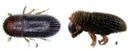
Hypothenemus eruditus is a small bark beetle in the Scolytinae, first described by Westwood in 1834. It has been recorded from North America, temperate Asia, Europe, and the Azores, with confirmed in Hawaiʻi. The has been described as the most abundant bark beetle in the world, though it is rarely encountered by casual observers due to its minute size and cryptic habits. In Hawaiʻi, it has been collected from Delonix regia pods and macadamia husks.
Pronunciation
How to pronounce Hypothenemus eruditus: /hʌɪ.poʊ.ˈθiː.nɪ.məs ɛ.ˈruː.dɪ.təs/
These audio files are automatically generated. While they are not always 100% accurate, they are a good starting point.
Images
Habitat
Associated with plant material including Delonix regia pods and macadamia husks; observed in field environments on Oʻahu, Hawaiʻi. Use of 'phloem sandwich' style observation chambers suggests association with phloem tissue.
Distribution
North America, temperate Asia, Europe, and the Azores (Faial, Pico, São Jorge, São Miguel, Santa Maria). Confirmed present in Hawaiʻi (Oʻahu: UH Mānoa campus, Waimānalo).
Behavior
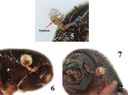
Has been observed exhibiting defensive action against attack by clamping down on the intruding ovipositor between the pro- and , though this was documented only once and its generality is uncertain.
Ecological Role
for ectoparasitoid including Prorops maya, Prorops umiehu, and Plastanoxus sp.; these are the only known bethylid wasps that parasitize the stage of their hosts and the only known ectoparasitoids of adult scolytine beetles.
Human Relevance
The epithet 'eruditus' inspired the name of the mobile application 'Eruditus,' a bark beetle identification training tool developed by the University of Florida and USDA-ARS.
More Details
Etymological note
The specific epithet 'eruditus' (Latin: learned, erudite) was selected by Dr. James Skelton as the namesake for the bark beetle identification app 'Eruditus,' which trains users in gestalt-based identification of scolytine beetles.
Taxonomic authority discrepancy
Sources vary between Westwood 1834 and Westwood 1836 for the original description date.
Sources and further reading
- BugGuide
- Wikipedia
- GBIF taxonomy match
- iNaturalist taxon
- NCBI Taxonomy
- Catalogue of Life
- Protecting American Coffee, Wine and Baseball Bats | Bug Squad
- Bark Beetle Identification: There’s an App for That, Too
- Frequent Harvesting Proves Optimal for Managing Coffee Berry Borer in Hawaii
- The Role of Crop Profiles and Pest Management Strategic Plans in IPM Data
- Bark Beetle Hypothenemus eruditus Westwood, 1836 (Insecta: Coleoptera: Curculionidae: Scolytinae)
- Life history of two new species of Prorops (Hymenoptera, Bethylidae) ectoparasitic on adult Hypothenemus eruditus beetles (Curculionidae, Scolytinae) in Hawai‘i
- Figure 7 from: Honsberger DN, Magnacca KN, Lorenzo-Elarco JH, Wright MG (2024) Life history of two new species of Prorops (Hymenoptera, Bethylidae) ectoparasitic on adult Hypothenemus eruditus beetles (Curculionidae, Scolytinae) in Hawai‘i. Journal of Hymenoptera Research 97: 1221-1256. https://doi.org/10.3897/jhr.97.138113
- Figure 1 from: Honsberger DN, Magnacca KN, Lorenzo-Elarco JH, Wright MG (2024) Life history of two new species of Prorops (Hymenoptera, Bethylidae) ectoparasitic on adult Hypothenemus eruditus beetles (Curculionidae, Scolytinae) in Hawai‘i. Journal of Hymenoptera Research 97: 1221-1256. https://doi.org/10.3897/jhr.97.138113