
Acanthocinus
Dejean, 1821
Species Guides
8- Acanthocinus angulosus
- Acanthocinus leechi
- Acanthocinus nodosus(Lesser Pine Borer)
- Acanthocinus obliquus
- Acanthocinus obsoletus(Obsolete Longhorned Beetle)
- Acanthocinus princeps(Ponderosa Pine Bark Borer)
- Acanthocinus pusillus(Little Flatface Longhorn Beetle)
- Acanthocinus spectabilis
Acanthocinus is a of longhorn beetles in the Lamiinae, described by Dejean in 1821. in this genus are associated with coniferous trees, particularly pines and spruces, where larvae develop in the phloem beneath bark. Several species exhibit cryptic coloration that provides camouflage against tree bark. The genus includes notable species such as Acanthocinus aedilis, A. nodosus, and A. princeps (the Ponderosa Pine Bark Borer).
Pronunciation
How to pronounce Acanthocinus: /əˌkænθoʊˈsaɪnəs/
These audio files are automatically generated. While they are not always 100% accurate, they are a good starting point.
Identification
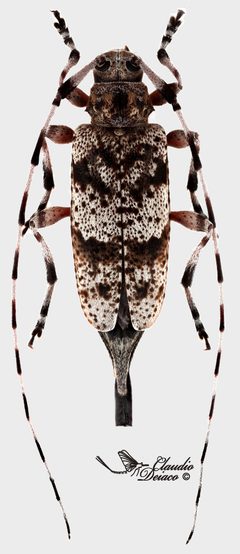
Distinguished from similar longhorn beetles by combination of: extremely long male (especially in A. nodosus); cryptic bark-patterned coloration with slate gray base and black markings; association with coniferous . Separated from Acanthoderes by different elytral patterns—Acanthoderes quadrigibba has distinctive -shaped maculae along the elytral midline, while Acanthocinus lack this pattern and instead show more uniform mottling. Differs from Monochamus species by generally more slender build and different antennal proportions.
Images
Appearance
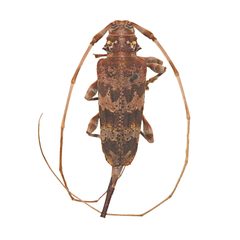
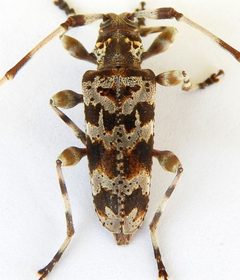
Medium to large-sized longhorn beetles with elongated bodies. Many exhibit somber coloration—slate gray, brown, or black—with variable black markings or mottling that provides bark-matching camouflage. Males typically possess exceptionally long ; in Acanthocinus nodosus, male antennal span reaches approximately 120 mm. Body form is more or less cylindrical, consistent with other Lamiinae.
Habitat
Forested areas with coniferous trees, particularly pine and spruce. Larvae develop in freshly dead or dying standing trees, stumps, and logs. found on tree trunks, at lights, and in logging areas with fresh cut timber.
Distribution
Holarctic distribution. North America: eastern United States (extending to southern Missouri), western North America including Colorado; Europe including Finland, Sweden, Norway, Denmark; additional records from Vermont, USA. Individual have more restricted ranges within this broad pattern.
Seasonality
activity peaks in early to mid-summer (June-July) in temperate regions. Wood-boring activity, including Acanthocinus, reaches peak abundance by early July in southern Missouri and similar latitudes.
Host Associations
- Pinus - larval developmentLarvae mine phloem beneath bark of dead and dying pines; includes Pinus echinata (shortleaf pine), Pinus taeda (loblolly pine), and other pine
- Picea - larval developmentLarvae develop in trunks of freshly dead, standing spruce trees
Life Cycle
Complete . laid in bark crevices, through bark beetle entrance holes, or at sites where outer bark is damaged and phloem exposed. Larvae mine phloem beneath bark, creating galleries in the inner bark and outer sapwood. High larval mortality observed due to and . occurs in wood; emerge to seek mates and new oviposition sites.
Behavior
exhibit cryptic , resting on tree trunks where their bark-matching coloration renders them nearly invisible. Females oviposit preferentially in wood previously attacked by bark beetles (Tomicus piniperda) when available, utilizing existing entrance holes. Males of some (notably A. nodosus) possess dramatically elongated , likely used in mate location and recognition. Adults occasionally attracted to lights at night. Some species active on tree trunks during day; others more .
Ecological Role
Primary decomposer of dead and dying coniferous wood; contributes to nutrient cycling in forest . Subject to significant and pressure during larval stage. Serves as prey/ for parasitoid including Aulacidae. Presence in logging areas and ports indicates potential role in wood-boring dynamics.
Human Relevance
Some associated with timber and logging operations; Acanthocinus princeps (Ponderosa Pine Bark Borer) referenced in forestry contexts. Potential for transport in wood packaging materials, contributing to range expansion through domestic and international trade. Not considered a major economic pest but part of the broader wood-boring fauna affecting forest products.
Similar Taxa
- AcanthoderesSimilar Lamiinae longhorns with cryptic coloration; distinguished by Acanthoderes quadrigibba having distinctive -shaped maculae along elytral midline versus Acanthocinus uniform mottling
- MonochamusSimilar large Lamiinae associated with conifers; distinguished by different antennal proportions and body shape—Monochamus more robust with different color patterns
More Details
Taxonomic note
Authorship sometimes cited as Megerle in 1821 per Wikipedia, but Catalogue of Life and other authoritative sources cite Dejean, 1821. The belongs to tribe Acanthocinini within Lamiinae.
Conservation status insight
Acanthocinus griseus in Finland was previously considered rare and red-listed but found to be an overlooked with broader requirements than assumed; detailed examination of suitable trees reveals many more occurrences than previously recorded.
Sources and further reading
- BugGuide
- Wikipedia
- GBIF taxonomy match
- iNaturalist taxon
- NCBI Taxonomy
- Catalogue of Life
- Domestic Sea Trade Aids Wood-Boring Beetles' Range Expansion
- More on ‘Conspicuous Crypsis’ | Beetles In The Bush
- ID Challenge #9 | Beetles In The Bush
- Ozark Landscapes – White River in northern Arkansas | Beetles In The Bush
- Bug Eric: Beetle Bonanza
- Ovipositing Pigeon Horntail | Beetles In The Bush
- OVIPOSITION BIOLOGY OF ACANTHOCINUS NODOSUS (COLEOPTERA: CERAMBYCIDAE) IN PINUS TAEDA
- Ecology and conservation status of <i>Acanthocinus griseus</i> (Fabricius, 1792) (Coleoptera: Cerambycidae) in Finland
- Oviposition behavior and reproductive success of the cerambycid Acanthocinus aedilis in the presence and absence of the bark beetle Tomicus piniperda