
Acanthocinus nodosus
(Fabricius, 1775)
Lesser Pine Borer
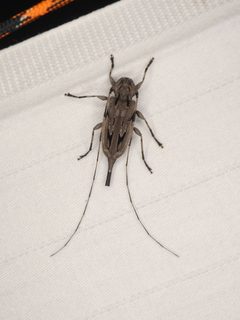
Acanthocinus nodosus, commonly known as the Lesser Pine Borer, is a longhorn beetle in the Lamiinae. First described by Fabricius in 1775, this occurs across the eastern United States, where its larvae mine the phloem beneath the bark of dead and dying pine trees. are notable for their cryptic gray coloration with black markings and, in males, exceptionally long reaching up to 120 mm. The species exemplifies "conspicuous "—appearing strikingly beautiful when isolated against contrasting backgrounds, yet nearly invisible when resting on weathered pine bark.

Pronunciation
How to pronounce Acanthocinus nodosus: /əˌkænθoʊˈsaɪnəs noʊˈdoʊsəs/
These audio files are automatically generated. While they are not always 100% accurate, they are a good starting point.
Identification
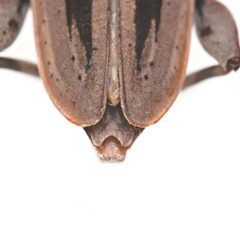
Distinguished from other eastern North American longhorn beetles by the combination of: (1) slate gray coloration with velvet black markings; (2) exceptionally long male (up to 120 mm span); (3) association with pine trees (Pinus spp.); and (4) cryptic appearance against weathered bark. Within the tribe Acanthocinini, most share somber coloration with variable black markings, but A. nodosus is among the most effectively cryptic. Males are readily distinguished from females by antennae length. Similar species in the include Acanthocinus obsoletus, which occurs sympatrically in some areas but may be distinguished by subtle differences in coloration and markings.
Images
Habitat
Associated with pine forests, particularly where dead or dying pines occur. have been observed on trunks of both healthy-appearing and declining pine trees. The occurs in sandstone glades and surrounding pine woodlands in the Ozark and Ouachita regions, as well as broader eastern pine forest . Larval habitat is beneath the bark of dead and dying pines, where they mine the phloem.
Distribution
Eastern United States, ranging from the southeastern states northward into the Ozark Highlands of southern Missouri. Documented from Arkansas (Calico Rock area, White River Hills), Missouri, Alabama, and presumably throughout the eastern pine belt. The northern limit appears to be southern Missouri, where it just enters the Ozark Highlands.
Seasonality
have been observed from June through at least September. Activity appears to span the warmer months, with specific peak activity periods not well documented. At least some individuals are diurnally active on tree trunks.
Diet
Larvae feed on phloem beneath the bark of dead and dying pine trees (Pinus spp.), specifically documented from Pinus echinata (shortleaf pine) and Pinus taeda (loblolly pine). feeding habits are not explicitly documented in available sources.
Host Associations
- Pinus echinata - larval Shortleaf pine. observed on trunks; larvae mine phloem beneath bark of dead and dying trees.
- Pinus taeda - larval Loblolly pine. Oviposition specifically studied in this .
Life Cycle
Complete with , larval, pupal, and stages. Larvae are wood-borers that mine the phloem beneath bark of dead and dying pines. Detailed duration and are not well documented. Adults emerge from trees and may be found on pine trunks during daytime.
Behavior
exhibit cryptic , resting on pine bark where their coloration renders them nearly invisible against weathered bark surfaces. When disturbed, they may remain motionless, relying on for protection. Males possess exceptionally long , likely used for detecting female . Adults have been observed active during daylight hours on tree trunks. The is rarely encountered despite occurring across a broad range, suggesting either genuinely low abundance or highly effective crypsis that causes observers to overlook them.
Ecological Role
As a phloem-borer in dead and dying pines, larvae contribute to nutrient cycling in pine forest by accelerating decomposition of stressed or dying trees. The is part of the guild of wood-boring beetles that process pine woody debris. Specific ecological impacts or interactions with other species are not documented.
Human Relevance
Not considered a significant economic pest. Unlike some related cerambycids, this appears to primarily colonize already dead or dying trees rather than attacking healthy timber. No documented impacts on forestry or agriculture. Of interest to coleopterists and naturalists due to its attractive appearance and remarkable male .
Similar Taxa
- Acanthocinus obsoletusOccurs sympatrically in some regions (e.g., Oklahoma). Distinguished by subtle differences in coloration and markings; both share long in males and pine association.
- Other Acanthocinini tribe membersMost share somber gray-brown coloration with black markings, but A. nodosus is distinguished by the effectiveness of its against weathered pine bark and the exceptional length of male .
More Details
Conspicuous Crypsis
This exemplifies "conspicuous "—a term coined to describe organisms that appear strikingly beautiful and conspicuous when viewed against contrasting backgrounds (such as when mounted in insect collections), yet are effectively invisible in their natural . When placed on weathered pine bark, the slate gray and black coloration renders the nearly impossible to detect without movement. This phenomenon has been noted by collectors who report past specimens on tree trunks without noticing them.
Rarity of Encounter
Despite occurring across the eastern United States and being locally present in areas with abundant pine , this is infrequently encountered by collectors. One experienced coleopterist reported seeing only single individuals on three occasions over many years prior to finding multiple specimens at Calico Rock, Arkansas. This rarity of encounter likely reflects the effectiveness of the species' cryptic coloration rather than genuinely low abundance.
Sources and further reading
- BugGuide
- Wikipedia
- GBIF taxonomy match
- iNaturalist taxon
- Catalogue of Life
- More on ‘Conspicuous Crypsis’ | Beetles In The Bush
- Ozark Landscapes – White River in northern Arkansas | Beetles In The Bush
- October | 2011 | Beetles In The Bush | Page 2
- North America’s most recognizable longhorned beetle | Beetles In The Bush
- [No taxon] | Beetles In The Bush | Page 10
- Arkansas | Beetles In The Bush
- OVIPOSITION BIOLOGY OF ACANTHOCINUS NODOSUS (COLEOPTERA: CERAMBYCIDAE) IN PINUS TAEDA