
Tomicus piniperda
(Linnaeus, 1758)
common pine shoot beetle, Eurasian pine shoot beetle
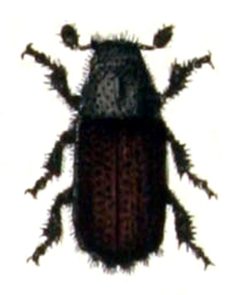
Tomicus piniperda is a bark beetle native to Europe, northwestern Africa, and northern Asia, and an in North America. It is one of the most destructive shoot-feeding beetles in northern Europe, causing economic damage to pine forestry through two distinct feeding : breeding in stressed or dead pine trunks and feeding on the pith of healthy young pine shoots. The has a single per year and does not use for mate location, instead relying on plant volatiles. It was first detected in North America in 1992 near Cleveland, Ohio, and has since spread to multiple U.S. states and Canadian provinces, triggering federal .

Pronunciation
How to pronounce Tomicus piniperda: /ˈtoʊmɪkəs ˌpɪnɪˈpɜːrdə/
These audio files are automatically generated. While they are not always 100% accurate, they are a good starting point.
Identification
Distinguished from Tomicus minor by breeding gallery orientation: T. piniperda constructs galleries parallel to wood grain, while T. minor galleries run across the grain. T. piniperda primarily uses fallen or stressed pines for breeding, whereas T. minor uses standing dead pines. Tomicus destruens, found in the Mediterranean region, differs in preference (primarily stone pine and maritime pine) and ecological details. Morphologically similar to other Tomicus ; identification often requires examination of gallery architecture and host context.
Images
Habitat
Pine forests; breeds in recently dead or dying pine trees including windblown trees, fire-killed standing trees, cut logs, branches, and stumps. feed on pith of healthy young pine shoots during autumn and winter.
Distribution
Native range: Europe, northwestern Africa, and northern Asia. range: northeastern North America, first detected in Ohio in 1992, now present in at least 11 U.S. states and Ontario and Quebec, Canada.
Seasonality
initiate from sites in late winter to early spring when daily high temperatures exceed 10–13°C. Breeding occurs in spring. Larvae develop through summer, emerging as new adults in late summer. Adults feed on shoots through autumn and winter. One per year.
Diet
Phloem of pine trees during larval development; pith of healthy pine shoots during maturation feeding. Primary is Scots pine (Pinus sylvestris); also uses European black pine (P. nigra), maritime pine (P. pinaster), eastern white pine (P. strobus), red pine (P. resinosa), jack pine (P. banksiana), and rarely spruce (Picea) and larch (Larix).
Host Associations
- Pinus sylvestris - primary Most important in native range
- Pinus nigra - European black pine
- Pinus pinaster - Maritime pine
- Pinus strobus - Eastern white pine
- Pinus resinosa - Red pine
- Pinus banksiana - Jack pine
- Picea - rare Spruce
- Larix - rare Larch
Life Cycle
One per year. emerge from sites in spring and seek breeding material. Females tunnel breeding galleries up to 25 cm long parallel to wood grain, laying along the gallery. Larvae hatch and chew radially through phloem for several months. New adults emerge in late summer, then feed on shoots of healthy young trees through autumn and winter. Most adults die after breeding; a small proportion survive to breed again the following year.
Behavior
Exhibits two main trunk attack patterns: in tree crowns followed by trunk , or direct trunk attack without crown aggregation. Unlike most bark beetles, does not use for pre-breeding association; instead locates mates and using olfactory detection of plant monoterpenes (alpha-pinene, 3-carene, terpinolene, myrcene) released from wound resin of damaged host trees. Both sexes respond similarly to monoterpene concentrations. When coexisting with other in trunks, distributes itself with highest near top of trunk and toward ground, rarely fully occupying entire trunk surface.
Ecological Role
Secondary pest that attacks stressed, dying, or recently dead pines; contributes to decomposition of dead wood. In shoot-feeding phase, damages growth form of healthy young trees without killing them, reducing timber economic value. Associated with fungal including Ceratocystis, Ophiostoma, and Ceratocystiopsis; fungi to newly colonized trees but lacks specialized structures for fungal transport. Interacts with Tomicus minor through spatial partitioning of trunk resources.
Human Relevance
Major economic pest of pine forestry in native range and threat in North America. Reduces timber value through growth deformation and growth rate reduction. Subject to federal in United States (1992) and Canada (1993) regulating movement of pine logs, bark, nursery stock, and Christmas trees. Managed through trap logs, monoterpene-baited funnel traps, application (permethrin, carbaryl), and destruction of material. Regularly intercepted at U.S. ports of entry on cargo from at least 18 countries.
Similar Taxa
- Tomicus minorLesser pine shoot with similar distribution but ecologically separated; uses standing dead pines and constructs breeding galleries across the grain rather than parallel to it; attacks mid- and lower trunk regions whereas T. piniperda occupies upper trunk.
- Tomicus destruensMediterranean reproductively isolated from T. piniperda; differs in and primarily infests stone pine (P. pinea) and maritime pine (P. pinaster); historically confused with T. piniperda.
- Tomicus yunnanensisSouthwestern China on Yunnan pine (Pinus yunnanensis); reproductively isolated and geographically separated.
More Details
Population genetics
European show genetic structure suggesting potential cryptic . Mediterranean populations differ from northern European populations in haplotypic groups, with comparable to that between T. piniperda and T. minor. Mediterranean populations may represent a separate species, supported by ecological differences including greater tree mortality in Mediterranean region.
Microsporidian pathogen
Principal of Canningia tomici, a microsporidian that infects reproductive organs and extends host lifespan. Field of C. tomici in T. piniperda is 1.9%, with significantly higher rates in females than males. No natural infections observed in T. minor.
Olfactory biology
Relies exclusively on plant volatiles rather than for host and mate location. Responds to monoterpenes from wound resin while in , enabling rapid of storm-damaged trees before competing bark beetle become active.
Sources and further reading
- BugGuide
- Wikipedia
- GBIF taxonomy match
- iNaturalist taxon
- NCBI Taxonomy
- Catalogue of Life
- Leucotaraxis piniperda fly and Melanips wasp - Entomology Today
- Leucotaraxis piniperda Archives - Entomology Today
- Leucopis piniperda Archives - Entomology Today
- Pests, Predators, and Parasitoids: Wasps Target Flies That Eat Hemlock Woolly Adelgid
- New Container Aids in Biocontrol of Hemlock Woolly Adelgid
- West Coast Flies to the Rescue of East Coast Hemlock Forests
- Simulation of the mate-finding behaviour of pine shoot beetles, Tomicus piniperda
- Infection, course of disease and action of Canningia tomici in Tomicus piniperda and Tomicus minor (Coleoptera: Curculionidae)
- Pine Shoot Beetle, Tomicus piniperda (Linnaeus) (Insecta: Coleoptera: Curculionidae: Scolytinae)
- Forest fire influence on Tomicus piniperda-associated fungal communities and phloem nutrient availability of colonized Pinus sylvestris
- Blue-stain fungi associated with Tomicus piniperda in Sweden and preliminary observations on their pathogenicity
- Predicting the distribution of the two bark beetles Tomicus destruens and Tomicus piniperda in Europe and the Mediterranean region
- Impacts of Tomicus minor on distribution and reproduction of Tomicus piniperda (Col., Scolytidae) on the trunk of the living Pinus yunnanensis trees
- ELECTROPHYSIOLOGICAL AND BEHAVIOURAL RESPONSES OF TOMICUS PINIPERDA AND TOMICUS MINOR (COLEOPTERA: SCOLYTIDAE) TO NON-HOST LEAF AND BARK VOLATILES
- Blue Stain Fungi Associated with Tomicus piniperda (Coleoptera: Scolytidae) on Japanese Red Pine
- Monoterpenes governing host selection in the bark beetles Hylurgops palliatus and Tomicus piniperda