
Tomicus
P.A. Latreille, 1802
pine shoot beetles
Species Guides
1- Tomicus piniperda(common pine shoot beetle)
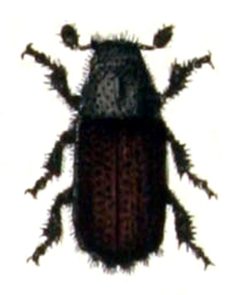
Tomicus is a of bark beetles in the Curculionidae, described by Pierre André Latreille in 1802. The genus contains at least seven recognized , including economically significant forest pests such as T. piniperda, T. minor, T. destruens, and T. yunnanensis. These beetles are commonly known as pine shoot beetles due to their distinctive involving feeding on pine shoots before trunk . Several species have caused substantial mortality in pine forests across Europe, the Mediterranean region, and southwestern China, with T. yunnanensis described as unusually aggressive in its native range.

Pronunciation
How to pronounce Tomicus: //ˈtɒmɪkəs//
These audio files are automatically generated. While they are not always 100% accurate, they are a good starting point.
Images
Habitat
Pine forests; in this are associated with Pinus including P. sylvestris, P. nigra, P. yunnanensis, P. kesiya, and P. armandii. Tomicus piniperda occupies colder climates while T. destruens occurs in warmer Mediterranean regions. In mixed , T. piniperda predominantly attacks mid- and upper trunk sections while T. minor occupies mid- and lower trunk zones, with approximately 80% overlap in the mid-trunk region.
Distribution
distribution with -specific ranges: T. piniperda in Europe and colder climates; T. destruens in Mediterranean regions; T. yunnanensis, T. minor, and T. brevipilosus in southwestern China (Yunnan Province); records from Austria, Finland, Poland, Czech Republic, Croatia, and Sweden. GBIF records indicate presence in Denmark, Norway, Sweden, and Vermont, USA.
Seasonality
Parental beetles active in spring; filial beetles emerge from infested logs and undergo maturation feeding on pine shoots before . Shoot-feeding phase represents a distinct behavioral period prior to trunk .
Diet
Pine (Pinus spp.); maturation feeding occurs on pine shoots, particularly P. sylvestris twigs. Tomicus yunnanensis and T. minor show reduced survival on P. armandii compared to P. yunnanensis, with beetles emerging from P. armandii weighing less than those from preferred .
Host Associations
- Pinus sylvestris - primary principal for T. piniperda in Europe
- Pinus nigra - attacked by T. piniperda and T. minor
- Pinus yunnanensis - primary principal for T. yunnanensis and T. minor in southwestern China; substantial mortality caused to forests
- Pinus kesiya - attacked by T. yunnanensis, T. minor, and T. brevipilosus
- Pinus armandii - secondary less suitable ; reduced survival and offspring weight
- Canningia tomici - microsporidian with T. piniperda as principal ; 1.9% in field
- Ophiostoma minus - fungal associatemost frequently isolated ophiostomatoid fungus from Tomicus-associated pine shoots in Poland
- Leptographium piriforme - fungal associateisolated from Tomicus-associated pine shoots
- Ophiostoma canum - fungal associateisolated from Tomicus-associated pine shoots
- Ophiostoma floccosum - fungal associateisolated from Tomicus-associated pine shoots
- Grosmannia cucullata - fungal associateisolated from Tomicus-associated pine shoots
Life Cycle
Includes distinct shoot-feeding phase where feed on pine shoots before migrating to trunks for . Parental active in spring; filial generation develops in galleries under bark and emerges to feed on shoots. Maturation feeding period on pine twigs precedes reproductive phase. occurs when multiple colonize the same tree, with T. minor negatively impacting T. piniperda larval in overlapping attack zones.
Behavior
Exhibits intraspecific attraction mediated by (−)-trans-verbenol as , attractive at low concentrations (0.1–1.0 ng/μl) but repellent at high concentrations. Verbenone functions as anti-aggregation pheromone to prevent overcrowding and mediate interspecific inhibition. Attraction to conspecifics inhibited by exposure to additional beetles or extracts. Antennal responses to green leaf alcohols (1-hexanol, (Z)-3-hexen-1-ol, (E)-2-hexen-1-ol) and C8-alcohols (3-octanol, 1-octen-3-ol) from non- birch and aspen bark; these compounds reduce trap capture by >60% and 90% when combined. T. piniperda fungi to newly colonized trees but lacks mycangia or body hairs for specific fungal transport.
Ecological Role
Secondary tree pest attacking weakened or stressed pines; cause considerable economic damage. T. yunnanensis described as unusually aggressive, causing forest decimation. When co-occurring, T. minor reduces T. piniperda reproductive success through resource competition. Associated with diverse epibiotic fungal (1,157 operational taxonomic units documented) dominated by Ascomycota; fungal community composition influenced more by geographic location and pine than by . Forest fire positively affects by providing fire-damaged trees with impaired defenses.
Human Relevance
Significant forest pest causing economic damage to pine plantations and natural forests. T. piniperda considered potential threat to pine in North America. -based management programs under development using non- volatile blends to repel beetles from breeding sites. Taxonomic confusion between T. piniperda, T. yunnanensis, and T. destruens has hindered management. Climate warming predicted to cause distribution shifts, with potential for range expansion into new pine plantation areas.
Similar Taxa
- Hylurgops palliatussympatric scolytine bark beetle that shares pine but differs in responses; attracted to -verbenone combinations and unaffected by green leaf volatile blends that repel Tomicus
- Dendroctonusanother of scolytine bark beetles with similar trunk-boring habits but distinguished by different gallery patterns and typically more aggressive primary attack on healthy trees
- Ipssympatric pine bark beetles with similar but distinguished by different chemistry and gallery architecture
More Details
Species diversity
The contains seven recognized : T. piniperda, T. minor, T. destruens, T. brevipilosus, T. yunnanensis, T. puellus, and T. . T. yunnanensis was long confused with T. piniperda until molecular studies and morphological examination (elytral surface , antennal club pilosity, coloration) confirmed its distinct status.
Climate partitioning
T. piniperda and T. destruens exhibit parapatric distributions with opposite climate requirements: T. destruens in warmer Mediterranean locations, T. piniperda in colder climates. Temperature is the most correlated bioclimatic variable for both .
Fungal associations
T. piniperda lacks mycangia and does not appear to derive nutritional benefits from vectored fungi; fungal vectoring appears incidental rather than obligate . Fire significantly alters associated fungal composition and may indirectly affect phloem nutrient availability.
Pathogen susceptibility
T. piniperda serves as principal for the microsporidian Canningia tomici with 1.9% field ; extends host lifespan at lower temperatures. T. minor shows experimental susceptibility but no natural infections observed despite sympatry.
Sources and further reading
- BugGuide
- Wikipedia
- GBIF taxonomy match
- iNaturalist taxon
- NCBI Taxonomy
- Catalogue of Life
- Infection, course of disease and action of Canningia tomici in Tomicus piniperda and Tomicus minor (Coleoptera: Curculionidae)
- Semiochemical Regulation of the Intraspecific and Interspecific Behavior of Tomicus yunnanensis and Tomicus minor during the Shoot-Feeding Phase
- Predicting the distribution of the two bark beetles Tomicus destruens and Tomicus piniperda in Europe and the Mediterranean region
- ELECTROPHYSIOLOGICAL AND BEHAVIOURAL RESPONSES OF TOMICUS PINIPERDA AND TOMICUS MINOR (COLEOPTERA: SCOLYTIDAE) TO NON-HOST LEAF AND BARK VOLATILES
- Description of the Yunnan shoot borer, Tomicus yunnanensis Kirkendall & Faccoli sp. n. (Curculionidae, Scolytinae), an unusually aggressive pine shoot beetle from southern China, with a key to the species of Tomicus
- Impacts of Tomicus minor on distribution and reproduction of Tomicus piniperda (Col., Scolytidae) on the trunk of the living Pinus yunnanensis trees
- Performance ofTomicus yunnanensisandTomicus minor(Col., Scolytinae) onPinus yunnanensisandPinus armandiiin Yunnan, Southwestern China
- Figure 1 from: Wang HM, Wang Z, Liu F, Wu CX, Zhang SF, Kong XB, Decock C, Lu Q, Zhang Z (2019) Differential patterns of ophiostomatoid fungal communities associated with three sympatric Tomicus species infesting pines in south-western China, with a description of four new species. MycoKeys 50: 93-133. https://doi.org/10.3897/mycokeys.50.32653
- Simulation of the mate-finding behaviour of pine shoot beetles, Tomicus piniperda
- Ophiostomatoid fungi isolated from fallen shoots of Scots pine pruned by Tomicus species in Poland
- Forest fire influence on Tomicus piniperda-associated fungal communities and phloem nutrient availability of colonized Pinus sylvestris
- Blue-stain fungi associated with Tomicus piniperda in Sweden and preliminary observations on their pathogenicity
- Pine Shoot Beetle, Tomicus piniperda (Linnaeus) (Insecta: Coleoptera: Curculionidae: Scolytinae)
- Epibiotic Fungal Communities of Three Tomicus spp. Infesting Pines in Southwestern China