
Hylurgops palliatus
Wood & Bright, 1992
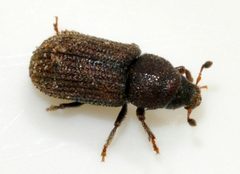
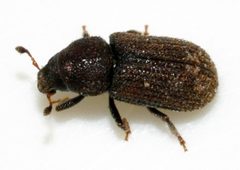
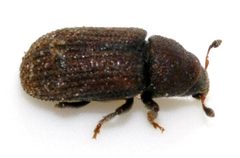
Hylurgops palliatus is a bark beetle in the Curculionidae that colonizes coniferous trees, primarily spruce (Picea) and pine (Pinus) . It is a secondary bark beetle, meaning it attacks weakened, dying, or recently dead trees rather than healthy ones. The species uses -specific monoterpene chemical cues to locate and select appropriate host trees. It various fungi, including ophiostomatoid species, which play roles in its and tree .
Pronunciation
How to pronounce Hylurgops palliatus: /hɪˈlɜːrɡɒps pəˈlaɪətəs/
These audio files are automatically generated. While they are not always 100% accurate, they are a good starting point.
Images
Habitat
Coniferous forests, particularly those containing spruce (Picea) and pine (Pinus) . Associated with the phloem layer of trees.
Distribution
Europe and Northern Asia (excluding China), North America, and Southern Asia. Documented in Poland on Pinus sylvestris.
Diet
Phloem of coniferous trees, primarily spruce (Picea) and pine (Pinus) .
Host Associations
- Picea abies - primary Preferred ; responds to host-specific monoterpene cues from this
- Pinus sylvestris - Documented in Poland; fungi to this
- Pinus sylvestris - Secondary ; responds to β-pinene and terpinolene from pine oleoresin
Behavior
selection is mediated by olfactory response to specific monoterpene compounds. Attracted to ethanol and host-specific oleoresins; response increases with myrtenol and decreases with (+)-trans-verbenol. Avoids volatiles from non-host conifers such as Larix decidua and Pseudotsuga menziesii. fungi to host trees, with fungal differing between overwintered and gallery systems.
Ecological Role
Secondary bark beetle that contributes to decomposition of weakened or dead conifers. Acts as a for fungal , including ophiostomatoid fungi (Leptographium lundbergii, Ophiostoma minus, O. piceae, O. piliferum) and other ascomycetes, thereby influencing fungal transmission and tree dynamics.
Similar Taxa
- Tomicus piniperdaBoth are bark beetles that respond to monoterpene cues, but T. piniperda is primarily associated with Pinus sylvestris, prefers lower ethanol concentrations, and is attracted by both myrtenol and (+)-trans-verbenol, whereas H. palliatus is repelled by (+)-trans-verbenol.
Sources and further reading
- BugGuide
- GBIF taxonomy match
- iNaturalist taxon
- NCBI Taxonomy
- Catalogue of Life
- Desmocerus palliatus – elderberry borer | Beetles In The Bush
- January | 2011 | Beetles In The Bush | Page 3
- Mycobiota associated with Hylurgops palliatus (Gyll.) on Pinus sylvestris L. in Poland
- Monoterpenes governing host selection in the bark beetles Hylurgops palliatus and Tomicus piniperda
- Host and non‐host odour signals governing host selection by the pine shoot beetle, Tomicus piniperda and the spruce bark beetle, Hylurgops palliatus (Col., Scolytidae)