
Ips
DeGeer, C., 1775
Engraver beetles, Ips engraver beetles, Pine engravers
Species Guides
14- Ips avulsus(Small Southern Pine Engraver)
- Ips borealis(Northern Engraver Beetle)
- Ips calligraphus(six-spined engraver beetle)
- Ips confusus(pinyon pine beetle)
- Ips emarginatus(Emarginate Ips)
- Ips grandicollis(eastern five-spined engraver)
- Ips lecontei(Arizona Five-Spined Ips)
- Ips paraconfusus(California fivespined ips)
- Ips perturbatus(Northern Spruce Engraver)
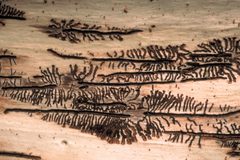
Ips is a of bark beetles in the Curculionidae, Scolytinae. are distributed throughout the Northern Hemisphere, with some introduced to Australia and Africa. Many species are forest pests, particularly of pines and spruces. They are commonly known as engraver beetles due to the distinctive gallery patterns their larvae carve beneath bark.

Pronunciation
How to pronounce Ips: /ɪps/
These audio files are automatically generated. While they are not always 100% accurate, they are a good starting point.
Identification
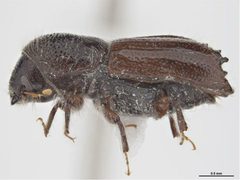
Distinguished from other bark beetle by the spine pattern on the declivity. Ips have spines arranged in distinct rows on the rear slope of the , unlike Dendroctonus (which typically lacks such pronounced spines) or other scolytine genera. Species-level identification relies on spine count and arrangement: I. grandicollis has five spines per row, I. calligraphus has six, I. pini has four. Examination requires magnification; pitfall trapping and bark dissection are standard collection methods.
Images
Appearance
Small cylindrical bark beetles, typically 2-6 mm in length. The declivity (rear slope of the ) bears characteristic spines arranged in distinct rows— are often named for spine number (e.g., fivespined, sixspined engraver). Body color ranges from reddish-brown to dark brown. are short with a distinct club. Elytra are striated and completely cover the .
Habitat
Coniferous forests, particularly pine and spruce stands. Colonizes phloem tissue beneath bark of trees. Found in both natural forests and urban/suburban settings where conifers are planted. Attacks stressed, weakened, or recently dead trees; some can attack apparently healthy trees during .
Distribution
Native throughout the Northern Hemisphere, including North America, Europe, and Asia. Introduced established in Australia and Africa. In North America, occur across the United States and Canada wherever suitable conifer are present.
Seasonality
activity varies by and latitude. In temperate regions, and typically occur from spring through fall, with peak activity in summer. Some species produce multiple per year in warmer climates; others have one generation annually in northern ranges. occurs primarily as adults beneath bark or in forest litter.
Diet
Phloem tissue of coniferous trees. Larvae feed on inner bark and phloem, creating galleries that girdle and kill trees. may also feed on phloem tissue. Some cultivate and feed on symbiotic fungi within galleries.
Host Associations
- Pinus spp. - primary Pines are principal for most Ips
- Picea spp. - primary Spruces frequently attacked
- Abies spp. - secondary Firs occasionally colonized
- Larix spp. - secondary Larches sometimes attacked
Life Cycle
are deposited in along maternal galleries constructed in phloem tissue. Larvae hatch and construct radiating feeding galleries perpendicular to the grain, widening as they grow. occurs in individual at gallery termini or in outer bark. New emerge through round exit holes, leaving distinctive . time ranges from 4-12 weeks depending on temperature and .
Behavior
Males typically initiate and excavate chambers. They produce that attract multiple females, resulting in polygamous harem formation. Females construct galleries branching from the central chamber. Mass attacks can overwhelm tree defenses. Some exhibit discrimination in pheromone communication. is dispersive, often occurring in afternoon hours.
Ecological Role
Primary ecological role is as a decomposer of stressed, dying, and dead conifers, accelerating nutrient cycling in forest . During , shift to aggressive of living trees, causing extensive mortality. Gallery construction creates for other organisms including predatory beetles, , and . Some pathogenic fungi that contribute to tree death.
Human Relevance
Major economic pests of forestry and timber industries. cause millions of dollars in timber losses, fire hazard from dead standing trees, and infrastructure damage from falling trees. Ips grandicollis and related are significant pests in pine plantations and urban landscapes. Management includes harvesting, monitoring, and preventive silviculture. Some species are concerns for international trade.
Similar Taxa
- DendroctonusAlso scolytine bark beetles of conifers; distinguished by larger size, lack of declivital spines, and typically more aggressive primary attack on living trees
- ScolytusBark beetles with similar gallery patterns; distinguished by different antennal club structure and declivity lacking the characteristic spine rows of Ips
- DryocoetesSmaller bark beetles with reduced or absent declivital spines; gallery patterns more irregular
Misconceptions
Widely but incorrectly assumed that all Ips are aggressive tree-killers. In reality, most Ips species are secondary colonizers of already stressed or dead trees. Only certain species, under specific environmental conditions (drought, dense stands), become primary pests. This misconception is reinforced by overemphasis in literature on a few European pest species.
More Details
Pheromone biology
Ips are extensively studied for their -mediated mass attack . Male-produced pheromones include ipsdienol, ipsenol, and related compounds. Pheromone blends are species-specific and have been exploited for monitoring and management.
Climate change impacts
Elevated temperatures and drought stress have been linked to expanded range and increased frequency of several Ips , particularly in western North America where warming winters reduce cold-induced mortality.
Sources and further reading
- BugGuide
- Wikipedia
- GBIF taxonomy match
- iNaturalist taxon
- NCBI Taxonomy
- Catalogue of Life
- Congrats to Antoine Abrieux, Innovator Fellow Award | Bug Squad
- Beetle Mania to Descend on the Bohart | Bug Squad
- Unhappy Christmas tree - Fivespined engraver, Ips grandicollis — Bug of the Week
- A thrips is a thrips… | Beetles In The Bush
- How Systematic Entomology Will Thrive in the Age of Artificial Intelligence
- Insect-resistant Maize Could Increase Yields and Decrease Pesticide Use in Mexico
- Figure 7: OCT4-MES, TG iPS 1-7, MES-FT, iPS-FT, MES-ST and iPS-ST express pluripotency genes; MES-FT, iPS-FT, MES-ST and iPS-ST more highly express several markers associated with germ cell formation.
- Wnt activation and dual SMAD inhibition for induction and maintenance of hindbrain-like neural stem cell from hiPSCs.