
Acanthocinus obliquus
(LeConte, 1862)
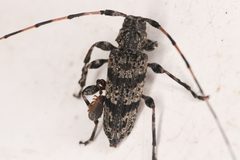
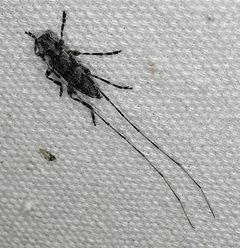
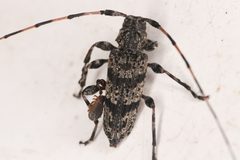
Acanthocinus obliquus is a of longhorn beetle in the Lamiinae, described by John Lawrence LeConte in 1862. It belongs to the tribe Acanthocinini, a group characterized by somber coloration and wood-boring larvae. The species is distributed across North America, with records from western Canada and the United States. Like other members of its , it is associated with coniferous forests and likely exhibits cryptic coloration adapted to pine bark.
Pronunciation
How to pronounce Acanthocinus obliquus: /əˌkænθoʊˈsaɪnəs əˈblɪkwəs/
These audio files are automatically generated. While they are not always 100% accurate, they are a good starting point.
Identification
Members of the Acanthocinus can be distinguished from similar longhorn beetles by their elongated bodies, relatively long (especially in males), and somber gray to black coloration with variable dark markings. The A. obliquus specifically may be separated from such as A. nodosus and A. princeps by subtle differences in elytral patterning and body proportions, though precise diagnostic features require examination of or specialized keys.
Images
Habitat
Associated with coniferous forests, particularly pine-dominated . have been observed on pine trunks, and larvae likely develop in dead or dying pine wood.
Distribution
North America, including western Canada (Alberta, British Columbia) and the United States. The is present in Middle America according to distribution records.
Host Associations
- Pinus - larval Inferred from -level association with pines; specific records for A. obliquus not documented in provided sources
Ecological Role
As a wood-boring , larvae contribute to decomposition of dead and dying coniferous wood, facilitating nutrient cycling in forest . may serve as prey for birds and other .
Human Relevance
Like other native cerambycids, this may be incidentally transported in wood packaging materials, contributing to intra-country range expansion through domestic trade networks. Not known to be a significant economic pest.
Similar Taxa
- Acanthocinus nodosusSimilar somber gray coloration with dark markings and shared coniferous ; distinguished by differences in elytral pattern and body proportions
- Acanthocinus princepsOverlapping geographic range and pine association; A. princeps specifically associated with ponderosa pine and may differ in antennal proportions
- Acanthoderes quadrigibbaDistinct -shaped elytral pattern and four pronotal ; not a but mentioned in similar identification challenges due to patterned
More Details
Taxonomic history
The was described by John Lawrence LeConte in 1862, a prolific 19th-century American entomologist who described numerous North American cerambycids.
Nomenclatural note
The specific epithet 'obliquus' (meaning slanting or oblique) may refer to the angled or slanting markings on the , a common naming convention in this .
Sources and further reading
- BugGuide
- Wikipedia
- GBIF taxonomy match
- iNaturalist taxon
- Catalogue of Life
- Bug Eric: Beetle Bonanza
- Nomenclatural changes in Phymatodes | Beetles In The Bush
- Naturalists can mediate silent plankton invasions | Blog
- Domestic Sea Trade Aids Wood-Boring Beetles' Range Expansion
- More on ‘Conspicuous Crypsis’ | Beetles In The Bush
- ID Challenge #9 | Beetles In The Bush