
Acanthocinus princeps
(Walker, 1866)
Ponderosa Pine Bark Borer
Acanthocinus princeps, commonly known as the ponderosa pine bark borer, is a longhorn beetle in the Lamiinae. First described by Francis Walker in 1866, this is associated with coniferous forests, particularly those containing ponderosa pine. are active during spring and early summer, with larvae developing beneath bark. The species has been documented in western North America including British Columbia and the western United States.
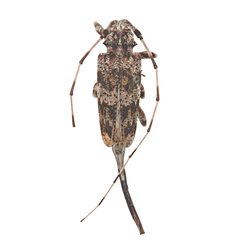
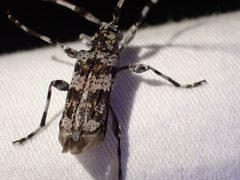
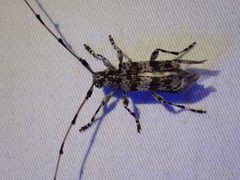
Pronunciation
How to pronounce Acanthocinus princeps: //əˌkænθoʊˈsaɪnəs ˈprɪnsɛps//
These audio files are automatically generated. While they are not always 100% accurate, they are a good starting point.
Images
Habitat
Coniferous forests, particularly those dominated by ponderosa pine (Pinus ponderosa). Associated with bark and wood of living or recently dead conifers.
Distribution
North America; recorded from British Columbia, Canada and the western United States.
Seasonality
active in spring and early summer; larval development occurs beneath bark.
Host Associations
- Pinus ponderosa - larval primary , larvae develop beneath bark
Life Cycle
Complete with , larva, pupa, and stages. Larvae are wood-borers that develop beneath the bark of conifers.
Ecological Role
Wood-boring whose larvae contribute to decomposition of weakened or dead conifers. May act as a secondary pest on stressed trees.
Human Relevance
Potential forest pest; larvae damage bark and outer wood of conifers. Documented as one of the more abundant cerambycid in some port surveys, suggesting potential for human-assisted via wood packaging materials.
Similar Taxa
- Acanthocinus aediliscongeneric with similar and , also associated with coniferous forests
- Acanthoderes quadrigibbalamiine cerambycid with somewhat similar elytral patterning, though distinct in pronotal structure
More Details
Taxonomic note
name 'princeps' is Latin for 'chief' or 'leader', though the specific etymology for this species has not been documented in primary literature. Placed in Acanthocinus, characterized by spines on the pronotum and antennal segments in some species.
Research context
Documented in Italian port surveys as one of the more abundant native cerambycid associated with wood packaging, indicating potential for range expansion via domestic trade routes.
Sources and further reading
- BugGuide
- Wikipedia
- GBIF taxonomy match
- iNaturalist taxon
- Catalogue of Life
- ID Challenge #9 | Beetles In The Bush
- Bug Eric: How Baskettails Got Their Name
- Domestic Sea Trade Aids Wood-Boring Beetles' Range Expansion
- parasitoids | Blog - Part 2
- spiders | Beetles In The Bush | Page 4
- Araneae | Beetles In The Bush | Page 4