
Spalangia drosophilae
Ashmead, 1887
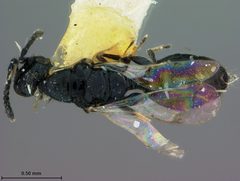
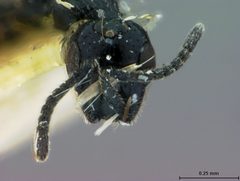
Spalangia drosophilae is a small in the Pteromalidae that attacks the of various Diptera. Originally described from North America in 1887, this has been documented as a parasitoid of frit flies (), house flies, stable flies, and other muscoid flies in agricultural and pastoral settings. Females exhibit sophisticated -finding , using sensory cues to locate damp, grassy areas where host puparia occur. The species demonstrates host discrimination abilities to avoid , though this restraint breaks down under high -host ratios. It has been recorded from the Galápagos Islands, western North America, and Brazil, and is utilized in programs for filth fly management in livestock operations.

Pronunciation
How to pronounce Spalangia drosophilae: /spəˈlændʒiə drɒˈsɒfɪli.iː/
These audio files are automatically generated. While they are not always 100% accurate, they are a good starting point.
Images
Habitat
Damp, grassy areas with soil level where occur; pastures with bovine ; manure accumulations in livestock facilities. Females are attracted to dampness and soil level in grassy environments where dipteran hosts are likely to be found.
Distribution
Galápagos Islands; western North America (Alberta, Arizona, Arkansas, British Columbia); Brazil (Goiás). Records indicate presence in both natural and agricultural .
Host Associations
- Oscinella frit - Natural field ; frit fly, a pest of cereal crops
- Drosophila melanogaster - Laboratory used in behavioral studies
- Hippelates collusor - used in behavioral studies on spatial distribution effects
- Brontaea debilis - Muscid fly from bovine in Brazil; 33.7% rate documented
- Peckia chrysostoma - Sarcophagid fly from human traps in Brazilian forest; 21.6%
Behavior
Females locate through sensory-mediated attraction to environmental cues, particularly dampness and soil level in grassy areas. Host searching appears random within suitable , but careful examination precedes oviposition. Females exhibit host discrimination, distinguishing parasitized from unparasitized puparia; examination of unparasitized hosts averages 3.5 minutes, while parasitized hosts are rejected in half that time or accepted only after prolonged examination. Restraint from ovipositing in already-parasitized hosts typically breaks down after approximately three successive unsuitable encounters. avoidance is effective at low -host ratios but increases as host availability decreases relative to parasite numbers. Females show greater initial attraction to clumped host distributions than linear arrangements. -laying output adapts to host availability: restricted to fewer than two eggs daily with single hosts, rising to 9-11 eggs on first day with excess hosts.
Ecological Role
agent; of dipteran pests associated with livestock manure and agricultural settings. Contributes to natural suppression of filth fly including house flies, stable flies, and other muscoid flies that pose nuisance and transmission risks to livestock and humans.
Human Relevance
Used in programs for livestock facilities, particularly for control of house flies and stable flies in cattle and poultry operations. Commercially available as part of mixes for of filth flies. Effectiveness depends on proper release timing (every two weeks minimum), adequate release rates, and compatible manure management practices that avoid excessive moisture or residues.
Similar Taxa
- Spalangia nigroaeneaCongeneric also used in of filth flies; both attack fly in manure-breeding . S. nigroaenea is specifically mentioned in poultry pest management literature as a commercially available biological control agent.
- Muscidifurax spp.Pupal frequently co-occurring in commercial products; both target filth fly . Research indicates Muscidifurax may prefer bovine manure while Spalangia species show preference for equine manure, suggesting differentiation.
More Details
Taxonomic Note
The -level classification of Spalangia has varied historically. Catalogue of Life places S. drosophilae in Spalangiidae, while GBIF and many contemporary sources treat it as Pteromalidae: Spalangiinae. The Entomology Research Museum primary type list uses Pteromalidae.
Commercial Use Considerations
Suppliers typically sell Spalangia in mixed products because pure cultures are difficult to maintain without . Research suggests -specific preferences for different manure types may affect field performance, indicating potential value in selecting appropriate species mixes for specific livestock operations.
Sources and further reading
- BugGuide
- GBIF taxonomy match
- iNaturalist taxon
- Catalogue of Life
- spalangia_xanthoscapa_gibson_holotype_ucrc_ent_146423_lateral.jpg | Entomology Research Museum
- Primary Type List | Entomology Research Museum
- Poultry Pest Management - AgriLife Extension Entomology
- Managing External Parasites of Texas Cattle - AgriLife Extension Entomology
- Spalangia Archives - Entomology Today
- Open-access Article Offers Horse Owners Advice on How to Control Flies with Parasitoid Wasps
- Superparasitism bySpalangia drosophilaeAshm
- Host Finding and Selection bySpalangia drosophilaeAshm.
- DISTRIBUTION PATTERN OF HOSTS AND PARASITIZATION BY SPALANGIA DROSOPHILAE (HYMENOPTERA: PTEROMALIDAE)
- NOVO HOSPEDEIRO E HABITAT PARA O PARASITÓIDE SPALANGIA DROSOPHILAE ASHMEAD (HYMENOPTERA: PTEROMALIDAE) NO BRASIL
- Brontaea debilis (Thomson, 1896) (Diptera: Cyclorrhapha: Muscidae) as host for Spalangia drosophilae Ashmead, 1885 (Hymenoptera: Pteromalidae: Spalanginae) in Brazil
- Observations on the Biology and Mass-breeding of Spalangia drosophilae Ashm. (Hymenoptera, Spalangiidae), a Parasite of the Frit-fly, Oscinella frit (L.)