
Ceratitis
MacLeay, 1829
Mediterranean fruit flies
Species Guides
1- Ceratitis capitata(Mediterranean fruit fly)
Ceratitis is a of tephritid fruit flies comprising approximately 80 , with () being the most economically significant and widely studied. The genus is organized into six subgenera: Acropteromma, Ceratalaspis, Ceratitis, Hoplolophomyia, Pardalaspis, and Pterandrus. Multiple Ceratitis species are major agricultural pests, particularly in Africa, the Mediterranean region, and areas where they have been introduced. The genus has been extensively studied for sterile insect technique applications, with C. capitata serving as a model organism for research.
Pronunciation
How to pronounce Ceratitis: //ˌsɛrəˈtaɪtɪs//
These audio files are automatically generated. While they are not always 100% accurate, they are a good starting point.
Identification
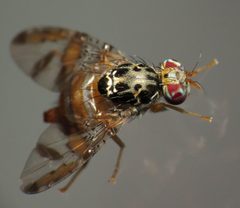
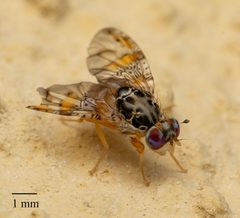
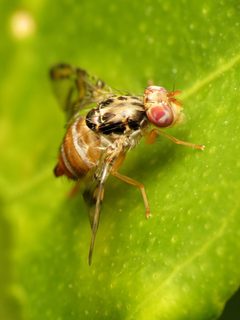
Ceratitis are distinguished from other tephritid fruit fly by characteristic wing patterns and body , though specific diagnostic features vary by subgenus. typically display patterned wings with dark markings and spots. Identification to species level requires examination of morphological characters including wing venation, body coloration patterns, and male genitalia. Larval identification is difficult and requires specialized expertise; molecular methods are increasingly used for accurate species determination. The genus is most readily confused with Bactrocera and Anastrepha, but differs in wing pattern details and geographic distribution.
Images
Habitat
Ceratitis occupy diverse ranging from natural vegetation to agricultural systems. Native African species occur in tropical and subtropical forests, savannas, and woodland edges. Agricultural thrive in orchards, fruit plantations, and areas with abundant plants. The introduced range of C. capitata extends to Mediterranean climates, temperate regions with suitable hosts, and urban areas with backyard fruit trees. Habitat suitability is primarily determined by host plant availability and temperature .
Distribution
The is native to sub-Saharan Africa, with highest in tropical and southern African regions. C. capitata has established worldwide, including the Mediterranean basin, Middle East, Central and South America, Hawaii, and Australia. Other with expanded ranges include C. rosa (Natal fruit fly) in Africa and Indian Ocean islands, and C. cosyra (mango fruit fly) across sub-Saharan Africa. C. quinaria occurs disjunctly in West Africa, Red Sea region, and eastern/southern Africa.
Seasonality
Activity patterns vary by and climate. In temperate regions, C. capitata is active during warmer months with peaks in summer. In tropical and subtropical regions, multiple overlapping occur year-round with seasonal fluctuations tied to fruit availability and rainfall. In Egypt, C. capitata completes 8–10 generations annually. South African studies show seasonal varies among sympatric species, with C. rosa often peaking in cooler months while C. capitata and C. cosyra show different seasonal patterns.
Diet
Larvae feed internally on fruit pulp of numerous plants. C. capitata has an exceptionally broad host range exceeding 300 plant across multiple , including citrus, stone fruits, pome fruits, and tropical fruits. Other species show narrower host associations: C. cosyra is particularly associated with mango; C. quinaria is a major pest of mango; C. rosa infests rosaceous and other fruits. feed on sugary substances including fruit juices, nectar, and honeydew, and require protein sources for reproductive maturation.
Host Associations
- Citrus spp. - primary Major economic for C. capitata; includes orange, grapefruit, lemon
- Mangifera indica - primary Critical for C. cosyra and C. quinaria; also utilized by C. capitata and C. rosa
- Prunus persica - Peach; significant for C. capitata and C. rosa
- Psidium guajava - Guava; common for multiple African Ceratitis
- Persea americana - poor Hass avocado is unsuitable for C. capitata, C. rosa, and C. cosyra based on South African studies
- Ficus carica - Fig; documented for C. capitata in Egypt
Life Cycle
Females deposit beneath the fruit using a retractable ovipositor. Larvae pass through three instars while feeding on fruit pulp, causing internal damage and facilitating secondary fungal and microbial . Mature third-instar larvae exit fruit and pupate in soil. Development rate is temperature-dependent; C. capitata completes development from egg to in 21–100 days depending on conditions. time allows multiple generations in favorable climates.
Behavior
Mating involves complex courtship with males producing and engaging in lekking or territorial displays. Females exhibit selection behavior, probing fruit with the ovipositor to assess suitability. Food-deprived individuals show increased responsiveness to food odors, with protein-deprived females particularly attracted to protein sources. are and exhibit strong capacity, with C. capitata capable of dispersing several kilometers. Mating behavior can be altered by fungal .
Ecological Role
Native African Ceratitis function as fruit consumers and seed in natural . In agricultural contexts, they act as primary pests causing direct fruit damage and indirect losses through premature fruit drop and secondary entry. They serve as prey for various natural enemies including birds (hornbills, hoopoes), predatory beetles, ants, spiders, and . and fungi can regulate . The has become a model system for studying invasion and .
Human Relevance
Ceratitis rank among the world's most economically damaging fruit pests, with C. capitata alone causing losses exceeding $2 billion globally. Direct damage includes fruit destruction, yield reduction, and quality degradation; indirect costs encompass restrictions, export market closures, programs, and applications. The sterile insect technique was pioneered and is widely deployed against C. capitata, involving mass-rearing, irradiation of pupae, and release of sterile males. Detection relies on extensive trapping networks using food-based and lures. Quarantine regulations for C. capitata, C. quinaria, and other species restrict international fruit trade. Research on Ceratitis has driven advances in machine learning applications for insect age determination and simulation modeling for survey optimization.
Similar Taxa
- BactroceraOverlapping geographic range in Africa and Asia; both are dacine fruit flies with patterned wings and economic importance; distinguished by wing pattern details, male genitalia, and molecular characters
- AnastrephaSimilar body plan and pest status in the Americas; distinguished by wing patterns, geographic distribution (primarily Neotropical), and larval
- RhagoletisTephritid fruit flies with similar and economic impact in temperate regions; distinguished by wing patterns, associations, and geographic distribution
More Details
Subgeneric classification
The contains six subgenera: Acropteromma (sometimes treated as separate genus), Ceratalaspis, Ceratitis, Hoplolophomyia, Pardalaspis, and Pterandrus. Subgeneric placement reflects morphological and presumably phylogenetic relationships, though comprehensive molecular phylogenetic studies remain incomplete.
Sterile insect technique applications
C. capitata is the most widely used for SIT implementation globally. Critical to success is precise timing of pupal irradiation, typically 2 days before . Recent research has applied machine learning algorithms to determine pupal physiological age from color images, achieving 83% for C. capitata.
Research significance
The serves as a model for invasion research. James R. Carey's work on C. capitata establishment in California contributed to scientific understanding of pest dynamics and influenced policy discussions regarding versus management approaches.
Sources and further reading
- BugGuide
- Wikipedia
- GBIF taxonomy match
- iNaturalist taxon
- NCBI Taxonomy
- Catalogue of Life
- Of Medflies and Light Brown Apple Moths | Bug Squad
- CDFA to Host Fruit Fly Workshop, Free to Participants | Bug Squad
- A Glimpse of George Compere, a Pioneer in Biological Control | Bug Squad
- New Guide Outlines Management for Mediterranean Fruit Fly in Egypt
- Artificial Intelligence Performs Key Step in Fruit Fly Management
- Researchers Use Simulation Model to Optimize Delimitation Trapping Surveys
- Effect of Metarhizium anisopliae inoculation on the mating behavior of three species of African Tephritid fruit flies, Ceratitis capitata, Ceratitis cosyra and Ceratitis fasciventris
- The Distribution, Relative Abundance, and Seasonal Phenology ofCeratitis capitata,Ceratitis rosa, andCeratitis cosyra(Diptera: Tephritidae) in South Africa
- Host Status of Avocado (‘Hass’) to <I>Ceratitis capitata</I>, <I>Ceratitis rosa</I>, and <I>Ceratitis cosyra</I> (Diptera: Tephritidae) in South Africa
- Effect of food deprivation on attractiveness of food sources, containing natural and artificial sugar and protein, to three African fruit flies: Ceratitis cosyra, Ceratitis fasciventris, and Ceratitis capitata
- Geographic Distribution, Host Fruit, and Parasitoids of African Fruit Fly Pests <I>Ceratitis anonae</I>, <I>Ceratitis cosyra</I>, <I>Ceratitis fasciventris</I>, and <I>Ceratitis rosa</I> (Diptera: Tephritidae) in Kenya
- Ceratitis capitata (Mediterranean fruit fly).
- Spatio-temporal distribution of Ceratitis capitata population in a heterogeneous landscape in Central Italy
- Ceratitis quinaria (five-spotted fruit fly).
- Effect of male age at the time of irradiation on the sexual performance of sterile Ceratitis capitata males: insights from remating female offspring.