
Dacinae
Cucurbit Fruit Flies
Genus Guides
2- Bactrocera(fruit flies)
- Ceratitis(Mediterranean fruit flies)
The Dacinae are a of true fruit flies ( Tephritidae) comprising 39-41 distributed among three tribes: Dacini, Ceratitidini, and Gastrozonini. The subfamily includes some of the world's most economically damaging agricultural pests, notably in the genera Bactrocera, Zeugodacus, Ceratitis, and Dacus. Many dacine species are attracted to specific male lures such as methyl eugenol, cue-lure, and zingerone, which are widely used in monitoring and management programs. The subfamily has a predominantly tropical and subtropical distribution, with significant impacts on fruit and vegetable production across Asia, Africa, the Americas, and Australia.
Pronunciation
How to pronounce Dacinae: /ˈdæ.sɪ.niː/
These audio files are automatically generated. While they are not always 100% accurate, they are a good starting point.
Identification
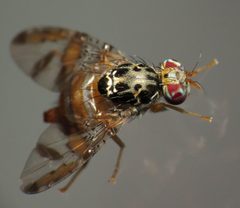
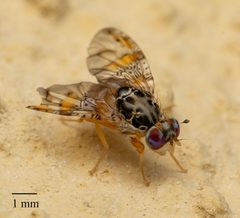
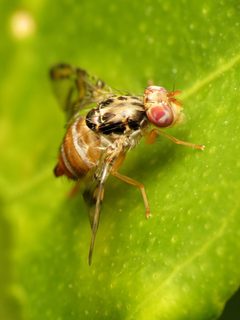
Dacinae can be distinguished from other Tephritidae by a combination of morphological features including wing venation patterns and abdominal structures. Members of the tribe Dacini (the largest tribe) possess an oval-shaped epandrium in males and an unpatterned praeputium, features that separate them from related . -level identification relies on detailed examination of postabdominal structures, particularly male genitalia and female ovipositor . The subfamily includes diverse body forms ranging from small to medium-sized flies, often with distinctive wing patterns; however, many economically important species have reduced or cryptic wing markings compared to other tephritid groups.
Images
Habitat
Dacinae occupy tropical and subtropical regions worldwide, with associated with diverse from lowland rainforests to agricultural landscapes and urban gardens. Many species are closely tied to their plants, occurring in orchards, vegetable fields, and areas with abundant fruiting vegetation. The demonstrates considerable habitat plasticity, with some species thriving in disturbed agricultural environments while others remain restricted to native vegetation.
Distribution
The has a global tropical and subtropical distribution, with major centers of diversity in Asia, Africa, and Australia. In Asia, dacine fruit flies are documented from southern China, India, Nepal, Cambodia, and throughout Southeast Asia. African representation includes South Africa and broader sub-Saharan regions. The Mediterranean fruit fly (Ceratitis capitata) and related are established in Europe and have been repeatedly introduced to the Americas. In Australia, multiple Bactrocera and Zeugodacus species are native or established, including the Queensland fruit fly (Bactrocera tryoni). Several species have become beyond their native ranges through international trade in fruits and vegetables.
Host Associations
- Cucurbitaceae - Multiple Zeugodacus are specialized on cucurbits, including the (Z. cucurbitae) and cucumber fruit fly (Z. cucumis)
- Rutaceae - Citrus are utilized by several Bactrocera , including B. minax
- Solanaceae - Some infest solanaceous vegetables
- Various fruits - such as B. dorsalis and B. tryoni attack diverse fruits including mango, peach, nectarine, apricot, avocado, grapefruit, orange, and cherry
Behavior
Male dacine fruit flies exhibit strong attraction to specific chemical compounds used as or . These lures—methyl eugenol, cue-lure, zingerone, and lati-lure—are -specific and form the basis of worldwide monitoring and control programs. Males of some species engage in lekking , aggregating on plants to attract females. Females exhibit precise host selection behavior, using olfactory and visual cues to locate suitable oviposition sites. Larval development occurs within host fruits, with feeding behavior causing direct damage to commercial crops.
Human Relevance
Dacinae include the world's most destructive agricultural fruit fly pests, causing billions of dollars in losses and control costs. Major pest include the Mediterranean fruit fly (Ceratitis capitata), (), Queensland fruit fly (Bactrocera tryoni), (Zeugodacus cucurbitae), and Mexican fruit fly (Anastrepha ludens, though this belongs to a different ). These species trigger extensive regulations, international trade restrictions, and programs. Management strategies include male annihilation using lure traps, sterile insect technique, sprays, and post-harvest treatments. The subfamily is a primary focus of agricultural biosecurity and programs globally.
Similar Taxa
- TephritinaeAnother of Tephritidae; Dacinae can be distinguished by male lure attraction chemistry and distinct wing venation patterns, whereas Tephritinae typically display more elaborate wing patterns and lack the dacine-specific systems
- Trypetinae of Tephritidae with different associations and morphological features; Dacinae generally have more robust bodies and different abdominal structures
- Anastrepha (subfamily Anastrephinae or Trypetinae depending on classification)New World fruit fly with similar economic importance; distinguished by different wing patterns, lack of dacine-specific male lures, and geographic distribution primarily in the Americas
Sources and further reading
- BugGuide
- Wikipedia
- iNaturalist taxon
- NCBI Taxonomy
- Catalogue of Life
- CDFA to Host Fruit Fly Workshop, Free to Participants | Bug Squad
- Medflies: Permanent Residents | Bug Squad
- Hot, Humid Conditions Degrade DNA Quality in Fruit Fly Samples
- Chemical Ecology of Dacinae Fruit Flies (Diptera: Tephritidae)
- Behavior of Flies in the Genus Ceratitis (Dacinae
- A checklist of the Dacinae (Diptera: Tephritidae) of South Africa
- Behavior of Flies in the Genus Ceratitis (Dacinae: Ceratitidini)
- NOTES ON THE DACINAE OF SOUTHERN CHINA (DIPTERA: TEPHRITIDAE)
- Sexual Behavior and Sexual Selection in the Mediterranean Fruit Fly, Ceratitis capitata (Dacinae: Ceratitidini)
- Phylogeny of the Tribe Dacini (Dacinae) Based on Morphological, Distributional, and Biological Data
- The Biology and Behavior of Flies in the Tribe Dacini (Dacinae)
- Review of cucumber fruit fly, Bactrocera cucumis (French) (Diptera: Tephritidae: Dacinae): Part 2, biology, ecology and control in Australia
- Morphological Features of the Tribe Dacini (Dacinae): Their Significance to Behavior and Classification
- New species, redescriptions and phylogenetic revision of tribe Dacini (Diptera: Tephritidae: Dacinae) from India based on morphological characters
- Sexual Behavior and Sexual Selection in the Mediterranean Fruit Fly, Ceratitis capitata (Dacinae
- Review of cucumber fruit fly, Bactrocera cucumis (French) (Diptera: Tephritidae: Dacinae) in Australia: Part 1, host range, surveillance and distribution
- Description of a new species and new country distribution records of Bactrocera (Diptera: Tephritidae: Dacinae) from Cambodia
- Fruit Flies (Diptera: Tephritidae: Dacinae: Dacini) Species Diversity In Nepal: A Review
- Characterization of the Complete Mitogenomes of Four Dacinae Species (Diptera: Tephritidae) with Phylogenetic Analysis.