
Tephritinae
Tribe Guides
9- Acrotaeniini(Acrotaeniini fruit flies)
- Cecidocharini
- Dithrycini
- Eutretini
- Myopitini
- Noeetini
- Tephritini
- Terelliini
- Xyphosiini
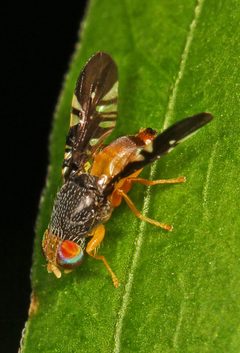
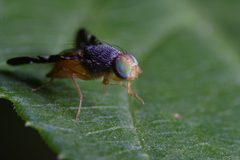
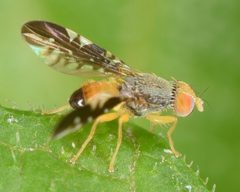
Tephritinae is a of tephritid fruit flies comprising approximately 2,000 described across 11 recognized tribes and several unplaced . Members are predominantly non-frugivorous, with many species specialized on flowerheads of Asteraceae. The subfamily exhibits a global distribution and is notable for widespread associations with co-evolved bacterial of the genus Candidatus Stammerula.
Pronunciation
How to pronounce Tephritinae: /tɛˈfrɪtɪneɪ/
These audio files are automatically generated. While they are not always 100% accurate, they are a good starting point.
Images
Distribution
Global distribution, with documented occurrences in the Palearctic, Hawaiian Archipelago, Australasia, East Africa, and the Arabian Peninsula.
Host Associations
- Vernonia - plantAll East African of Microtreta (Schistopterini) recorded on this (Asteraceae)
More Details
Bacterial symbiosis
Many Tephritinae harbor co-evolved, vertically transmitted bacterial of Candidatus Stammerula (Enterobacteriaceae) in their . This association has been documented in Palearctic, Hawaiian, and Australian Tephritini, with phylogenetic analyses showing substantial -symbiont cophylogeny and cospeciation patterns.
Tribal classification
The contains 11 tribes: Acrotaeniini, Cecidocharini, Dithrycini, Eutretini, Myopitini, Noeetini, Schistopterini, Tephrellini, Tephritini, Terelliini, and Xyphosiini. Four (Acinia, Lilloaciura, Rhithrum, Tanaodema) remain unplaced (incertae sedis). Tephritini is the largest tribe with 976 in 80 genera.
Sources and further reading
- BugGuide
- Wikipedia
- iNaturalist taxon
- NCBI Taxonomy
- Catalogue of Life
- Behavior of Flies in the Subfamily Tephritinae
- Behavior of Flies in the Subfamily Tephritinae
- Systematics of Schistopterini (Diptera: Tephritidae: Tephritinae), with descriptions of new genera and species
- Detection of a conserved bacterial symbiosis in non-frugivorous Australian fruit flies (Diptera, Tephritidae, Tephritinae) supports its widespread association
- Detection of a Conserved Bacterial Symbiosis in non-frugivorous Australian Fruit Flies (Diptera, Tephritidae, Tephritinae) Supports its Widespread Association.