
Clitostethus arcuatus
(Rossi, 1794)
Horseshoe Ladybird
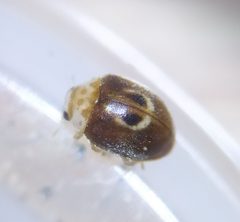
Clitostethus arcuatus is a minute ladybird beetle in the Scymninae, measuring 1.3–1.5 mm as an . Native to Europe, it has been introduced or reported from Bermuda and is expanding its range northward in European Russia. It serves as an important agent of whitefly pests, particularly the ash whitefly Siphoninus phillyreae, and has been evaluated for biocontrol programs.


Pronunciation
How to pronounce Clitostethus arcuatus: /ˌklaɪtoʊˈstiːθəs ɑrˈkjuːətəs/
These audio files are automatically generated. While they are not always 100% accurate, they are a good starting point.
Identification
are distinguished by their small size (1.3–1.5 mm), black to light brown coloration with a yellow lateral area on the pronotum, and a yellow band on the with a dark discal spot. The "Horseshoe Ladybird" likely refers to the arcuate yellow marking pattern.
Images
Habitat
Found in urban and suburban environments, parks, gardens, and greenhouses. Associated with deciduous trees, particularly ash (Fraxinus spp.), as well as apple, pear, apricot, acer, plum, and other small trees and shrubs. Overwinters in leaf litter, bark crevices, clods of earth, and plant debris.
Distribution
Native to Europe; reported from the Palaearctic region including Iran, former USSR, Sardinia, Portugal, Africa, Italy, USA, Germany, former Yugoslavia, Greece, and Iraq. Expanding northward in European Russia with new records from the Central Federal District. Also reported from Bermuda and the Azores (Faial, Graciosa, Pico, São Jorge, São Miguel).
Seasonality
active from April to October, with peak abundance in July–August in European Russia and mid-August and mid-October in Fars Province, Iran. Four per year in Iran. Hibernation occurs from mid-December to spring, triggered by shedding of ash leaves.
Diet
Specialized of whiteflies (Aleyrodidae), primarily Siphoninus phillyreae and nymphs. Also preys on Trialeurodes vaporariorum, Bemisia tabaci, Dialeurodes citri, Aleurotrahelus jelinekii, Aleurodes proletella, and unspecified . Consumes eggs of Tetranychus urticae. Fourth instar larvae and females exhibit highest feeding rates.
Host Associations
- Siphoninus phillyreae - primary preyash whitefly; and nymphs consumed
- Trialeurodes vaporariorum - preygreenhouse whitefly
- Bemisia tabaci - prey
- Dialeurodes citri - prey
- Aleurotrahelus jelinekii - prey
- Aleurodes proletella - prey
- Tetranychus urticae - prey only
- Fraxinus excelsior - plantcommon ash; supports Siphoninus phillyreae
Life Cycle
Four larval instars with total -to- development averaging 15.6 days under laboratory conditions (27±1°C, 38±2% RH, 16:8 L:D). Egg incubation: 3.8 days. Larval development: 11.4 days (1st instar 2.5 days, 2nd 3.5 days, 3rd 3.4 days, 4th 4.3 days). Pupal stage: 3.9 days. First larval instar most vulnerable with highest mortality (6.2%). Multivoltine with overlapping ; four generations per year in Iran.
Behavior
laid preferentially on lower leaf surfaces near masses of Siphoninus phillyreae eggs and inside empty whitefly through exit holes left by emerging , likely for protection. First instar larvae relatively immobile, feeding on limited leaf surface area; later instars move rapidly and feed on all nymphal stages with preference for eggs. Feeding activity peaks 2 hours after starvation then declines to minimum at 5 hours, with secondary smaller peak at 12 hours. can survive maximum 4 days without food.
Ecological Role
Important natural agent of ash whitefly and other whitefly pests. closely track prey availability, with increase leading to prey decline. Significant role in suppression of Siphoninus phillyreae in programs.
Human Relevance
Evaluated and used in biocontrol programs for management of whitefly pests in agricultural and greenhouse settings, particularly for Siphoninus phillyreae on pomegranate and other crops.
Sources and further reading
- BugGuide
- Wikipedia
- GBIF taxonomy match
- iNaturalist taxon
- NCBI Taxonomy
- Euhagena nebraskae… again | Beetles In The Bush
- New Data on the Distribution and Hosts of the Ladybird Clitostethus arcuatus (Rossi) (Coleoptera, Coccinellidae) in European Russia
- Biology and Feeding Behaviour of Ladybird,Clitostethus arcuatus, the Predator of the Ash Whitefly,Siphoninus phillyreae, in Fars Province, Iran
- Augmentation and evaluation of a parasitoid,Encarsia inaron, and a predator,Clitostethus arcuatus, for biological control of the pomegranate whitefly,Siphoninus phillyreae