
Dialeurodes citri
(Ashmead, 1885)
Citrus Whitefly
, the citrus whitefly, is a pest native to Southeast Asia that has become established in citrus-growing regions worldwide. and stages feed on phloem sap, secreting honeydew that promotes growth. The completes 2–3 annually in most regions, with development arrested in the fourth instar during cooler months. It is distinguished from the similar Parabemisia myricae by its larger size, preference for fully developed leaves, and slower .
Pronunciation
How to pronounce Dialeurodes citri: /dɪˌæl.jʊəˈroʊ.diːz ˈsɪtraɪ/
These audio files are automatically generated. While they are not always 100% accurate, they are a good starting point.
Identification
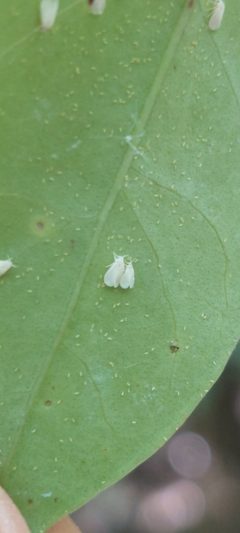
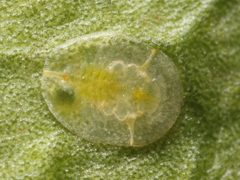
Larger than Parabemisia myricae; confined to fully developed leaves rather than youngest unfolded foliage. are small, -like whiteflies with white, powdery wings. stages are , -like, and found on lower leaf surfaces. Distinguished from P. myricae by : D. citri appears later in spring and completes only 2–3 per year versus 7–8 for P. myricae.
Images
Habitat
Dense citrus stands with high humidity and limited air movement; prefers inner and shaded sides of trees for oviposition. Thrives in orchard environments with minimal wind exposure.
Distribution
Native to Southeast Asia; established in Mediterranean region (Turkey since 1976, Israel since 1975, France, Greece, Italy, Spain), North Africa, South Asia (India, Pakistan, Bangladesh, Sri Lanka), East Asia (China, Japan, Korea, Taiwan), Middle East, Americas (USA including California and Florida, Mexico, Central and South America), and Australia.
Seasonality
Completes 2–3 per year in most regions; first generation April–June, second July–August, third September–April with in fourth instar. peaks vary regionally: October and April–August in Egypt; spring through fall activity in Mediterranean climates.
Diet
Phloem-feeding on Citrus and related Rutaceae; also recorded on Coffea arabica, Gardenia jasminoides, Melia species, and various ornamental trees and shrubs.
Life Cycle
→ four nymphal instars → pupal stage (fourth instar with red ) → . Under laboratory conditions (25°C, 16:8 L:D): egg 12.1 days, first instar 6.5 days, second instar 5.5 days, third instar 7.6 days, fourth instar 18 days, pupal (red eye) stage 4.7 days; total ~54 days. Field times: 65 days (spring), 52 days (summer), 8 months ( generation). Female averages 151 eggs. Adult longevity 16–19 days.
Behavior
preferentially oviposit on young, fully developed leaves in shaded inner positions. stages are and feed on lower leaf surfaces. Development arrested by shortened and reduced temperature October–April.
Ecological Role
Herbivore; honeydew secretion supports fungi that reduce . Preimaginal mortality in California ranges 56–94%, attributed primarily to . Serves as for introduced agent Encarsia lahorensis and subject to natural by fungus Aschersonia aleyrodis.
Human Relevance
Major pest of citrus production causing direct damage through sap removal and indirect damage via . Competes with other whitefly ; suppressed by cultural methods (wide spacing, pruning, white oil sprays) and . Subject to ongoing programs in commercial citrus regions.
Similar Taxa
- Parabemisia myricaeOverlapping distribution and ; distinguished by smaller size, preference for youngest unfolded leaves, earlier spring appearance, and faster (7–8 annually). P. myricae competitively excludes D. citri where both occur, though of P. myricae can allow D. citri recovery.
- Dialeurodes kirkaldyiCongeneric citrus whitefly with similar and ; precise distinction requires examination of pupal case characters.
Sources and further reading
- BugGuide
- GBIF taxonomy match
- iNaturalist taxon
- NCBI Taxonomy
- Catalogue of Life
- Molecular Biologist Michelle Heck: Challenges of Citrus Greening Disease | Bug Squad
- Walter Leal: Special Award for Citrus Pest Research | Bug Squad
- Check Your Citrus Trees for Signs of This Pest | Bug Squad
- Deadly Citrus Greening Disease: A Better Lure for Asian Citrus Psyllids | Bug Squad
- Research Examines Potential of Alternate Host Plant as a Trap Crop for Asian Citrus Psyllid
- Wasps Used to Combat Citrus Greening Disease are Unlikely to Threaten Non-target Insects
- Dialeurodes citri . [Distribution map].
- Dialeurodes citri . [Distribution map].
- Biology of citrus whitefly, Dialeurodes citri (Ashmead) on Citrus reticulate (Mandarin) var. Kinnow
- Fecundity, survival and life cycle of the citrus white-fly, Dialeurodes citri (Ashm.)
- Stability in the host-parasitoid relationship of Dialeurodes citri and Encarsia lahorensis in the citrus orchard
- Seasonal Population Trends of Lepidosaphes beckii, Dialeurodes citri and its Parasitoids on Balady Orange Orchid in Egypt
- Distribution on the Côte d'Azur of Encarsia lahorensis (How.), a parasite introduced against the citrus white-fly, Dialeurodes citri (Ashm.)
- STUDYING THE EFFICACY OF ALLCHUNGKILL CYC.K. AGAINST CITRUS CITRUS WHITEFLY (DIALEURODES CITRI ASHM.) IN CULTURE LEMON
- Field population biology of citrus whitefly, Dialeurodes citri (Ashmead) (Heteroptera: Aleyrodidae), on oranges in California
- EFFECIENCY OF TWO ORGANOPHOSPHOURUS INSECTICIDES ON THE CITRUS WHITEFLY, DIALEURODES CITRI WITH SPECIAL REFERENCE TO THEIR RESIDUAL BEHAVIOUR ON ORANGE FRUITS.
- The biology and phenology of the citrus whitefly, Dialeurodes citri, on citrus in the Coastal Plain of Israel
- Two species of whiteflies on citrus in Eastern Mediterranean: Parabemisia myricae (Kuwana) and Dialeurodes citri (Ashmead)
- Natural occurrence of entomopathogenic fungus, <i>Aschersonia aleyrodis</i> on citrus whitefly, <i>Dialeurodes citri</i> (Ashmead) in Kinnow mandarin in Punjab, India
- Interactions between two introduced species of whiteflies in the mediterranean area of Turkey: Dialeurodes citri (Ashmead) and Parabemisia myricae (Kuwana) (Hom., Aleyrodidae)