
Clitostethus
Weise, 1885
dusky lady beetles
Species Guides
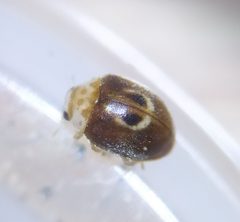
1- Clitostethus arcuatus(Horseshoe Ladybird)
Clitostethus is a of minute lady beetles (Coccinellidae: Scymninae) comprising over 40 . Members are recognized as specialized of whiteflies (Aleyrodidae). Several species have been evaluated as agents against agricultural pests including Bemisia tabaci and Siphoninus phillyreae. The genus was established by Weise in 1885 and includes species formerly classified under Nephaspis.


Pronunciation
How to pronounce Clitostethus: /ˌklaɪtoʊˈstɛθəs/
These audio files are automatically generated. While they are not always 100% accurate, they are a good starting point.
Images
Distribution
occur across Europe, Asia, and Africa. Documented records include China, Iran, European Russia, Denmark, Norway, and Sweden. Specific distribution varies by species.
Diet
Specialized of whiteflies (Aleyrodidae). Documented prey includes Bemisia tabaci and Siphoninus phillyreae.
Host Associations
- Bemisia tabaci - preyDocumented for C. arcuatus and C. brachylobus
- Siphoninus phillyreae - preyDocumented for C. arcuatus
Ecological Role
of whiteflies (Aleyrodidae). Functions as a agent in agricultural and horticultural systems.
Human Relevance
Evaluated and used in programs against whitefly pests. Clitostethus arcuatus and C. brachylobus have been studied specifically for and management of Bemisia tabaci and Siphoninus phillyreae in crop protection.
Similar Taxa
More Details
Taxonomic History
The Clitostethus was established by Weise in 1885. Many were formerly placed in the genus Nephaspis. A 2022 taxonomic review revised nine species and described two new species from China.
Biological Control Research
Multiple have been subject to studies and trials. C. brachylobus shows female longevity exceeding 190 days and of approximately 155 per female under laboratory conditions.
Sources and further reading
- BugGuide
- Wikipedia
- GBIF taxonomy match
- iNaturalist taxon
- NCBI Taxonomy
- A taxonomic review of the genus Clitostethus Weise (Coleoptera: Coccinellidae), with descriptions of two new species from China
- BIOLOGY OF THE COCCINELLID PREDATOR, Clitostethus acuatus (ROSSI), IN WINTER , AS REARED ON EGG OF THE WHITE FLY , Bemisia tabaci
- New Data on the Distribution and Hosts of the Ladybird Clitostethus arcuatus (Rossi) (Coleoptera, Coccinellidae) in European Russia
- Biology and Feeding Behaviour of Ladybird,Clitostethus arcuatus, the Predator of the Ash Whitefly,Siphoninus phillyreae, in Fars Province, Iran
- Augmentation and evaluation of a parasitoid,Encarsia inaron, and a predator,Clitostethus arcuatus, for biological control of the pomegranate whitefly,Siphoninus phillyreae
- Development, biology, and life table parameters of the predatory species, Clitostethus brachylobus Peng, Ren & Pang 1998 (Coleoptera: Coccinellidae), when fed on the whitefly, Bemisia tabaci (Genn.)