
Siphoninus phillyreae
(Haliday, 1835)
ash whitefly
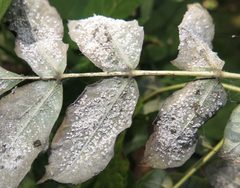
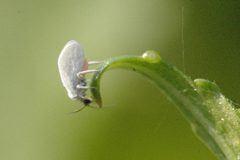
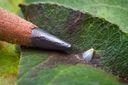
, commonly known as the , is a whitefly native to western Eurasia, India, and North Africa. It has been introduced to North America, South America, and Oceania, where it is recognized as a significant agricultural pest. The species feeds on a broad range of plants including ash, pomegranate, apple, pear, and other fruit trees. Encarsia inaron is a primary used for its .
Pronunciation
How to pronounce Siphoninus phillyreae: /sɪˈfoʊnɪnəs ˌfɪlɪˈriːaɪ/
These audio files are automatically generated. While they are not always 100% accurate, they are a good starting point.
Images
Habitat
Found in agricultural orchards, particularly pomegranate, apple, and pear orchards, as well as urban and suburban landscapes where ash and ornamental pear trees are present. In Egypt, varies with tree direction and level, with distinct vertical distribution patterns observed on pomegranate trees.
Distribution
Native to western Eurasia, India, and North Africa. Introduced to North America (USA: California, Florida, Nevada; Mexico), South America (Argentina, Chile, Venezuela, Brazil, Peru), and Oceania (Australia, New Zealand). In Europe: Austria, Bulgaria, Croatia, Cyprus, Czech Republic, France, Corsica, Germany, Greece, Hungary, Ireland, Italy, Sicily, Netherlands, Poland, Portugal, Romania, Russia, Spain, Canary Islands, UK, England and Wales, Ukraine. In Asia: India (Andhra Pradesh, Bihar, Gujarat, Karnataka, Maharashtra, Tamil Nadu, Uttar Pradesh), Iran, Israel, Japan (Honshu, Kyushu), Oman, Pakistan, Saudi Arabia, Syria, Turkey, Turkmenistan. In Africa: Cameroon, Egypt, Eritrea, Ethiopia, Libya, Morocco, South Africa, Sudan, Tunisia.
Diet
Phloem-feeding on plant sap. on multiple plant including Oleaceae (Fraxinus, Olea, Phillyrea), Rosaceae (Crataegus, Cydonia, Malus, Prunus, Pyrus), Lythraceae (Punica granatum), and others. Ovipositional preference studies show distinct ranking among tested , with survival rates varying significantly by host plant.
Host Associations
- Punica granatum - pestMajor agricultural ; first recorded in Greece in 2012, established in Brazil, Egypt, and elsewhere
- Fraxinus spp. - pestPrimary giving rise to ''
- Malus domestica - pestSignificant fruit tree ; oviposition and development documented on 'Granny Smith' cultivar
- Pyrus communis - pestPear orchards affected; 'Bartlett' cultivar studied for suitability
- Prunus persica - pestPeach ; 'O'Henry' cultivar evaluated
- Olea europaea - pestDocumented in Oleaceae
- Phillyrea spp. - pest referenced in specific epithet
- Citrus sinensis - Navel orange evaluated as ; oviposition observed but relative preference lower than some other hosts
- Heteromeles arbutifolia - Toyon evaluated as in California studies
- Pistacia vera - Pistachio 'Kerman' cultivar tested for suitability
Life Cycle
Developmental time and survival are strongly influenced by plant and temperature. to development varies with thermal conditions; is temperature-dependent as demonstrated in controlled studies. Multiple per year occur in favorable climates, with seasonal abundance peaking during warmer periods in Mediterranean and subtropical regions.
Ecological Role
Serves as for multiple including Encarsia inaron, Encarsia partenopea, and Encarsia brasiliensis. include the ladybird beetle Clitostethus arcuatus and the drosophilid fly Aclctozenus indica. are interdependent with natural enemy abundance and influenced by weather factors including minimum temperature and humidity.
Human Relevance
Significant agricultural pest causing economic damage to pomegranate, apple, pear, and other fruit crops. Defoliation and reduced productivity documented in orchards. Subject to programs employing through (Encarsia inaron, Encarsia partenopea) and conservation (Clitostethus arcuatus). Neonicotinoid applications used in some management contexts, with resistance concerns noted.
Similar Taxa
- Singhiella simplexBoth are whitefly associated with ornamental and fruit trees, but S. simplex is specifically tied to Ficus species and causes severe defoliation of Ficus benjamina hedges, whereas S. phillyreae has a broader range including ash and pome fruits
- Bemisia tabaciBoth are agricultural whitefly pests, but B. tabaci has a much broader range and is of plant viruses; S. phillyreae is distinguished by association with ash and specific fruit trees
- Aleurodicus rugioperculatusBoth occur on ornamental plants in subtropical regions, but spiraling whitefly produces distinctive spiral wax patterns on leaves not characteristic of S. phillyreae
Sources and further reading
- BugGuide
- Wikipedia
- iNaturalist taxon
- NCBI Taxonomy
- Catalogue of Life
- Parasitoids to the rescue - Emerald Ash Borer, Agrillus plenipennis, and its assassins Oobius agrili, Tetrastichus planipennisi, and Spathius agrili — Bug of the Week
- Don't Bet Your Hedges: IPM Guide Outlines Ficus Whitefly Management
- Siphoninus phillyreae . [Distributiom map].
- First record of Siphoninus phillyreae on pomegranate in Greece
- Biology of Siphoninus phillyreae (Haliday) (Homoptera: Aleyrodidae) and Its Relationship to Temperature
- Submission to: Phytoparasitica Occurrence of ash whitefly, Siphoninus phillyreae (Haliday) (Hemiptera: Aleyrodidae), in Brazil
- Ovipositional preference of Siphoninus phillyreae and its fitness on seven host plant species
- Primer registro de siphoninus phillyreae (hemiptera: aleyrodidae) y su parasitoide encarsia inaron (hymenoptera: aphelinidae) en Morelos, México
- Evaluation of biological control of Siphoninus phillyreae (Haliday) by the parasitoid Encarsia partenopea (Walker), using life-table analysis
- SIPHONINUS PHILLYREAE (HALIDAY) (HEMIPTERA: STERNORRHYNCHA: ALEYRODIDAE) AND ITS PARASITOID, ENCARSIA INARON (WALKER) (HYMENOPTERA: APHELINIDAE): TWO NEW RECORDS OF INSECTS FOR MEXICO
- Effect of Weather Factors on the Host-Predators Relationship in the Aleyrodid, Siphoninus phillyreae finitimus Goux on Pomegranate
- POPULATION DENSITY OF THE POMEGRANATE WHITEFL Y,Siphoninus phillyreae (HALIDA Y) (HOMOPTERA: ALEYRODIDAE) AND ITS PARASITOIDS IN MIDDLE EGYPT.
- SEASONAL ABUNDANCE OF THE WHITEFLY, Siphoninus phillyreae(HALIDAY) ( HEMIPTERA : ALEYRODIDAE) AND ITS PARASITOID, Encarsia inaron (WALKER) (HYMENOPTERA : APHELINIDAE) WITH PRODUCTIVITY AND ECONOMIC INDICATORS FOR THE POMEGRANATE CROP IN EGYPT
- Augmentation and evaluation of a parasitoid,Encarsia inaron, and a predator,Clitostethus arcuatus, for biological control of the pomegranate whitefly,Siphoninus phillyreae
- Biology and Feeding Behaviour of Ladybird,Clitostethus arcuatus, the Predator of the Ash Whitefly,Siphoninus phillyreae, in Fars Province, Iran
- INFLUENCE OF DIFFERENT DIRECTIONS AND LEVELS OF THE POMEGRANATE TREES ON THE WHITEFLY Siphoninus phillyreae (HAL.) AND ITS PARASITOID Encarsia inaron (WALK.) AT KAFER EL-SHEIKH GOVERNORATE, EGYPT