
Hyperaspis binotata
(Say, 1826)
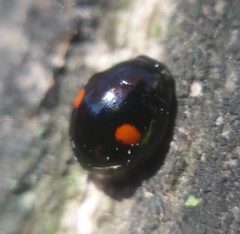
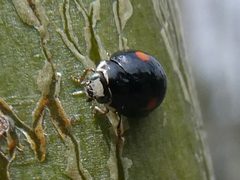
Hyperaspis binotata is a small lady beetle in the Coccinellidae. measure 2.40–4.50 mm and display distinct in pronotum coloration: males have yellow on the lateral and margins, while females have entirely black pronota. The are black with red spots. The occurs across eastern and central North America.
Pronunciation
How to pronounce Hyperaspis binotata: /haɪpɚˈæspɪs bɪˈnoʊtətə/
These audio files are automatically generated. While they are not always 100% accurate, they are a good starting point.
Identification
can be distinguished from other Hyperaspis by the combination of black with red spots and the sexually dimorphic pronotum pattern. The small size (under 5 mm) and specific spot pattern help separate it from larger lady beetles. Larvae are easily mistaken for mealybugs due to their waxy coating; they can be distinguished by their quick movement when disturbed, unlike the sluggish mealybugs.
Images
Appearance
are 2.40–4.50 mm in length. The pronotum is sexually dimorphic: yellow on lateral and margins in males, entirely black in females. are black with red spots. Larvae produce white wax from glands along their sides, giving them a mealybug-like appearance.
Distribution
Eastern and central North America. Recorded from Maine and Quebec south to North Carolina, west to North Dakota and Louisiana. Additional records from Manitoba, New Brunswick, and Nova Scotia in Canada.
Diet
of scale insects and their , including crapemyrtle bark scale. Both larvae and feed on .
Life Cycle
Larvae develop through several instars, feeding on scale insects while cloaked in protective wax. occurs on or near plants. emerge in summer, feed on , then overwinter in protected locations beneath bark or in leaf litter. Adults return to scale-infested trees in spring to reproduce.
Behavior
Larvae are active that chew holes in sacs to consume eggs. and larvae are both predatory on scales. Larval wax production serves as protection against ants and other predators.
Ecological Role
agent of scale insects. Specialized that helps regulate of economically important , including like crapemyrtle bark scale.
Human Relevance
Beneficial insect in horticulture and urban landscapes. Provides natural control of crapemyrtle bark scale and other pests. Frequently misidentified and mistakenly killed due to larval resemblance to mealybugs.
Similar Taxa
- Mealybugs (Pseudococcidae)Hyperaspis larvae are covered in white wax and resemble mealybugs; distinguished by faster movement when disturbed and predatory on sacs.
- Other Hyperaspis speciesSpot number and pattern vary among ; H. binotata specifically has two red spots on black with the characteristic sexually dimorphic pronotum.
Misconceptions
Larvae are often mistaken for pests and killed; they are actually beneficial . The waxy coating is protective, not a sign of or .
More Details
Taxonomic history
First described by Thomas Say in 1826.
Conservation status
Not evaluated; appears to be common and widespread in its range.
Sources and further reading
- BugGuide
- Wikipedia
- GBIF taxonomy match
- iNaturalist taxon
- NCBI Taxonomy
- Waxy lady beetles come to the rescue of pest-plagued crapemyrtles, Hyperaspis spp. — Bug of the Week
- How One Entomologist Puts Communication and Policy Training Into Action in Pesticide Safety Education
- Bizarre, beautiful extremes | Beetles In The Bush