
Hyperaspis trifurcata
Schaeffer, 1905
Trident Lady Beetle
Hyperaspis trifurcata, commonly known as the trident lady beetle, is a small predatory lady beetle native to North America. Both larvae and are of cochineal scale insects (Dactylopius spp.), particularly Dactylopius opuntiae, which feed on prickly pear cacti (Opuntia). The has been introduced to Israel and Jordan as a agent against cochineal . Larvae are covered in white waxy secretions that protect them from ants and other predators.
Pronunciation
How to pronounce Hyperaspis trifurcata: /hɪˈpɛr.ə.spɪs traɪˈfɜːr.kɑːtə/
These audio files are automatically generated. While they are not always 100% accurate, they are a good starting point.
Identification
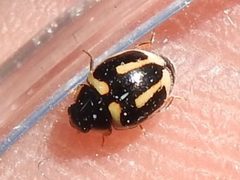
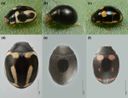
are distinguished from other Hyperaspis by the trident-shaped red or yellow pattern on the black . Males have white facial coloration. Larvae can be distinguished from mealybugs by their quick movement when disturbed, whereas mealybugs remain stationary. The waxy coating and association with colonies also help distinguish larvae from other lady beetle larvae.
Images
Habitat
Found in cactus fields and orchards, particularly those with prickly pear cactus (Opuntia ficus-indica) infested with cochineal scale insects. Native occur in arid and semi-arid regions of the southwestern United States and Mexico. Introduced populations established in Israel, Jordan, and recently recorded in Syria.
Distribution
Native to North America: recorded from Mexico (Durango), Arizona, and Texas. Introduced to Israel and Jordan as a agent. First recorded in Syria in 2020–2021 (Rif-Damascus Governorate).
Diet
of cochineal (Dactylopius spp.), particularly Dactylopius opuntiae. Both larvae and feed on all developmental stages of the scale insect, including , nymphs, and adults. Adults consume a mean of 5,293 first instar nymphs during their lifetime under laboratory conditions.
Host Associations
- Dactylopius opuntiae - preyWild cochineal ; primary food source for all life stages
- Opuntia ficus-indica - associated withPrickly pear cactus; plant of D. opuntiae
Life Cycle
Complete . Under laboratory conditions (25±2°C, 60±10% RH, 12:12 L:D): stage 5.9 days; first instar larva 3.1 days; second instar larva 3.6 days; third instar larva 3.1 days; fourth instar larva 8.9 days; pupa 11.4 days; total development from egg to approximately 36.6 days. Can complete on any developmental stage of D. opuntiae. Females lay eggs in the wax secreted by cochineal to conceal them from .
Behavior
Females oviposit in the waxy secretions of cochineal , which conceals from . Larvae shelter in the waxy filaments of scale colonies after hatching. Larvae move quickly when disturbed, unlike the sedentary mealybugs they resemble. sequester carminic acid from their prey to deter , which also contributes to the red coloration of larvae. Adults overwinter in protected locations beneath bark or in leaf litter.
Ecological Role
of cochineal , functioning as a agent in native and introduced ranges. Helps regulate of Dactylopius opuntiae, an economically important pest of prickly pear cactus. Serves as for , including Homalotylus cockerelli (primary parasitoid) and hyperparasitoids Pachyneuron sp. and Tetrastichus sp.
Human Relevance
Used as a agent against cochineal (Dactylopius opuntiae) in Israel, Jordan, and potentially Syria to protect prickly pear cactus crops. Larvae are frequently misidentified as mealybugs and killed by applications, reducing their effectiveness as natural enemies. The gut microbiome contains bacteria that may aid in digesting carminic acid, a toxic compound in cochineal .
Similar Taxa
- Hyperaspis spp.Other in the share similar small size, black coloration with red or yellow markings, and waxy larvae that prey on scale insects. H. trifurcata is distinguished by the trident-shaped elytral pattern.
- Mealybugs (Pseudococcidae)H. trifurcata larvae are frequently mistaken for mealybugs due to their white waxy covering. Larvae can be distinguished by faster movement when disturbed and their presence within colonies rather than independently on plants.
- Scymnus saturalisAnother coccinellid of Dactylopius opuntiae found in the same in Syria. H. trifurcata was more abundant in field surveys, while S. saturalis remained rare.
Misconceptions
Larvae are commonly mistaken for mealybugs or other pest insects due to their white waxy appearance, leading to unnecessary applications that harm this beneficial . The waxy coating is a defensive , not a sign of pest status.
More Details
Parasitism
The encyrtid Homalotylus cockerelli is the primary of H. trifurcata larvae and pupae, with rates up to 46.2% in field collections from central Mexico. Parasitoid increase synchronously with populations. Hyperparasitoids Pachyneuron sp. and Tetrastichus sp. are infrequently collected.
Gut microbiome
The gut microbiome contains bacteria that may aid in digesting carminic acid, a toxic substance found in cochineal . This allows H. trifurcata to specialize on a prey that is toxic to many other .
Population parameters
Under laboratory conditions on a mixed diet of D. opuntiae stages: net rate (Ro) = 112, time (T) = 68.4 days. Highest (237.4 ) achieved on mixed diet compared to single-stage diets.
Sources and further reading
- BugGuide
- Wikipedia
- GBIF taxonomy match
- iNaturalist taxon
- NCBI Taxonomy
- Soybean Insects: Early-to-Late Season Pests (Emergence to R7) - AgriLife Extension Entomology
- Waxy lady beetles come to the rescue of pest-plagued crapemyrtles, Hyperaspis spp. — Bug of the Week
- Waxy ladies: Hyperaspis ladybugs — Bug of the Week
- White, waxy ladies - Hyperaspis ladybugs — Bug of the Week
- Cerotoma-trifurcata - Entomology Today
- Treating Southern Soybeans with Neonicotinoids Yields Economic Benefits After All
- Biology and life history of Hyperaspis trifurcata feeding on Dactylopius opuntiae
- Hyperaspis Trifurcata (Coleoptera: Coccinellidae) And Its Parasitoids In Central Mexico
- First Record of the Predators Scymnus saturalis and Hyperaspis trifurcata on Dactylopius opuntiae in Cactus Fields in Syria
- Differential Impact of Temperature, Release Rate, Prey Density, and Pesticides on Hyperaspis trifurcata (Coleoptera: Coccinellidae) to Optimize Integrated Management of Dactylopius opuntiae (Hemiptera: Dactylopiidae).