
Tetrastichus
Haliday, 1844
Tetrastichus is a of in the Eulophidae. in this genus are known agents that parasitize various insect , including beetles and . Several species have been introduced to North America to manage pests, including T. planipennisi for emerald ash borer control. The genus exhibits endoparasitoid development, with females using elongated ovipositors to deposit inside host larvae concealed under bark or within plant tissue.
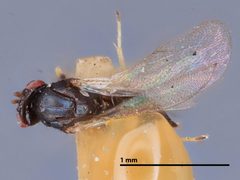
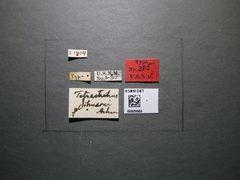
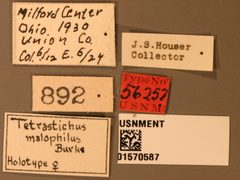
Pronunciation
How to pronounce Tetrastichus: //tɛtˈræstɪkəs//
These audio files are automatically generated. While they are not always 100% accurate, they are a good starting point.
Identification
Tetrastichus are small distinguished from other eulophid by structural features detailed in taxonomic keys for Nearctic fauna. Specific identification to species level requires microscopic examination. T. planipennisi possesses an ovipositor approximately 1.5–2.5 mm in length, shorter than that of Spathius galinae, a congeneric of emerald ash borer. The genus is characterized by four tarsal segments on the mid and hind legs, a trait reflected in its name.
Images
Habitat
correspond to those of their : forested areas with ash trees for T. planipennisi, lily-growing regions for T. setifer, and asparagus areas for T. coeruleus. are associated with woody plants and agricultural crops supporting their target host insects.
Distribution
The occurs across multiple continents. Distribution records include Denmark, Norway, and Sweden. Specific have been introduced to North America: T. planipennisi from Asia for emerald ash borer biocontrol, released in multiple U.S. states and Canadian provinces; T. setifer introduced for scarlet lily beetle management; T. coeruleus utilized for common asparagus beetle control.
Seasonality
Multiple occur annually. T. planipennisi completes several generations per growing season. occurs as mature last-instar larvae within galleries between bark and sapwood. Activity resumes with warming temperatures in spring.
Diet
Larval development is , feeding on tissues. T. planipennisi larvae consume emerald ash borer larvae from the inside; more than 120 individuals may emerge from a single host. T. setifer parasitizes scarlet lily beetle. T. coeruleus targets common asparagus beetle. The parasitizes various Lepidoptera , including Pyralis farinalis.
Host Associations
- Agrilus planipennis - Emerald ash borer; primary target for T. planipennisi biocontrol
- Lilioceris lilii - Scarlet lily beetle; for T. setifer
- Crioceris asparagi - Common asparagus beetle; for T. coeruleus
- Pyralis farinalis - Lepidopteran for members
Life Cycle
Females locate larvae using sensory organs on their legs to detect feeding activity beneath plant surfaces. They drill through bark or plant tissue with the ovipositor and deposit inside host larvae. Eggs hatch within days; larvae consume host tissues and complete development as . occurs within the host gallery. Multiple per year are possible under favorable conditions. stage is mature last-instar larva.
Behavior
Females fly while gravid, following chemical cues associated with . They land on host plants and use leg-mounted sensory structures to pinpoint larval location under bark. Oviposition requires drilling through woody tissue. T. planipennisi exhibits limited , spreading approximately 2 miles per year.
Ecological Role
As larval , regulate of wood-boring and foliage-feeding beetles. T. planipennisi achieves rates of 30–85% in ash saplings, though effectiveness decreases in larger trees due to ovipositor length limitations. The contributes to trophic cascade effects in forest and agricultural by suppressing herbivorous insect populations.
Human Relevance
Primary value lies in biological pest control. T. planipennisi was released in the United States between 2007 and 2012 as part of a classical biocontrol program against emerald ash borer. Establishment success varies geographically; rates reached 30–85% in saplings but remained under 6% at many sites five years post-release. T. setifer and T. coeruleus are deployed against agricultural pests. Climate change poses challenges: extreme cold events cause up to 30% winter mortality in T. planipennisi, reducing field effectiveness compared to native Asian .
Similar Taxa
- SpathiusBoth are eulophid of wood-boring beetles. Spathius are ectoparasitoids that lay on skin, while Tetrastichus species are endoparasitoids that deposit eggs inside hosts. S. galinae possesses an ovipositor twice the length of T. planipennisi, enabling of larger-diameter trees.
- OobiusBoth parasitize emerald ash borer. Oobius are attacking EAB eggs on bark surfaces, whereas Tetrastichus species attack larval stages concealed under bark.
More Details
Climate vulnerability
sourced from temperate coastal regions of China and Russia show reduced cold-hardiness compared to requirements for northern inland North America. Supercooling point is approximately -28 to -35°C for emerald ash borer but several degrees higher for T. planipennisi, creating a survival mismatch during extreme cold events.
Biocontrol limitations
T. planipennisi effectiveness is constrained by ovipositor length: larvae in trees with bark thicker than 3.5 mm are inaccessible. This excludes most mature ash trees from effective , limiting the to sapling-focused suppression.
Sources and further reading
- BugGuide
- Wikipedia
- GBIF taxonomy match
- iNaturalist taxon
- NCBI Taxonomy
- Catalogue of Life
- Parasitoids to the rescue - Emerald Ash Borer, Agrillus plenipennis, and its assassins Oobius agrili, Tetrastichus planipennisi, and Spathius agrili — Bug of the Week
- Temperature Extremes May Undermine Biocontrol of Emerald Ash Borer
- A Promising New Parasitoid Drills Down on Emerald Ash Borers