
Crioceris asparagi
(Linnaeus, 1758)
Common Asparagus Beetle
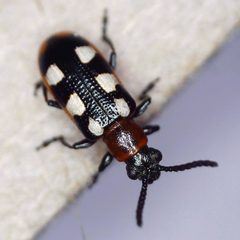
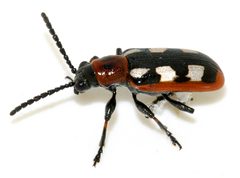
Crioceris asparagi, the common asparagus , is a leaf beetle in the Chrysomelidae. Native to Europe, the Middle East, Central Asia and Siberia, it has been introduced to North America where it is a significant pest of cultivated asparagus. Both and larvae feed externally on leaves and stems of Asparagus . The beetle is notable for its distinctive appearance: metallic blue-black with cream or yellow spots on red-bordered , and for its specialized attachment mechanism that allows eggs to adhere to the anti-adhesive crystalline waxy surface of plants.
Pronunciation
How to pronounce Crioceris asparagi: //kriˈoʊsɛrɪs əˈspærədʒaɪ//
These audio files are automatically generated. While they are not always 100% accurate, they are a good starting point.
Identification
Cannot easily be confused with other British leaf beetles due to unique coloration. The cylindrical shape combined with blue metallic or shiny black ladder-like elytral pattern on whitish background, reddish elytral margins and pronotum is diagnostic. The twelve-spotted asparagus beetle (Crioceris duodecimpunctata), a related also found on asparagus, has twelve distinct black spots on orange or yellow rather than the ladder-like pattern of C. asparagi.
Images
Habitat
Strongly associated with Asparagus . Found in cultivated asparagus allotments and gardens, as well as wild asparagus stands. occurs in soil at the base of the plant.
Distribution
Native to almost all of Europe except the far North, extending through the Middle East, Central Asia and Siberia. Introduced to the United States and Canada as a non-native pest. In Britain: widespread in England, scarce in the North and West, few scattered records in Wales, historically absent from Scotland and Northern Ireland but now occurring in a few places in Scotland with increased range and abundance overall. Also present in the Oriental and Afrotropical regions.
Diet
Obligate feeder on Asparagus (Asparagaceae). and larvae consume leaves and stems externally. Asparagus is the only food plant.
Host Associations
- Asparagus officinalis - primary cultivated asparagus; attached to crystalline waxy cladophyll surface
- Asparagus spp. - wild and cultivated
Life Cycle
are attached to the crystalline waxy surface of plant cladophylls using specialized proteinaceous adhesive secretions. Larvae are fat gray with dark that feed externally on host plant leaves and stems. takes place in the soil at the base of the plant. stages have been described by Steinhausen (1994; 2001).
Behavior
and larvae feed externally and conspicuously on plants, making them readily visible to observers. Females attach to host plant surfaces using proteinaceous secretions that overcome the anti-adhesive properties of crystalline epicuticular waxes. The egg secretion wets superhydrophobic surfaces and after solidifying builds a composite structure of solidified glue and wax crystals at the egg-plant interface. Mean pull-off force of attached eggs is 14.7 mN, approximately 8650 times higher than egg weight.
Ecological Role
Herbivore specialized on Asparagus. Serves as for gregarious including Tetrastichus asparagi and Tetrastichus spec. (Eulophidae). As a pest of cultivated asparagus, it can significantly impact crop yields.
Human Relevance
Important pest of asparagus crops in both Europe and North America. Economic impact through direct feeding damage to leaves and stems of cultivated asparagus, potentially reducing yields. Subject of research utilizing . sequenced as part of the Darwin Tree of Life Project.
Similar Taxa
- Crioceris duodecimpunctataAlso occurs on asparagus but distinguished by twelve distinct black spots on orange or yellow rather than the ladder-like pattern of C. asparagi; commonly known as the spotted asparagus beetle or twelve-spotted asparagus beetle
More Details
Egg Attachment Mechanism
Research published in Proceedings of the Royal Society B (2009) demonstrated that C. asparagi attach to plants through proteinaceous secretions that wet and spread over crystalline wax arrays, creating a composite bond of solidified glue and wax crystals. This mechanism overcomes the typically anti-adhesive properties of superhydrophobic plant surfaces.
Genomic Resources
sequenced as part of the Darwin Tree of Life Project from a male specimen collected from cultivated asparagus at an allotment in Penge, England. Genome assembly available with accession GCA_963668235.1.
Sources and further reading
- BugGuide
- GBIF taxonomy match
- iNaturalist taxon
- NCBI Taxonomy
- Seeing Spots at the Bohart | Bug Squad
- Reaching Across the Ocean, 5000 Miles Away.... | Bug Squad
- Encyrtid Holdings | Entomology Research Museum
- Aspects of the Foraging Behaviour of Tetrastichus Asparagi Crawford and Tetrastichus Spec. (Eulophidae), Gregarious Egg Parasitoids of the Asparagus Beetles Crioceris Asparagi L. and C. Duodecimpunctata L. (Chrysomelidae)
- Egg attachment of the asparagus beetle Crioceris asparagi to the crystalline waxy surface of Asparagus officinalis
- The genome sequence of the Asparagus Beetle, Crioceris asparagi (Linnaeus, 1758).