
Crioceris
Geoffroy, 1762
asparagus beetle
Species Guides
2- Crioceris asparagi(Common Asparagus Beetle)
- Crioceris duodecimpunctata(Spotted Asparagus Beetle)
Crioceris is a of leaf beetles (Chrysomelidae) commonly known as asparagus beetles. The genus includes both widespread agricultural pests and rare restricted to specialized . Several species are associated with Asparagus plants, with C. asparagi and C. duodecimpunctata being notable pests. Other species such as C. quinquepunctata and C. quatuordecimpunctata are rare and occupy steppe-like habitats in Eurasia. The genus has been subject to molecular barcoding studies to distinguish closely related species.
Pronunciation
How to pronounce Crioceris: //kraɪˈoʊsɛrɪs//
These audio files are automatically generated. While they are not always 100% accurate, they are a good starting point.
Identification
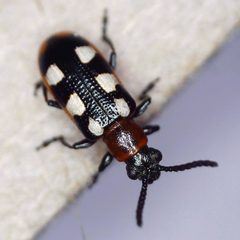
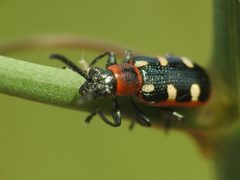
-level identification in Crioceris requires careful examination of elytral coloration and spot patterns. C. asparagi has a distinct appearance with reddish and black markings, while C. duodecimpunctata and C. quatuordecimpunctata share similar spot patterns that necessitate close inspection—C. duodecimpunctata typically has twelve spots versus fourteen in C. quatuordecimpunctata. Molecular identification using COI and ITS1 markers provides reliable species discrimination, particularly for the closely related C. duodecimpunctata and C. quatuordecimpunctata pair. EF1-α is unsuitable due to high heterozygosity.
Images
Habitat
varies considerably among . C. asparagi and C. duodecimpunctata occupy agricultural and disturbed habitats associated with their plants. C. quinquepunctata and C. quatuordecimpunctata are strictly associated with steppe-like habitats in Central and Eastern Europe. C. nigroornata has been recorded on asparagus plants in India.
Distribution
The occurs across Europe, Asia, and has been introduced to other regions including Australia and North America. C. asparagi and C. duodecimpunctata are widespread. C. quatuordecimpunctata and C. quinquepunctata are restricted to Eurasian steppe zones, with C. quinquepunctata currently known from only two in Moravia and the Podolian Upland. C. nigroornata occurs in India. GBIF records indicate presence in Denmark, Norway, and Vermont, USA.
Diet
Larvae and feed on plants in the Asparagus. C. nigroornata larvae have been documented feeding on asparagus plants in India. C. merdigera has been observed on Salix viminalis (osier willow), though the feeding relationship requires confirmation.
Host Associations
- Asparagus - primary plant for multiple Crioceris including C. asparagi and C. nigroornata
- Salix viminalis - possible plantObserved association with C. merdigera in France; feeding not confirmed
- Lemophagus larvivorus - Ichneumonid that parasitizes larvae of C. nigroornata
Life Cycle
Larval stage present; larvae feed on plant foliage. C. nigroornata larvae are subject to by the ichneumonid Lemophagus larvivorus. endosymbionts have been detected in C. quinquepunctata, suggesting potential influence on .
Ecological Role
Herbivore on Asparagus . Serves as for larval in the Ichneumonidae. Some species act as pests in agricultural systems. Rare steppe-dwelling species may serve as indicators of grassland quality.
Human Relevance
C. asparagi and C. duodecimpunctata are serious pests of asparagus crops, causing economic damage through larval and feeding. Crioceris have been investigated as potential agents for invasive Asparagus species, particularly A. asparagoides in Australia. The has been the subject of sequencing efforts (C. asparagi).
Similar Taxa
- other Chrysomelidae generaCrioceris can be distinguished from related leaf beetle by its association with Asparagus plants and characteristic body form; molecular barcoding provides definitive identification where is ambiguous
Sources and further reading
- BugGuide
- GBIF taxonomy match
- iNaturalist taxon
- NCBI Taxonomy
- Catalogue of Life
- Willow as Host-Plant of Crioceris merdigera
- Figure 4 from: Ranjith AP, Kedar SC (2025) New species of Lemophagus Townes, 1965 (Hymenoptera, Ichneumonidae, Campopleginae) from India reared as a larval parasitoid of Crioceris nigroornata Clarke, 1866 (Coleoptera, Chrysomelidae). Journal of Hymenoptera Research 98: 743-755. https://doi.org/10.3897/jhr.98.154760
- Molecular barcoding for central-eastern European Crioceris leaf-beetles (Coleoptera: Chrysomelidae)
- New species of Lemophagus Townes, 1965 (Hymenoptera, Ichneumonidae, Campopleginae) from India reared as a larval parasitoid of Crioceris nigroornata Clarke, 1866 (Coleoptera, Chrysomelidae)
- Restricted geographic distribution and low genetic distinctiveness of steppic <i>Crioceris quinquepunctata</i> (Coleoptera: Chrysomelidae) populations in Central East Europe
- Aspects of the Biology, Distribution, and Host Range of Crioceris sp. (Col.: Chrysomelidae: Criocerinae), a Potential Biological Control Agent for Asparagus asparagoides in Australia
- Preliminary evidence of the horizontal transmission of Wolbachia between Crioceris leaf beetles (Coleoptera: Chrysomelidae) and their Asparagus host plants
- The genome sequence of the Asparagus Beetle, Crioceris asparagi (Linnaeus, 1758).