
Crioceris duodecimpunctata
(Linnaeus, 1758)
Spotted Asparagus Beetle
A small leaf beetle in the Chrysomelidae, Crioceris duodecimpunctata is a significant pest of asparagus cultivations. feed on tender shoots and leaves, while larvae develop exclusively on asparagus berries. The is widespread across the Palearctic region and has been introduced to North America. Molecular studies confirm its status as a sister to C. quatuordecimpunctata, with both species originating nearly simultaneously from a common ancestor.
Pronunciation
How to pronounce Crioceris duodecimpunctata: /kriːˈoʊsərɪs duːəˌdɛsɪmpʊŋkˈteɪtə/
These audio files are automatically generated. While they are not always 100% accurate, they are a good starting point.
Identification
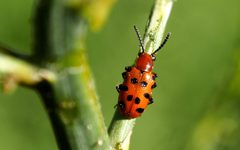
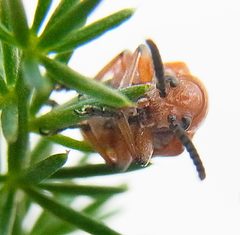
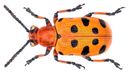
measure 5–6.5 mm in length. The , pronotum, and are reddish-orange; the scutellum is black. The elytra bear twelve distinct black dots, giving the its specific epithet. The color pattern distinguishes it from the related common asparagus beetle (Crioceris asparagi), which has a more uniform coloration with different markings.
Images
Habitat
Primarily associated with asparagus cultivations. Also found on wild asparagus and related Cucurbitaceae in open, disturbed .
Distribution
Native to the , including the British Isles and throughout Europe and Northern Asia. Introduced and established in North America.
Diet
feed on tender asparagus shoots and leaves. Larvae feed exclusively on asparagus berries.
Host Associations
- Asparagus - primary larvae develop on berries; feed on shoots and leaves
- Cucurbitaceae - feeding have been observed feeding on plants in this
Behavior
Males exhibit sexually dimorphic olfactory responses to plant volatiles, being attracted to intact and mechanically damaged asparagus cladophylls while females show no attraction. Males display dose-dependent attraction to (Z)-3-hexen-1-ol at 10 μg concentrations but repellence at 50 μg. Both sexes perceive a wide range of asparagus volatiles with similar electroantennographic profiles.
Ecological Role
-specific pest of asparagus cultivations, causing significant agricultural damage. Serves as host for gregarious in the Tetrastichus (Eulophidae).
Human Relevance
Second most important pest of asparagus after Crioceris asparagi. Economic impact through damage to cultivated asparagus shoots, leaves, and berries. Subject of -based management research due to its olfactory responses to volatiles.
Similar Taxa
- Crioceris asparagiCommon asparagus beetle; co-occurs on asparagus but lacks twelve distinct elytral spots, has more uniform coloration
- Crioceris quatuordecimpunctataSister with fourteen elytral spots; restricted to steppe-like in Eurasia, not
Sources and further reading
- BugGuide
- Wikipedia
- GBIF taxonomy match
- iNaturalist taxon
- NCBI Taxonomy
- Meloidae Holdings | Entomology Research Museum
- Olfactory Response of the Spotted Asparagus Beetle, Crioceris duodecimpunctata (L.) to Host Plant Volatiles
- Aspects of the Foraging Behaviour of Tetrastichus Asparagi Crawford and Tetrastichus Spec. (Eulophidae), Gregarious Egg Parasitoids of the Asparagus Beetles Crioceris Asparagi L. and C. Duodecimpunctata L. (Chrysomelidae)
- Molecular barcoding for central-eastern European Crioceris leaf-beetles (Coleoptera: Chrysomelidae)