
Tetrastichinae
Förster, 1856
Genus Guides
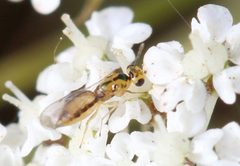
12Tetrastichinae is one of the largest of Eulophidae, containing over 100 and nearly 3,000 of minute chalcid wasps. Members exhibit exceptionally diverse : most are attacking across 10 insect orders and over 100 , including , mites, and spider . Some species are phytophagous (typically as in galls), gall formers, or inquilines. Endoparasitism predominates over ectoparasitism, with both solitary and gregarious forms known; gregarious species may produce over 2,000 individuals from a single host. is often by , though occurs in some .
Pronunciation
How to pronounce Tetrastichinae: /ˌtɛtɹəˈstɪkaɪni/
These audio files are automatically generated. While they are not always 100% accurate, they are a good starting point.
Identification
Tetrastichinae are morphologically uniform small , historically difficult to classify due to preservation challenges and subtle morphological variation. The was traditionally dominated by the single large Tetrastichus until Graham's 1987 revision split it into multiple natural groupings including 15 new genera. Modern identification relies on this taxonomic framework. Key diagnostic features include: four tarsal segments (tetratarsal), reduced wing venation with typically a single closed behind the , and characteristic antennal structure with funicle segments often bearing longitudinal .
Images
Habitat
Found in almost any terrestrial type worldwide, from arid to tropical environments. Specific microhabitats vary by : occur wherever are present (galls, leaf mines, insect , concealed larvae), while phytophagous and species are associated with plant galls or other plant structures.
Distribution
Worldwide distribution except Antarctica. Presence documented across all major biogeographic regions including Palearctic, Nearctic, Neotropical, Afrotropical, Oriental, and Australasian realms.
Life Cycle
Development is typically rapid, with multiple per year possible. Larval development occurs within or on ; endoparasitic consume host tissues from within, while ectoparasitic forms feed externally. Gregarious species show variable sizes, with some producing few offspring per host and others hundreds to thousands. typically occurs within the host remains or in the immediate vicinity.
Behavior
Hyperparasitism has been documented, particularly in Eutetrastichus (now synonymized with Baryscapus), occurring both as obligate and facultative strategies. Some exhibit complex male-male combat within , with surviving males performing elaborate courtship rituals. Host searching varies: some are highly host-specific (e.g., Tamarixia on Psylloidea, most Aprostocetus on Cecidomyiidae), while others target hosts by such as leaf miners (Minotetrastichus on Coleoptera, Hymenoptera, or Lepidoptera leaf miners regardless of taxonomic identity) or gall inhabitants.
Ecological Role
Major regulators of insect across diverse . As , they contribute significantly to of agricultural and forest pests, including leafhoppers, gall midges, psyllids, and scale insects. Some serve as hyperparasitoids, potentially disrupting primary parasitoid populations. Phytophagous and members participate in gall dynamics.
Human Relevance
Important agents used in classical, augmentative, and programs. Notable examples include targeting glassy-winged sharpshooter (Homalodisca vitripennis), eucalyptus gall wasp (Leptocybe invasa), and various agricultural pests. Some species have been introduced internationally for pest management. The 's taxonomic complexity has historically impeded identification and deployment of appropriate biological control agents.
Similar Taxa
- Entedoninae (Eulophidae)Both are of Eulophidae with reduced wing venation; Tetrastichinae is distinguished by four tarsal segments versus three in Entedoninae, and different antennal patterns.
- Eulophinae (Eulophidae)Shares -level characters; Tetrastichinae typically has more reduced wing venation and different antennal structure, with Eulophinae often having more complete venation and distinct body proportions.
Sources and further reading
- BugGuide
- Wikipedia
- iNaturalist taxon
- NCBI Taxonomy
- Catalogue of Life
- Publications | Entomology Research Museum
- Two new Aprostocetus species (Hymenoptera: Eulophidae: Tetrastichinae), fortuitous parasitoids of invasive eulophid gall inducers (Tetrastichinae) on Eucalyptus and Erythrina
- Tetrastichinae (Hymenoptera: Eulophidae) associated with spider egg sacs
- An annotated checklist of the Eulophidae (excl. Tetrastichinae (Hymenoptera: Chalcidoidea) of Israel
- Tetrastichinae (Hymenoptera: Chalcidoidea, Eulophidae) reared from some gall-inducing Cecidomyiidae (Diptera) in Britain
- A new species and three newly recorded species of Tetrastichinae (Hymenoptera, Eulophidae) from China
- Four new species of Zeytinus Doğanlar, 2011 (Hymenoptera: Eulophidae: Tetrastichinae) from Turkey and a redescription of the type species, Zeytinus hatayensis Doğanlar, 2011 Türkiye’den Zeytinus Doğanlar, 2011 (Hymenoptera: Eulophidae: Tetrastichinae) Cinsine giren dört yeni türün tanılanmaları ve cinsin tip türü, Zeytinus hatayensis Doğanlar, 2011’in yeniden tanılanması
- Tetrastichinae wasps (Hymenoptera: Eulophidae) associated withStenodiplosisReuter (Diptera: Cecidomyiidae) in eastern South Dakota
- The genus Eriastichus La Salle (Hymenoptera, Eulophidae, Tetrastichinae) in the Neotropical region, introducing 48 new species
- A New Species of Galeopsomyia (Hymenoptera: Eulophidae: Tetrastichinae): A Fortuitous Parasitoid of the Citrus Leafminer, Phyllocnistis citrella (Lepidoptera: Gracillariidae)
- Descriptions ofTachinobiagen. n. and three new species of Tetrastichinae (Hymenoptera: Eulophidae), with a tentative key to genera
- A new species of Phymastichus (Hymenoptera: Eulophidae: Tetrastichinae) parasitic on Xyleborus beetles (Coleoptera: Curculionidae: Scolytinae) in Hawaiʻi, and aspects of its biology, life history, and behavior
- Notes on Kocourekia Bouček (Hymenoptera: Eulophidae: Tetrastichinae) with description of a new species from China
- Selitrichodes neseri n. sp., a new parasitoid of the eucalyptus gall wasp Leptocybe invasa Fisher & La Salle (Hymenoptera: Eulophidae: Tetrastichinae)