
Pyralis farinalis
Linnaeus, 1758
meal moth
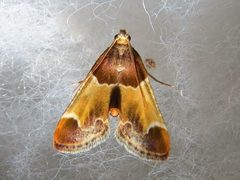
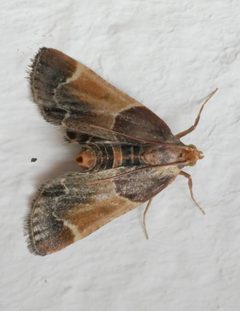
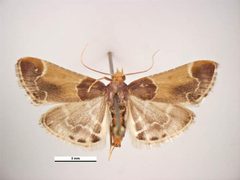
Pyralis farinalis, the meal , is a in the Pyralidae and the type species of its , tribe, , and family. are recognized by their colorful upperwings and characteristic resting posture with the held at 90° to the body. The species is strongly , associated with stored grain and food products worldwide, and completes its in approximately eight weeks with multiple per year. Larvae are significant pests of milled plant products, feeding on cereals, grains, and other stored foods.
Pronunciation
How to pronounce Pyralis farinalis: /pɪˈræ.lɪs fæ.rɪˈneɪ.lɪs/
These audio files are automatically generated. While they are not always 100% accurate, they are a good starting point.
Identification
are distinguished from similar pyralid moths by the characteristic resting posture with raised at 90° to the body, combined with colorful upperwings. The wingspan of 18–30 mm provides a size reference. Larvae construct silk tunnels mixed with meal particles for shelter.
Images
Habitat
Primarily found in stored-product environments including grain silos, barns, warehouses, and food storage facilities. Occurs in poorly stored grain where moisture has infiltrated. Also found in accumulated vegetable refuse, detritus in almond orchards, and poultry manure. Outside anthropogenic settings, inhabits damp, moist plant debris.
Distribution
distribution worldwide. Found across the United States, especially along the eastern coast and in the Northeastern region. Present in Great Britain, the Falkland Islands, and China. Distribution limited by climatic factors that affect fungal and microbial growth required for larval development.
Seasonality
fly from June to August in temperate regions. The produces multiple per year due to rapid completion in approximately eight weeks.
Diet
Larvae feed primarily on milled plant products including cereals and grains. Observed feeding on all parts of grain plants including seed, bran, husk, and straw without preference. Also consumes potatoes and other vegetables. have short lifespans and likely do not feed extensively.
Life Cycle
are ellipsoid, wrinkled with lengthwise creases forming a reticulated pattern. Females lay 2–5 days after copulation; eggs hatch after nine days. Larvae construct silk tunnels mixed with meal particles for protection, feeding at tunnel openings. occurs in cocoons spun by mature larvae. emerge after 6–8 weeks total development time (60–65 days from oviposition). Mated adults live 9–10 days. Four can occur per year under favorable conditions.
Behavior
Larvae spend most of their time concealed in silk tunnels, emerging only to feed at openings. are short-lived after mating. Males have been observed attempting to mate with females of other (Amyelois transitella), attracted to shared components; these interspecific copulations are unlikely to produce viable offspring.
Ecological Role
Larvae serve as prey and for multiple antagonists including (Meteorus ictericus, Tetrastichus, Lespidea tarsalis, Apantales carpatus, Goniozus columbianus, Metacoelus mansuetos, Melanophora roralis) and . Larval shelters provide microhabitat structure that supports of associated arthropods in stored-product . Larval feeding contributes to decomposition and nutrient cycling in detritus .
Human Relevance
Major pest of stored grain and milled food products, capable of causing considerable damage to improperly stored crops. Used commercially in China as the main ingredient in "insect tea," a traditional beverage. Scientific studies have investigated optimal growth conditions for potential commercial . association with humans documented since the 18th century.
Similar Taxa
- Amyelois transitella (navel orangeworm)Males of P. farinalis are attracted to and attempt to mate with females of this due to shared components, though the species are otherwise distinct in associations and .
Sources and further reading
- BugGuide
- Wikipedia
- GBIF taxonomy match
- iNaturalist taxon
- NCBI Taxonomy
- Catalogue of Life
- Photinus-pyralis-AW - Entomology Today
- Fireflies are busy flashing for mates! Lampyridae spp. — Bug of the Week
- Bug Eric: Firefly Tag
- Fireflies celebrate 20 years of Bug of the Week – Fireflies, Lightning Bugs, Lampyridae — Bug of the Week
- Bug Eric: Home Bioblitz, Ongoing
- Bug Eric: 2021
- Development and life history of Pyralis farinalis L. (Lepidoptera: Pyralidae) on an artificial diet
- Arthropod antagonists of Pyralis farinalis (L.) (Lep., Pyralidae) and visitors of its larva shelters1