
Amyelois transitella
Walker, 1863
Navel Orangeworm, Navel Orangeworm Moth
The navel orangeworm (Amyelois transitella) is a pyralid moth native to the tropical western Hemisphere and southwestern United States. First described from Arizona in 1899, its abundance in California increased dramatically during the first half of the 20th century. It is now the most serious insect pest of almonds and pistachios in California, with larvae feeding directly on nuts and capable of introducing fungi that produce aflatoxins. The has been extensively studied for its chemical , particularly its system, which has enabled practical programs in agricultural fields.
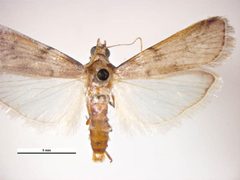
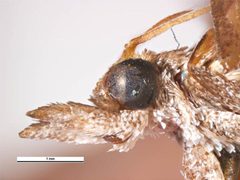
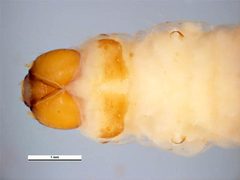
Pronunciation
How to pronounce Amyelois transitella: /əˈmaɪəloɪs ˌtrænsɪˈtɛlə/
These audio files are automatically generated. While they are not always 100% accurate, they are a good starting point.
Identification
Distinguished from similar pyralid moths by its association with nut crops and specific chemistry. Walter Leal's laboratory identified and synthesized the sex pheromones, enabling field-level identification through trapping. Mass-reared males used in sterile insect technique programs show reduced performance and impaired ability to locate pheromone sources compared to locally reared individuals, which may affect trap catch interpretations. Cuticular hydrocarbon profiles differ between - and susceptible strains, with resistant strain R347 showing greater total CHC quantities than susceptible ALMOND strain.
Images
Habitat
Agricultural environments, specifically orchards producing almonds, pistachios, walnuts, figs, and pomegranates. Laboratory colonies maintained on dried, roasted pistachios. Climate suitability analysis indicates establishment potential in Mediterranean climate zones; within Europe, most likely to establish in Southern and Mediterranean areas if introduced.
Distribution
Native to southwestern United States and Mexico; first described from Arizona in 1899. to tropical western Hemisphere. Now abundant throughout California, particularly in Central Valley nut-producing regions. Present in Hawaii. Introduced to South Africa (Northern Cape). Absent from European Union territory but considered a potential threat.
Seasonality
Mating activity peaks during the last hour of scotophase and first 30 minutes of photophase at 25°C. Eighty percent of mating occurs within first two days after . Protandry observed with males emerging before females in first two days of emergence period.
Diet
Larvae feed on nuts of almond (Prunus dulcis), pistachio (Pistacia vera), walnut (Juglans regia), and fig (Ficus carica). Laboratory colonies maintained on dried, roasted pistachios. do not feed; their role in aflatoxin introduction suggests association with fungal spores rather than direct feeding.
Host Associations
- Prunus dulcis - larval food sourcealmond; major in California
- Pistacia vera - larval food sourcepistachio; major in California
- Juglans regia - larval food sourcewalnut
- Ficus carica - larval food sourcefig
Life Cycle
Complete with , larval, pupal, and stages. Adults live at least 7 days based on cuticular hydrocarbon aging studies. Females mate once; males may mate multiple times (55% once, 40% twice, 5% three times). Copulation duration averages over 3 hours. Mass-rearing for sterile insect technique involves irradiation and shipping from USDA APHIS facility in Phoenix, Arizona to California release sites.
Behavior
Female calling involves protrusion between wings with segments perpendicular to body, exposure, and continuous . Male courtship involves wing fanning and antennation from short distance. After coupling, male rotates 180° to linear abdomen-to-abdomen position. Mated females fly significantly longer and farther than unmated females, possibly representing appetitive ranging behavior searching for oviposition cues. Mass-reared males show reduced capacity and impaired source location compared to locally reared males. Chilling before irradiation and transportation may negatively impact male .
Ecological Role
Major economic pest of nut crops in California. Larval feeding directly reduces crop quality and yield. introduce fungi that produce aflatoxins, creating food safety concerns. Subject of research including Goniozus legneri (Hymenoptera: Bethylidae). Target of sterile insect technique development as environmentally friendly alternative to .
Human Relevance
Most serious insect pest of California almond and pistachio industries. California produces 80% of global almond supply; 2012 crop valued at approximately $3 billion. identification by Walter Leal enabled programs, significantly reducing spray requirements. Almond Board of California committed to 25% increase in environmentally friendly pest management tools by 2025. Sterile insect technique under development but requires optimization due to performance issues in mass-reared males. Overseas markets including South Korea and European Union have strict pesticide residue regulations, driving demand for reduced-chemical management.
Similar Taxa
- Pectinophora gossypiellaPink bollworm; successfully managed with sterile insect technique using mass-rearing, irradiation, and transportation methods that prove iffy for navel orangeworm due to differential performance impacts
More Details
Chemical Ecology Research
Walter Leal's laboratory at UC Davis identified and synthesized the of Amyelois transitella, leading to first structure of an insect -binding protein through collaborative efforts. This work has been deployed in agricultural fields via , significantly reducing spray requirements. Leal's research on this contributed to his induction as Fellow of the National Academy of Inventors.
Sterile Insect Technique Challenges
Current SIT programs specific technical challenges with this . Mass-rearing, irradiation, transportation, and release processes present stress points that negatively affect male performance. Flight mill experiments show mass-reared males have more 'non-fliers' displaying less than two minutes continuous flight. Unlike pink bollworm programs, navel orangeworm SIT requires considerable method refinement. Potential improvements include lowering radiation dose, manipulating atmospheric conditions, changing radiation source, and incorporating radioprotectants into artificial diet.
Insecticide Resistance
- strain R347 shows greater total cuticular hydrocarbon quantities than susceptible ALMOND strain. Cuticular hydrocarbon profiles may serve as biomarkers to differentiate resistant from susceptible , with potential management applications.
Sources and further reading
- BugGuide
- GBIF taxonomy match
- iNaturalist taxon
- NCBI Taxonomy
- Catalogue of Life
- Walter Leal Selected to Give ESA Founders' Memorial Award Lecture | Bug Squad
- Congrats to NAI Fellow UC Davis Distinguished Professor Walter Leal | Bug Squad
- Looking for Lygus | Bug Squad
- Amazing Project | Bug Squad
- A Good Day on the UC Davis Campus | Bug Squad
- Why Flight Testing is an Important Step in Sterile Insect Technique
- Sexual behavior of the navel OrangeWorm, Amyelois transitella (Walker) (Lepidoptera: Pyralidae)
- Effect of Female Flight Activity on Reproduction in the Navel Orangeworm (Amyelois transitella)
- Factors Associated with Variation in Cuticular Hydrocarbon Profiles in the Navel Orangeworm, Amyelois transitella (Lepidoptera: Pyralidae)
- Climate suitability analysis in the context of EFSA Pest Risk Assessment. Amyelois transitella, the navel-orange worm, as a case study
- Evaluating Response of Mass-Reared and Irradiated Navel Orangeworm, Amyelois transitella (Lepidoptera: Pyralidae), to Crude Female Pheromone Extract
- An in vivo study of intracytoplasmic membranous structures associated with chronic stunt virus infection in granular hemocytes of Amyelois transitella
- Parasitization of Goniozus legneri (Hymenoptera: Bethylidae) at Increasing Parasite and Host, Amyelois transitella (Lepidoptera: Phycitidae), Densities